Local News CTV News: Peter Sloly, Ottawa’s police chief, has resigned after an Ottawa Police Services Board meeting this Tuesday, Feb. 15. Named chief in August 2019, his contract was due to end in 2024. Sloly has faced a lot of criticism from citizens for his handling of the truck convoy protest that has been […]
Aadil Naik
Photos:
February 16, 2022 Revised: February 16, 2022 10:29am
Local News
CTV News: Peter Sloly, Ottawa’s police chief, has resigned after an Ottawa Police Services Board meeting this Tuesday, Feb. 15. Named chief in August 2019, his contract was due to end in 2024. Sloly has faced a lot of criticism from citizens for his handling of the truck convoy protest that has been taking place in downtown Ottawa since Jan. 29, disrupting the lives of residents and businesses alike.
“The board is already at work to put in place a new command structure and will be appointing a new chief very soon,” said board chair Diane Deans.
National News
CTV News: International travellers will no longer require a pre-arrival PCR test when they enter Canada if they are fully vaccinated from Feb. 28, announced Health Minister Jean-Yves Duclos on Tuesday, Feb. 15. Travellers can instead opt for a cheaper rapid antigen test approved by their country of departure, taken 24 hours before their scheduled flight. Travellers may still be selected for random testing will not have to quarantine while awaiting test results.
International News
CBC: The Russian Defence Ministry announced a partial pullback of troops from the Ukraine border from military exercises – a move that could de-escalate friction between Moscow and the West on Tuesday, Feb. 15. Russian President Vladimir Putin said Moscow is ready for talks with the U.S. and NATO – who have agreed to discuss a range of security measures that Russia had previously proposed – reiterating that Russia does not want a war and wants to solve this by “peaceful means through a diplomatic process.”
Learning, and raising a child can be a tall task, however, such is life for some students at Algonquin College. Making time for studying, schoolwork and care of a child, simultaneously, may not be familiar to most students. But, that is exactly what Primrose Broverman, a first-year esthetician student at Algonquin College is trying to […]
Tyler Major-Mcnicol
Photos: Tyler Major-Mcnicol
February 15, 2022 Revised: January 30, 2024 3:37pm
Photo: Tyler Major-Mcnicol
Primrose Broverman, a first-year esthetician student at Algonquin College, getting in some study time alongside her son, Robin.
Learning, and raising a child can be a tall task, however, such is life for some students at Algonquin College.
Making time for studying, schoolwork and care of a child, simultaneously, may not be familiar to most students. But, that is
exactly what Primrose Broverman, a first-year esthetician student at Algonquin
College is trying to manage.
“I find that my biggest struggle balancing
parenting and school, is getting enough studying done for tests and quizzes.
Finding time in my schedule to review my notes is difficult,” said Broverman.
Finding time for yourself is always important,
as taking your mental health into consideration is crucial, but it’s even more
essential when you are responsible for a child’s care. Being mentally and physically rested is important to accomplish the multitasking of being a student and a parent at the same time, according to Broverman.
“Recently my mom has been coming over twice a
week to babysit my son. She also occasionally takes him for the weekend, so I
can catch up on homework and do some household chores,” she said.
“Time, or should I say, lack of it, it really is a balancing act, and my time management has to be on point at all times or it’s easy to slip and get behind. The other thing that gets to me is the whole mom guilt. There are times when I really just want to lie next to my son and watch a movie, but with assignments, readings and lectures, I have to put that on hold, and it sucks,” said Catherine Coleman, a second-year social support worker student at Algonquin College.
But, getting everything done is not the only difficulty.
Staying motivated isn’t always the easiest task,
but having a good reason to stay invested goes a long way, according to
Alexandra Ladouceur, a graduate of the early childhood education program at Algonquin College.
“When I faced times of exhaustion, the only
thing that motivated me was my daughter. The reason being, I thought of her
future and what me getting a career was going to do to help her in the long
run. Thinking about my family’s future is what kept me motivated throughout the
semesters,” said Ladouceur.
An integral part of managing a busy life raising
a child and a work schedule attending college, is having professors who are
understanding. Leniency in providing extensions on assignments has been crucial, according to
Broverman.
“I’ve been blessed with wonderful teachers. Most
of the time I would need to email them in advance to increase deadline times,
but that’s all,” she said.
“My daughter was born Jan. 11, 2021, and my
courses were starting around the same time, which meant that I was so busy
having to give birth and having to go to doctors’ appointments with her that I
could not focus on school as much, so I had asked my professor for an extension
on some of my assignments and she had given me the time,” said Ladouceur.
Facing such busy schedules keeps these students on their toes, and at the end of the day, their child’s smile keeps them motivated, even when stress levels get high.
Featured Story | Life
Lifestyle | Mental health breaks | Organization | Reflection | Student | Student Parent | Time management
A short drive past Perth and up a long laneway is Willow Creek Stables. Owned by Korrine Affleck and Wayne Jordan, the farm provides a home for rescued Newfoundland ponies and a breeding program for this critically endangered equine species. After rescuing a Newfoundland pony a few years ago, the couple learned of their endangered […]
Carol Goddard
Photos: Carol Goddard
February 11, 2022 Revised: January 30, 2024 3:37pm
Photo: Carol Goddard
Korrine Affleck brushes the neck of Indigo in early autumn at Willow Creek Stables near Algonquin's Perth campus.
A short drive past Perth and up a long laneway is Willow Creek Stables. Owned by Korrine Affleck and Wayne Jordan, the farm provides a home for rescued Newfoundland ponies and a breeding program for this critically endangered equine species.
After rescuing a Newfoundland pony a few years ago, the couple learned of their endangered status and decided to begin a breeding program. They currently have 14 full-breed and three part-breed Newfoundland ponies on the farm.
Since the fall of 2021, wood shavings from the Perth Campus of Algonquin College have been donated to Willow Creek Stables located just outside of Perth. The wood shavings are used for bedding on the farm, which frees up money for other necessities.
Several of the large oversized bales of hay are needed weekly Willow Creek Stables at a considerable cost as the ponies are not able to eat Ontario grass as it is too rich for their digestive system. Algonquin College’s Perth Campus is helping to support Willow Creek Stables which, in turn, is helping to increase the number of Newfoundland ponies, a critically endangered breed.
Inside the immaculate barn, Affleck and Jordan both expressed their thanks to Algonquin College for the donation of the shaving. From their stalls, Maggie and Moonlight, the two oldest Newfoundland ponies at WCS, acknowledge their owners’ presence in their own special way. Maggie continued eating her hay, looking up at Affleck occasionally, while Moonlight came to the stall door to interact with Jordan.
Moonlight was a victim of abuse, Affleck explained, and was in very poor physical condition when he arrived at Willow Creek Stables. Jordan was instrumental in helping him heal from the abuse. As Jordan stroked his head, Moonlight’s eyes shone with pleasure at Jordan. Soon Maggie was on her way over to visit Affleck in search of a treat.
The Newfoundland pony is known for its docile temperament, they don’t carry genetic diseases and enjoy being outside whatever the weather, Affleck says. They range between 12-14.2 hands tall, four and five feet, weigh between 500 and 900 pounds and have many adaptations for the Newfoundland climate. These surefooted animals have short ears to protect them against blackflies, thick hair and low-set tails help keep ice and snow off them before noting they are usually healthy animals with no genetic diseases.
Maggie is one of the oldest Newfoundland ponies at Willow Creek Stables near Perth. She enjoys a mid-morning snack of hay. Photo credit: Carol Goddard
This rather short, stocky but hardworking equine emerged as a distinct breed from ponies brought by the first European settlers a few hundred years ago and are considered a landrace species. A landrace species is one which has evolved in response to the climate of an area, in this case Newfoundland, rather than human genetic breeding.
Prior to the 1970s there were thousands and thousands of Newfoundland ponies on its namesake island. In 2021 there are only an estimated 500 Newfoundland ponies, of which only 200 are breeding animals worldwide.
Heather Megill, a retired teacher living in South Stormont, grew in Newfoundland and has many childhood memories of the Newfoundland ponies which lived on the Avalon Peninsula. “I saw them often in small outports around St. John’s as they grazed in small outports around St. John’s as they grazed in open fields,” she said. They were called Torbay ponies in the St. John’s area.
“The terrain is very rocky and hilly with extremely poor soil for growing, so the fields around rural homes were left wild,” Megill said. “You would sometimes see small herds of ponies as they trotted down the rural roads between fields.”
Larry Sharron, a friend of Megill’s, who grew up in Botwood a community in the central Newfoundland, explained how “from 1945-1960, many families had a Newfoundland pony.” The ponies were used to bring the firewood and coal used in heating homes in winter, with ponies usually wintering in outbuildings on the farm.
In spring they were pastured, gathered into small herds, with people keeping track of their location. He recalled as a youngster, he and his friends would locate a herd and “catch one or two and ride them bare back through the trails” and in the fall “the men would locate the herd and their pony home for winters work.”
One of his former neighbours, Sharron said, had a close and long-lasting relationship with a Newfoundland pony. They had spent their lives working together and were often seen in the neighbourhood.
With the opening of the Newfoundland portion of the TransCanada Highway in 1966 and the subsequent end of rail service in the province, there was a correspondingly increase in road traffic. Affleck mentioned records show in the early 1970s there were approximately 12,000 Newfoundland ponies roaming freely in the province.
As road traffic increased, so did the collisions between the wandering Newfoundland pony and vehicles which eventually led to municipalities enacting anti-roaming by-laws. With the need to feed their ponies with imported and costly hay, the day of the Newfoundland pony began to wane.
Andrea Hyde, information specialist in the Legislative Library of Newfoundland and Labrador, explained she had found records in the provincial department of Fisheries, Forestry and Agriculture regarding the decline of the Newfoundland pony. These records indicated the pony population decline was due to several factors. Hyde described these as including horsepower being replaced by mechanical power, owners gelding stallions and communities passing anti-roaming legislations.
This led to thousands of ponies being exported to off-island slaughterhouses and eventually sold as food in European countries. Within a few years their numbers had declined to the point where this gentle, friendly pony was listed as “critically endangered by Rare Breeds Canada, The Livestock Conservancy and Equus Survival Trust” according to information available on the website of the Newfoundland Pony Society.
The Newfoundland and Labrador Heritage Animals Act was passed in December of 1996 after the NPS convinced the government “that the Newfoundland Pony was a living part of the province’s cultural history” requiring legal protection before there few too ponies to maintain a healthy population.
This legislation required all Newfoundland ponies who were exported to have an export permit and mandated the NPS “to protect and maintain the Newfoundland Pony Registry.” The registry provides a lineage report and location of ponies as well as the opportunity for DNA testing of ponies.
In addition to the NPS, there is also the Change Island Newfoundland Pony Sanctuary which provides a breeding program to increase the number of Newfoundland ponies. The NPS is currently working to establish a Newfoundland Pony Heritage Park and Pasture near Trinity Bay in Newfoundland which will provide breeding and pastureland for the ponies.
Increasing the number of Newfoundland ponies is crucial to ensuring their survival. There are currently more Newfoundland Ponies living outside of Newfoundland in other Canadian provinces and the United States. In 2021 there are only an estimated 500 Newfoundland ponies, of which only 200 are breeding animals worldwide.
With the pony population numbers critical, the good news in the Newfoundland pony community was that nine foals were born in 2021.
Local News CBC News: The National Capital Commission announced the Rideau Canal was closed effective at 10 p.m. Wednesday night due to mild weather conditions, which has affected the ice. The NCC, that manages the skate way announced that red flags will be hoisted, and all the entry points will be closed. “The closure will […]
Tyler Major-Mcnicol
Photos:
February 11, 2022 Revised: February 11, 2022 11:17am
Local News
CBC News: The National Capital Commission announced the Rideau Canal was closed effective at 10 p.m. Wednesday night due to mild weather conditions, which has affected the ice. The NCC, that manages the skate way announced that red flags will be hoisted, and all the entry points will be closed. “The closure will help preserve the ice so it can be reopened as soon as possible,” said the commission.
National News
CBC News: The Vancouver Canucks announced Thursday afternoon that they hired former Hockey Canada women’s Olympic gold medalist Cami Granato, as an assistant general manager. Granato, formerly a pro scout for the National Hockey League’s newest franchise the Seattle Kraken, spent ample time in Vancouver’s Rogers Arena in search of talent for the league’s newest team. “Cammi is a tremendous leader and has earned the respect of the hockey world. She has a great mind for the game and experience and influence at all levels,” said Jim Rutherford, the Canucks president of hockey operations, in a statement.
International News
CTV News: Marinella Beretta’s body was found in a chair in the living room of her home in Northern Italy, two years after her death reported CNN affiliate SkyTg24 on Monday. The cause of Beretta’s death is unknown according to Francesca Manfredi, a Como city hall press officer. The medical examiner reported she died sometime toward the end of 2019, based on the extent of the decomposition.
Local News CTV News Ottawa: Steve Kanellakos, the city manager of Ottawa, announced Wednesday morning that the Ottawa police have made the decision to designate specific parking spots for the truckers in the convoy. The parking spot will be located at 1500 Bronson Ave. The police are hoping that this will help with the congestion […]
Myriam Landreville
Photos:
February 10, 2022 Revised: February 10, 2022 10:40am
Local News
CTV News Ottawa: Steve Kanellakos, the city manager of Ottawa, announced Wednesday morning that the Ottawa police have made the decision to designate specific parking spots for the truckers in the convoy. The parking spot will be located at 1500 Bronson Ave. The police are hoping that this will help with the congestion happening on the residential street due to the trucks.
National News
The Canadian Press: Christine Elliott, the health minister of Ontario announced Wednesday afternoon, that the province has no plan to scale back mandates. Unlike the other provinces such as Alberta, that are removing vaccine mandates, Ontario will still keep in place their mask and vaccine mandates. Although the Ontario government will continue with their plan to ease back restrictions in three weeks intervals.
International News
CBC News: Sweden will no longer be doing wide-scale testing throughout the country. Karin Tegmark Wisell, Sweden’s public health agency chief, told the national broadcast SVT that starting Wednesday wide-scale testing will no longer be available due to the cost overweighing the benefits. Only health-care workers, elderly-care workers and vulnerable citizens will be granted free PCR testing. Rapid testing will be available for the rest of the citizens to buy at local pharmacies. Sweden does have a high vaccination rate of 85 per cent, leaving health officials optimistic towards the future.
Parking fees and rising gas prices have caused students and staff to set aside more commuting funds than they initially expected, according to Lisa Fournier, a first-year paralegal student at Algonquin College. With gas prices reaching $1.50/litre , students and staff at Algonquin College are familiar with cutting back on extra-curricular driving, according to Fournier. […]
Tyler Major-Mcnicol
Photos: Tyler Major-Mcnicol
February 10, 2022 Revised: February 10, 2022 10:26am
Photo: Tyler Major-Mcnicol
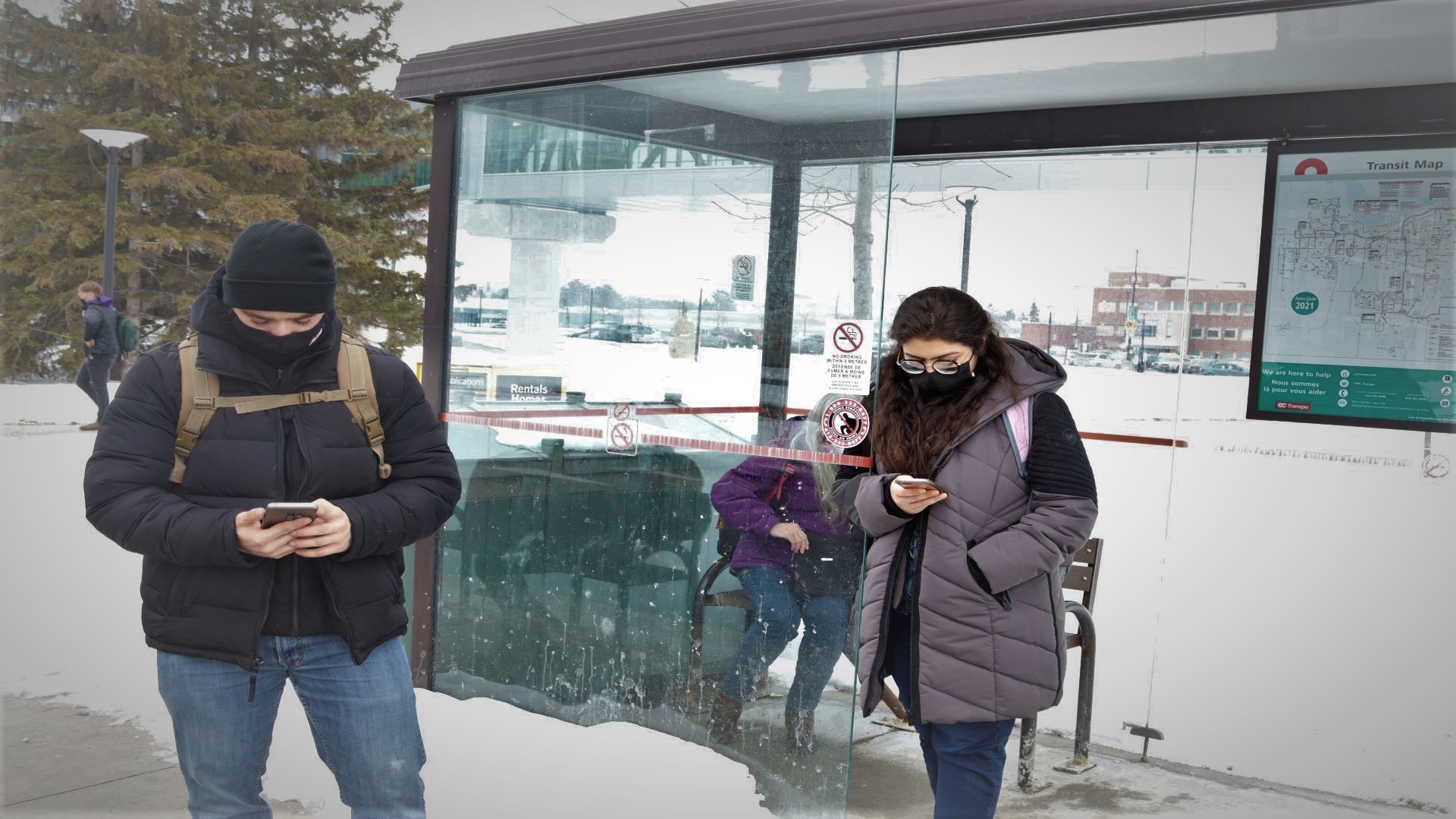
Nicolas Touma, a first-year engineering technician student at Algonquin College waiting for his bus to go home alongside Aashima Gulati, a University of Ottawa student
Parking fees and rising gas prices have caused students and staff to set aside more commuting funds than they initially expected, according to Lisa Fournier, a first-year paralegal student at Algonquin College.
With gas prices reaching $1.50/litre , students and staff at Algonquin College are familiar with cutting back on extra-curricular driving, according to Fournier.
“I am sad about the increased gas prices,” she said. “As a student, I pay my own rent and bills, so the increased prices have required me to focus more on only going to places I absolutely have to.”
Travelling from all over Ottawa and the surrounding area, and even parts of Quebec, students are familiar with the time, money and mileage spent to get to and from the college.
“I actually did the math with a classmate and the move to hybrid will save her $400 a month on gas – she lives in Arnprior, Ont,” said Fournier. “My transportation is more reliable than OC Transpo. Given the recent weather, I would be nervous to rely on public transit and their timing.”
A daily commute to Algonquin College campus from Arnprior, Ont. is 62.2 kilometers one way.
While alternative modes of transportation are an option, and always have been, the uncertainty of OC Transpo arrival times has prompted certain students to stick to their own vehicles. Among other things, the bus fare can add up quickly with each trip costing $3.65. A monthly bus pass would cost $122.50.
“I prefer driving to campus because it means I can avoid waiting for the train and risking running late to class,” said Melissa Cousineau, a second-year animation student.
“My transportation is more reliable than OC Transpo. Given the recent weather, I would be nervous to rely on public transit and their timing,” said Fournier.
O-Train fare is the same as OC Transpo – $3.65 per ride. While buses and the O-train are accessible for some people, such is not the same for Cory Haskins, the academic chair for the school of hospitality and tourism at Algonquin College.
“I have not considered alternative modes of travel. Bus service from my neighborhood is very limited,” said Haskins.
“I prepaid for my parking pass at school and am no longer getting the benefit of having a parking space there, that I have paid for. But I am saving significantly on gas, and just have to go to and from work now,” said Fournier. Day, weekly or monthly passes can be purchased at the College, costing $18, $121, and $736, respectively.
Claude Brulé, president and chief executive officer at Algonquin College sent an email in late January, stating classes would remain hybrid, causing students and staff to move forward predominantly via remote delivery.
“I prefer remote learning for many things, and the commute is one of them,” said Cousineau.
While many students, and staff at Algonquin College pay a lot for travel, and parking at the college. Such isn’t the same for those living within walking distance, or living in residence. Although, living closer has provided alternate issues such as increased rent costs and no hands on learning, according to Angela Arthur, a first-year early childhood education student at Algonquin College.
“I do think that it’s not value for money for me as I’m paying such huge fees and still studying online,” said Arthur.
The Ontario Colleges Athletic Association announced in a statement varsity basketball and volleyball will be returning to competitive play on Wednesday, Feb. 9. It was March 8, 2020, when Algonquin College’s women’s basketball team last played. Now, the team is preparing to play for the first time in almost two years. The Algonquin Wolves women’s […]
Liam Fox
Photos: Liam Fox
February 9, 2022 Revised: January 30, 2024 3:37pm
Photo: Liam Fox
“I couldn’t be happier about being back in the gym,” said Jaime McLean, the head coach of the women’s basketball team at Algonquin College.
The Ontario Colleges Athletic Association announced in a statement varsity basketball and volleyball will be returning to competitive play on Wednesday, Feb. 9.
It was March 8, 2020, when Algonquin College’s women’s basketball team last played.
Now, the team is preparing to play for the first time in almost two years.
The Algonquin Wolves women’s basketball team will open their return to competitive play on Friday, Feb. 11, against Durham College in Oshawa. The team’s first home game on their new court at the ARC will be on Friday, Feb. 18, against Loyalist College.
The season will have eight regular-season games, followed by playoffs.
The Wolves began practising for a return to competitive play in October 2021 but got shut down from playing when the Ontario government announced new COVID-19 restrictions on Jan. 2, including a ban on indoor sports. The team’s first game was originally scheduled for Jan. 11.
“I couldn’t be happier about being back in the gym,” said Jaime McLean, the head coach of the women’s basketball team at Algonquin College.
McLean has been coaching the team since the 2017-18 season.
“Finally stepping back onto the floor, I had those going into a championship game nerves,” said McLean.
“Returning to competitive play is something that I thought would never come back to us,” said Jade Lyons, a forward on the team.
Lyons previously played for Carleton University’s women’s basketball team. Carleton University attended U Sports nationals and finished sixth in the country while Lyons was on the team.
“Being able to return to play is something that I have waited for since the day that it was taken away from me,” said Lyons. “Being within the sports environment again is so stress relieving and is a really huge part of my life.”
“I can’t even describe how excited I am to begin playing again,” said guard Sydney Moore. “It was the one thing I felt I missed most with COVID, just being able to compete.”
This is Moore’s first season playing with the Algonquin Wolves and her second playing OCAA basketball. Moore last played with St. Lawrence College during her freshman year in 2019-20, a season in which she won rookie of the year.
The pandemic has been tough for athletes and coaches alike.
“COVID really messed up a lot of plans and the lockdowns almost felt endless,” said Lyons.
“During COVID everybody has had those highs and lows,” said McLean. “But then, being in touch with our athletes and keeping in the loop on how they’re doing and stuff, sort of kept that coaching flame going.”
The Algonquin Wolves have an optimistic view on expectations for their upcoming season.
“I think we can have a winning record but it’s about being competitive in every game,” said McLean.
Players and coaches have a positive attitude towards their season partly because of the work ethic of the team.
“I think we have a strong group of girls who are willing to put in the time and effort required to win,” said Moore.
“I would say that my expectations for this season would be to win most of our games, persevere through adversity and continue to work harder every day and every game,” said Lyons.
Winning each game will be even more important for the Algonquin Wolves as every game is even more meaningful than before because of the shortened eight-game season.
“Playoffs are going to come much quicker than in previous years and we need to ensure that we take every game seriously,” said Lyons.
A shortened season is not necessarily a negative change for teams returning to play after a pandemic-caused hiatus, said McLean.
“With a shortened season it’s kind of actually something that’s beneficial in disguise,” said McLean. “It’s going to be nice to have a shortened season to just get everybody back into competing again.”
In their previous 2019-20 season, the Algonquin Thunder played 16 regular-season games. In the seasons before 2019-20, the team played 17 games.
For the Algonquin Wolves women’s basketball team, it is a year of many new changes: a new return to play, a new team name switched from the Thunder to the Wolves, new team members and a brand new court.
The new court is one of the main attractions at the new $50 million ARC and has athletes excited to be the first at Algonquin College to call it their home court.
“The ARC building is a phenomenal building that I feel privileged to be able to call home court,” said Lyons. “It is an amazing facility that offers all athletes so many opportunities to get stronger and better.”
The new court at the ARC is larger than the previous court located in the A-building at the Algonquin College campus.
“I’ve got to double how loud I am just to communicate up and down the floor,” said McLean.
Bleachers at the ARC will be empty of fans to begin the season.
“Due to COVID-19 protocols, the OCAA has determined that there are to be no spectators at games until reviewed on February 21,” said Cheryl MacEwen, manager athletic operations – varsity.
Playoffs across all OCAA sports are set to begin on March 9 and will wrap up on March 17 with championship games.
Local News CTV News Ottawa: Ottawa police are growing concerned about the children who are allegedly living inside the trucks that are a part of the convoy. The police are discussing the next steps with the Children’s Aid Society but according to Deputy Chief Steve Bell, they are not considering enforcement activity. Bell believes that […]
Jantina Huizenga
Photos:
February 9, 2022 Revised: February 9, 2022 9:51am
Local News
CTV News Ottawa: Ottawa police are growing concerned about the children who are allegedly living inside the trucks that are a part of the convoy. The police are discussing the next steps with the Children’s Aid Society but according to Deputy Chief Steve Bell, they are not considering enforcement activity. Bell believes that 25 per cent of the trucks parked outside of Parliament have children living in them and there are health concerns regarding the conditions.
National News
CTV News: The premier of Saskatchewan Scott Moe announced at a press conference on Tuesday that proof of vaccination will no longer be mandatory as of Feb. 14 at 12:01 a.m. Moe believes that the vaccination policy has done its job and encouraged residents to get vaccinated but that now it is creating a divide in the province. The Saskatchewan NDP has asked the government to share a clear map indicating the easing of restrictions. The NDP said they find it hard to trust Moe and believe that the Saskatchewan government wants to be the first province to ease restrictions.
International News
CBC News: New Zealand is seeing its own convoy protest outside of Parliament. People from all over the country drove to Parliament on Tuesday to protest vaccine mandates. Most of the protestors were unmasked and their vehicles blocked roads in Wellington for several hours. Prime Minister Jacinda Ardern is not going to meet with protesters and believes that the convoy does not represent the majority of the country.