New book details alumni’s battle with leukemia

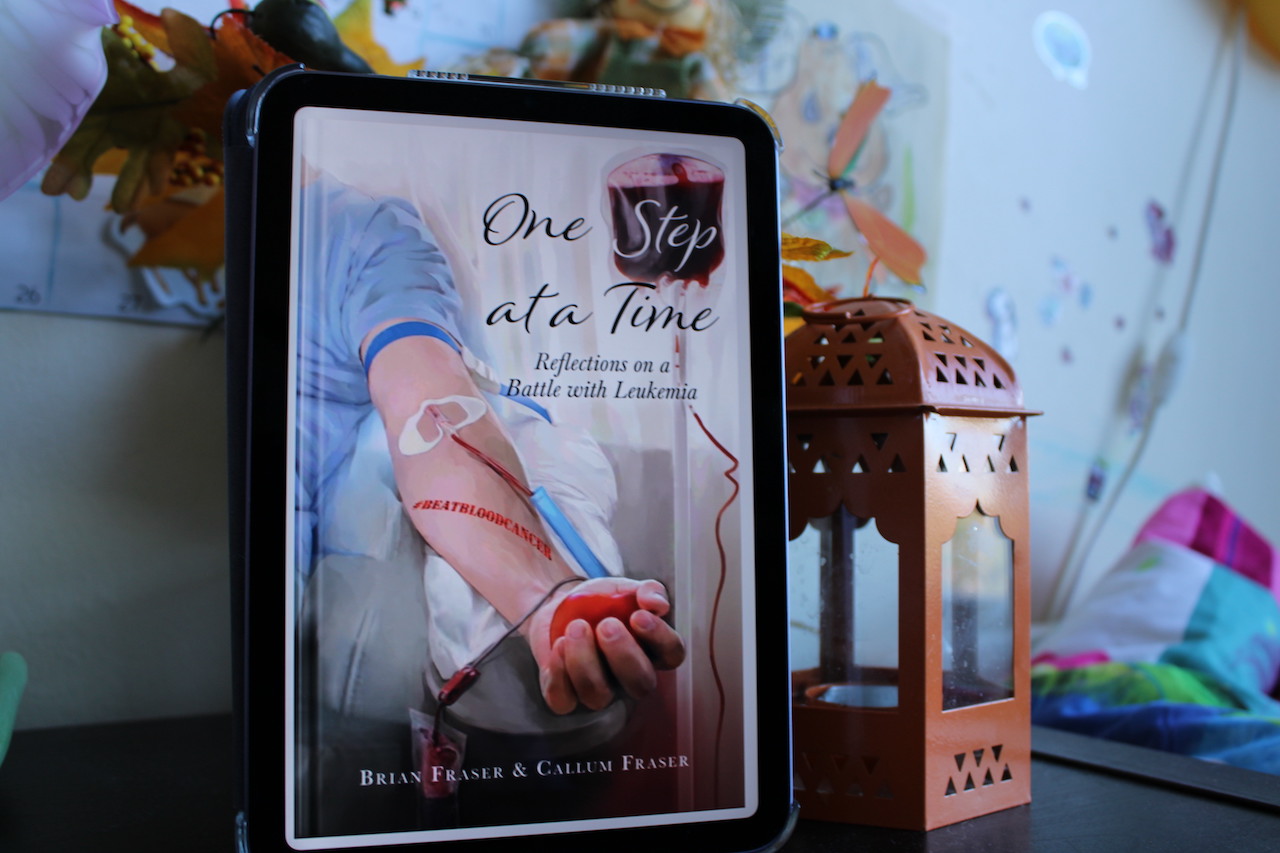
One Step at a Time is Algonquin College alumni Brian Fraser’s autobiography. He spent the last months of his life working on it but was unable to finish before he […]
Photo: Nathan Drescher
One Step at a Time is available on all major online book platforms.

One Step at a Time is Algonquin College alumni Brian Fraser’s autobiography. He spent the last months of his life working on it but was unable to finish before he died. His friend, Callum Fraser, also an Algonquin College alumni, took over and finished the book, which was released on Oct. 17.

One Step at a Time is an emotionally-charged, painfully honest first-hand look at living, and dying, with leukemia.

“Brian came to me in December 2020,” Callum said in an interview with the Algonquin Times. “The main reason for his call was him enquiring with me to help him out with a book project. He wanted to put together a professional-sounding book. I told him it would be an honour and a privilege.”

Brian Fraser graduated from the broadcasting radio program in 2016 and worked as 580 CFRA’s technical producer on The Morning Rush with Bill Carroll until 2020, when he was diagnosed with leukemia. Fraser then gained national attention through his advocacy for blood donations following a CTV interview from his hospital bed.

“We assembled four or five chapters very quickly, but we didn’t have enough time to finish it before we lost him,” Callum said.

“I had to figure out what to do. I decided to take the journalistic approach and talk to the big players in his life. I managed to put together five or six more chapters and really focused on the inside story of how he became the poster child for blood donations in Canada.”

Callum met Brian at the Bell Media building while Callum was working with TSN. Although both men studied at Algonquin College at the same time, Brian in the radio program and Callum one floor above him in the journalism program, they never ran into each other. But once out of school, they became great friends.

“He was the most candid person you could ever meet,” Callum told the Times. “We decided early on in the process of writing the book that the best way to deal with these heavy topics was with brutal honesty.”

The college renamed one of its Alumni of Distinction awards to the Brian Fraser Recent Graduate award in 2021 in honour of Fraser’s promotion of blood donations in Canada.

One Step at a Time is published by FriesenPress and is available online at various bookstores, including Amazon, Apple Books and Barnes and Noble.

International students will soon be able to work more hours off-campus

Starting Nov. 15, any student with a study permit and off-campus work authorization will be able to work more than the current maximum of 20 hours per week. The federal […]
Photo: Leslie Bader
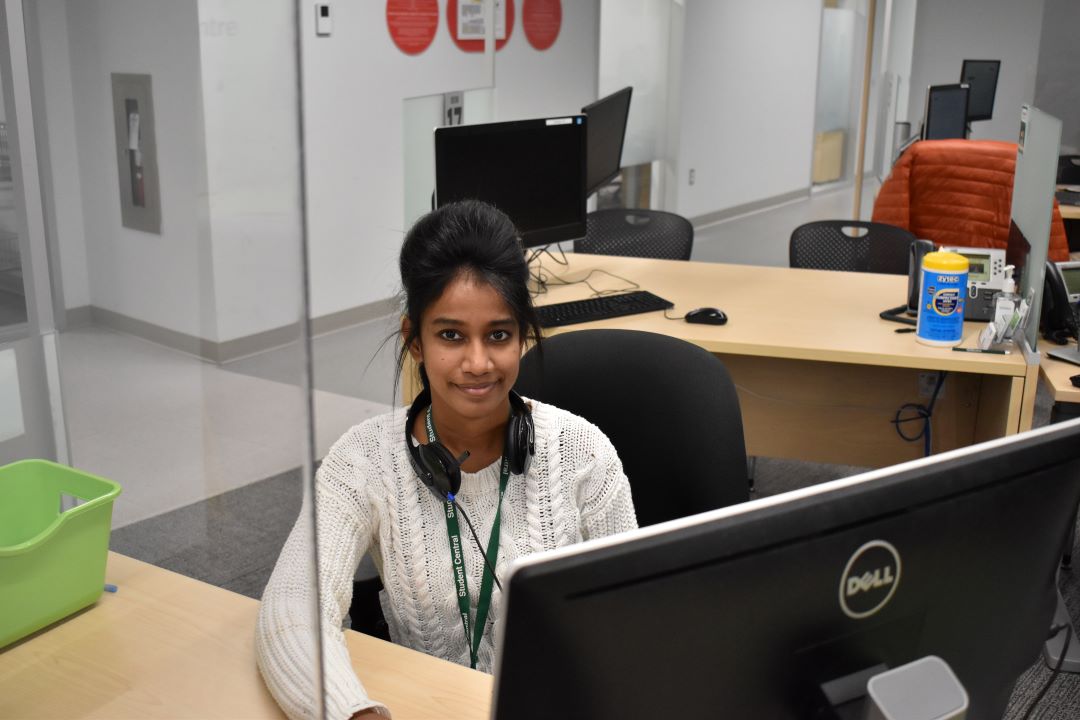
Algonquin College alumna Irene Thomas takes calls at Student Central.

Starting Nov. 15, any student with a study permit and off-campus work authorization will be able to work more than the current maximum of 20 hours per week.

The federal pilot project is being established to help combat the country’s labour shortages.

“International students will get to be exposed to a continuous working environment to help them prepare for their future endeavours,” said Brian Padre-e, a fourth-year business management and entrepreneurship student from the Philippines. “It will help the country deal with labour shortages while allowing students to save up for all their basic necessities.”

There is currently no limit on the number of hours international students can work in on-campus jobs, but the number of applicants greatly exceeds the positions available.

Irene Thomas, a graduate of the project management and regulatory affairs program, welcomed the government’s news.

“Yeah, I actually feel so happy for that. It was so hard for all of us to get some money to pay the fees,” said Thomas. “When I was a student, I always had eight-hour shifts, but then three shifts was 24 hours, so I was always stressed about that. I had to ask my employer to deduct my breaks so I wasn’t over 20 hours.”

Thomas, who now works as an enrollment services representative, echoed the sentiments of Padre-e.

“Now we can work full-time and build relationships with our employers. It will help us to be successful after our studies,” she said.

Damien Dunne is the acting director of the International Education Centre, which is located in the back corner of Student Central. While acknowledging the removal of the 20-hour cap will allow international students more flexibility as they balance their school and work commitments, Dunne stressed that academic success is the priority for Algonquin College students.

“I think it will allow students to work additional hours in weeks when their academic workload is not as demanding, and perhaps fewer when their program workload is higher,” said Dunne.

Padre-e, who also works as a student recruiter for Algonquin College, agreed there could be academic consequences to taking on more work.

“There is a huge possibility of loss of focus for students who want to earn more resulting in neglect of their studies,” he said.

The pilot project runs until Dec. 31, 2023.

Algonquin College throws a Diwali party

When 3 Peg by Sharry Maan started playing, a look of disbelief rippled through the throng of mostly Indian students in the Student Commons. It was immediately followed by incredulous […]
Photo: Aadil Naik
Bhangra originated in the Northern state of Punjab in India, and is traditionally performed in a circle by farmers during the harvest season. It is a popular dance form in India and will regularly be performed at parties and celebrations.

When 3 Peg by Sharry Maan started playing, a look of disbelief rippled through the throng of mostly Indian students in the Student Commons. It was immediately followed by incredulous acknowledgment and wild cheering. All inhibitions were immediately abandoned, pure joy and memories plastered on their faces, as everyone lost themselves in the dance.

On Oct. 20, the Students’ Association hosted the annual Algonquin College Diwali celebration in the Student Commons at the Woodroffe campus, filling the space with light, energy and the aroma of delicious snacks.

Diwali – also called the festival of lights – is one the biggest celebrations of the year in India. It symbolizes the spiritual victory of light over darkness, celebrating the day the Hindu deity Rama returned to his kingdom with his wife Sita after defeating the demon Ravana.

It is usually observed by members of all faiths in India and traditionally celebrated with fireworks, dance and food. Algonquin College has a sizable chunk of students from the region and every year the Students’ Association brings the celebration to them.

“I find it very important, especially for our foreign students who might not be able to go back home for holidays,” said Nakeya Francis, diversity and inclusivity events coordinator for the Students’ Association. “For them to feel seen and celebrated on campus is super important so they know they are a core and a great part of the community here at Algonquin.”

The celebration kicked off at 1 p.m. with a dance performance by Bhangrascape, an Ottawa-based group that teaches and performs a dance form popular in the Northern regions of India called bhangra. It is characterized by vigorous kicks, foot stomping and leaps accompanied with upraised thrusting arm and shoulder movements. It is played to the beat of a double-headed drum called the dhol.

After a few dance numbers, the group invited the rest of the attendees to join them, and everyone was happy to oblige. The dance party didn’t stop until 4 p.m.

Diwali is a very social festival for Indians and an opportunity to bond and spread good cheer. This event was a reflection of that spirit.

“It’s great fun, but it also reminds us of our culture and traditions. It’s a great perk,” said Kasha Deep Singh, a student in the business program, who came to Canada in May 2021, and is celebrating his first Diwali away from family. The last time he danced to bhangra music was at his brother’s wedding and he said this brought back all those memories. “I have no words to describe it,” he said, before running back to join the dance.

While the vast majority were from the Indian diaspora, there were others, too.

“These are moves I’ve never seen in my life, and I want to learn it,” said Francis Aikhuomon, a student in the computer systems technician networking program and a passionate Afrobeats dancer. He wasn’t aware of the event and was just passing by, heard there was a dance party and couldn’t resist joining in.

“I like it because it not only promotes dancing but it promotes culture and that’s what matters to me,” said Aikhuomon.

All around, people had their phones out smiling as they recorded the passionate dancers.

Applying intricate designs of henna on your hands is a popular tradition for Indians during festivals and weddings.
Applying intricate designs of henna on your hands is a popular tradition for Indians during festivals and weddings. Photo credit: Aadil Naik

Off to the side, Indian snacks like samosas and batata vadas were being served. The line to grab some of these tasty delights extended all the way to the Algonquin Commons Theatre. Further down, henna artist Shelina Syed was applying beautiful designs onto people’s palms – another popular Diwali tradition.

For the first time this year, the Students’ Association also had a Diwali celebration at the Algonquin College Perth campus on Oct. 17. It was a huge success, according to Francis.

College Ward Conversations, Ep. 2 – The Contenders

Join hosts Kolbe Devaux and Connor Lalande as they explore the good, the bad and the ugly sides of the race for city councillor.

College Ward Conversations turns up the volume on municipal politics in our own backyard. 

Join hosts Kolbe Devaux and Connor Lalande as they explore the good, the bad and the ugly sides of the race for city councillor.

It’s a podcast for voters who want straight talk about their issues, their candidates, and their ward.

Featuring reporting and editing by Connor Lalande, Kolbe Devaux, Nathan Drescher, Lara Faceroli, Sophia Adams and Adil Naik.

Click here to listen to episode one.

Cyclists are ready for change this municipal election

Every election cycle has a hot-button issue, and this year it is bike lanes. Two of the candidates in Ottawa’s mayoral race have gone back and forth on cycling infrastructure. […]
Photo: Myriam Landreville
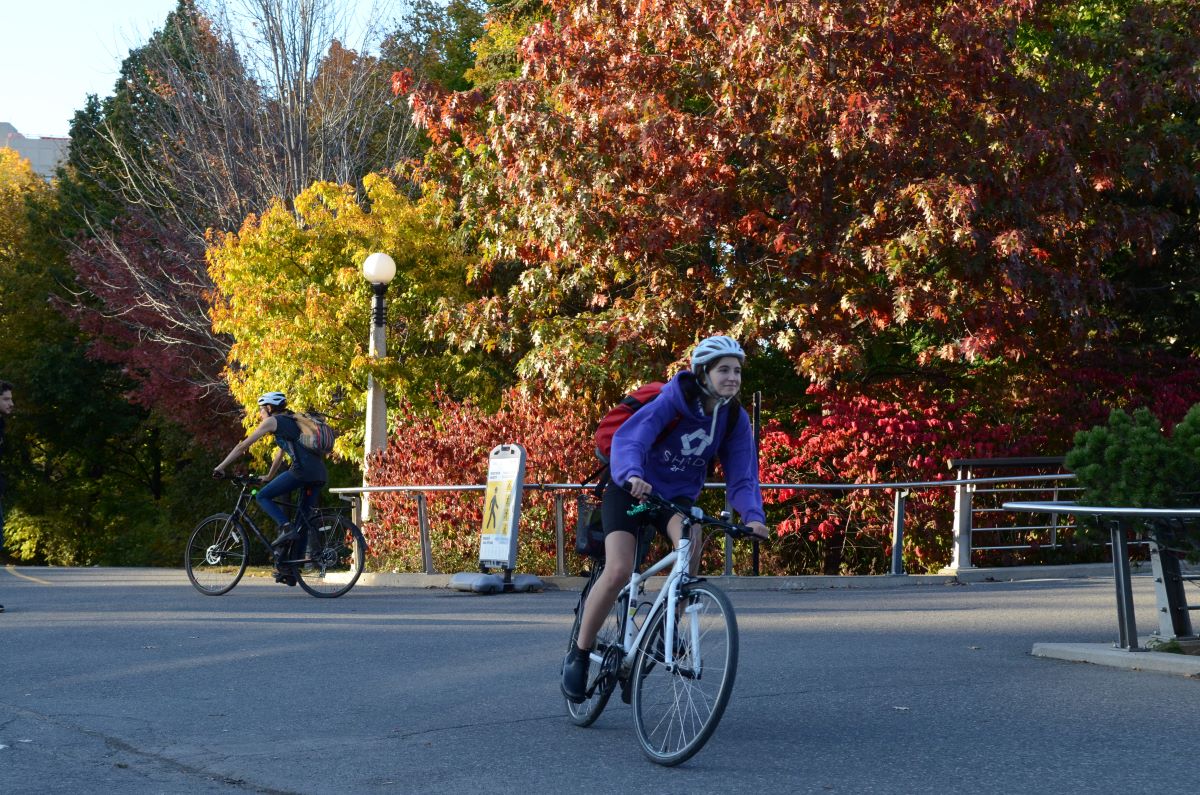
On a warm and sunny October afternoon, cyclists pack a pathway near the Rideau Canal.

Every election cycle has a hot-button issue, and this year it is bike lanes. Two of the candidates in Ottawa’s mayoral race have gone back and forth on cycling infrastructure.

Catherine McKenney’s campaign has been promising to extend bike lanes throughout the city. They intend to achieve this by spending $250 million by issuing green bonds.

“As mayor, I will transform Ottawa into one of the best cities in the world for cycling,” McKenney said.

Mark Sutcliffe, another prominent mayoral candidate, has opposed McKenney’s plan.

“Ottawa needs transportation priorities that work for them. Whether you’re getting groceries, taking your kids to school, getting to the community centre for hockey practice, bike lanes aren’t going to help you with that,” said Sutcliffe.

Sutcliffe has instead promised to spend $100 million on road maintenance.

According to Ottawa Insight, a project that collects local data, 2.5 per cent of commuters in Ottawa chose cycling as their method of choice to travel.

“It gives me much more independence than transit, it’s faster than walking and I don’t have a driver’s license. It’s also so much more fun,” said Christiane Wilke, an Ottawa resident who uses a bicycle as her main mode of transportation.

“We need to have a serious discussion about turning some of the mid-20th century scenic parkways into scenic bikeways: Queen Elizabeth Drive, Colonel By Drive and Sir John A. Macdonald Parkway, for example,” said Wilke. “Collisions become less likely if cyclists have space that cars can’t encroach on, and collisions become less severe when the speeds at which cars can go are lower.”

Andrea Emery, an Algonquin College professor of graphic design who uses a bike to get to school, echoed the sentiment.

“We need more protected bike lanes and pathways specifically for bikes. There has been an increase in cyclists since the pandemic with more people embracing the sport. Which is great. Our multi-use pathways are busier than ever with walkers, runners and cyclists. We need to prioritize bikes over cars for our city,” said Emery.

“Catherine McKenney has vowed to transform Ottawa into one of the best cycling cities in the world,” explained Emery. “Since they spend a good deal of time on their bike and in our communities, they are aware of the cycling infrastructure. I think their green bond plan is exciting and I hope they get the opportunity to implement it.”

Rodd Heino who used his bike as his main mode of transportation for more than 30 years explained his challenges while cycling.

“The biggest difficulties are the cars. Other road users make using a bike very stressful if you don’t choose your route carefully. The weather can be a challenge, too,” said Heino. “I am excited to see Catherine McKenney’s platform and I’m encouraged by the fact that they see the bigger picture. More facilities for cycling means more people on bikes.”

According to the Ottawa Road Safety Report, two cyclists died in 2020 due to road collisions, compared to four in 2019.

The Prince of Wales Drive and West Hunt Club Road intersection and Hunt Club Road and Riverside Drive intersection each had 32 collisions in 2020, making them tied for the intersections with the most collisions that year.

How did we become so desensitized to overt violence?

A stranger walked through the Algonquin College parking lot and threatened to shoot up the Woodroffe campus on Oct. 12, some time before noon. I was sitting in a stairwell […]
Photo: Rohan Kanchan
Violence is a part of our daily news intake, and it has stopped having the effect it should, writer Aadil Naik argues.

A stranger walked through the Algonquin College parking lot and threatened to shoot up the Woodroffe campus on Oct. 12, some time before noon. I was sitting in a stairwell with 10 colleagues when the news reached us. But it didn’t inspire fear or anxiety. At all. Only one of us reacted with the despair someone threatening to kill should receive. For the rest of us, it was straight on to discussing lunch.

That’s when it hit me. We have become truly desensitized to violence and death.

The last time news of violence or death really moved me was probably when the dastardly Al-Qaeda flew planes into the Twin Towers over two decades ago. That was a worthy reaction to obscene violence – shock, anger, fear and anxiety. I remember staying glued to the television for days. I was almost exactly on the opposite side of the world – it affected me not – and yet I remember it striking my heart with fear and sorrow.

Ironically, what followed played a huge role in desensitizing me to violence. With the U.S.-led invasion of Afghanistan, casualty reports became regular news fare. We followed them for a while, rejoicing when it was an evil Al-Qaeda operative, and mourning when it was an innocent child. We protested collateral deaths in horror. But it became so common that in a few years it stopped moving that part of us that makes us human – we stopped feeling. I could soon watch a live news broadcast of 40 people being killed while having dinner and go to the movies immediately after.

We had long believed it was video games made that us violent and desensitized us. That’s what my parents still tenuously believe, but that myth has long since been debunked. On the other hand, exposure to excessive violence early in life can make us emotionally desensitized in early adulthood.

But that still doesn’t explain this weird middle ground we exist on. Most of us are still empathetic people. The death of grandma still moves us, and we will open our purses and hearts for the local charity, but a school shooting doesn’t. Not anymore. Sure, we will talk about it and change our social media display pictures. But it does little more than that.

By the third school shooting in America, it didn’t make me nauseous imagining a 10-year-old being shot at point blank range. I didn’t feel sick reading accounts of parents getting a call at work that their kid was not going to make it home. Thinking about that now in retrospect makes my heart bleed for the kids and the anguish the parents go through. It makes my blood boil at the insufficiency and injustice of it just being another news cycle and will be forgotten in a week. And despite all this, when it happens again, I don’t feel.

Is it because today violence permeates our lives so deeply and regularly, our innate reaction is to avoid it? Our default is to protect ourselves from emotional distress, and with emotionally distressing news drowning us daily, our minds subconsciously run from it.

But the people who report on it make a living off making us empathize. And to truly empathize, you need pedantic visual and graphic details and it isn’t considered iniquitous anymore. But we don’t want to have those feelings. Ever. And yet, because we live in a world that’s so connected, there’s no escaping the news. Ever.

So even though we stoically avoid it, we receive it in headlines and blurbs nonetheless. On Twitter, Instagram and billboards. Devoid of all detail, but enough to know someone died or got shot. But devoid of detail, it doesn’t evoke the same response. It feels…normal. Because headlines are dehumanizing. A headline says “School shooting in Texas. 3 dead.” They are numbers and statistics, never feelings. And numbers are inanimate, while feelings are human. Is it any wonder then that we don’t feel the way we all believe we should be feeling?

Or is this just our generation’s coping mechanism? Because we know that if we did feel as we should, it would utterly consume us. It brings to mind something Barney Ross – played by Sylvester Stallone – says in the movie The Expendables 2. “That’s how we deal with death. We can’t change what it is, so we keep it light until it’s time to go dark.” And if I’m being honest, it works. It keeps us effective, and we continue to live and work, ignoring what we can’t change.

This approach can sometimes be beneficial. In the case of the threat made on campus, it amounted to nothing. When police were contacted, they confirmed that the person had been “spoken to and escorted off the property without incident. No charge was laid.”

But I wonder what that says about us as a society and species who have attained this stage of modernity through collaboration and empathy between each other. Is that where we stand today then – partially informed, physically awake but fully dead inside? Is this the true victory of violence? Not the lives lost, but our indifference to it.

Editorial: Students must vote to be heard

The Ontario municipal elections are less than a week away and Ottawa will elect a new mayor for the first time since 2010. The issues in this campaign vary depending […]
Photo: Leslie Bader
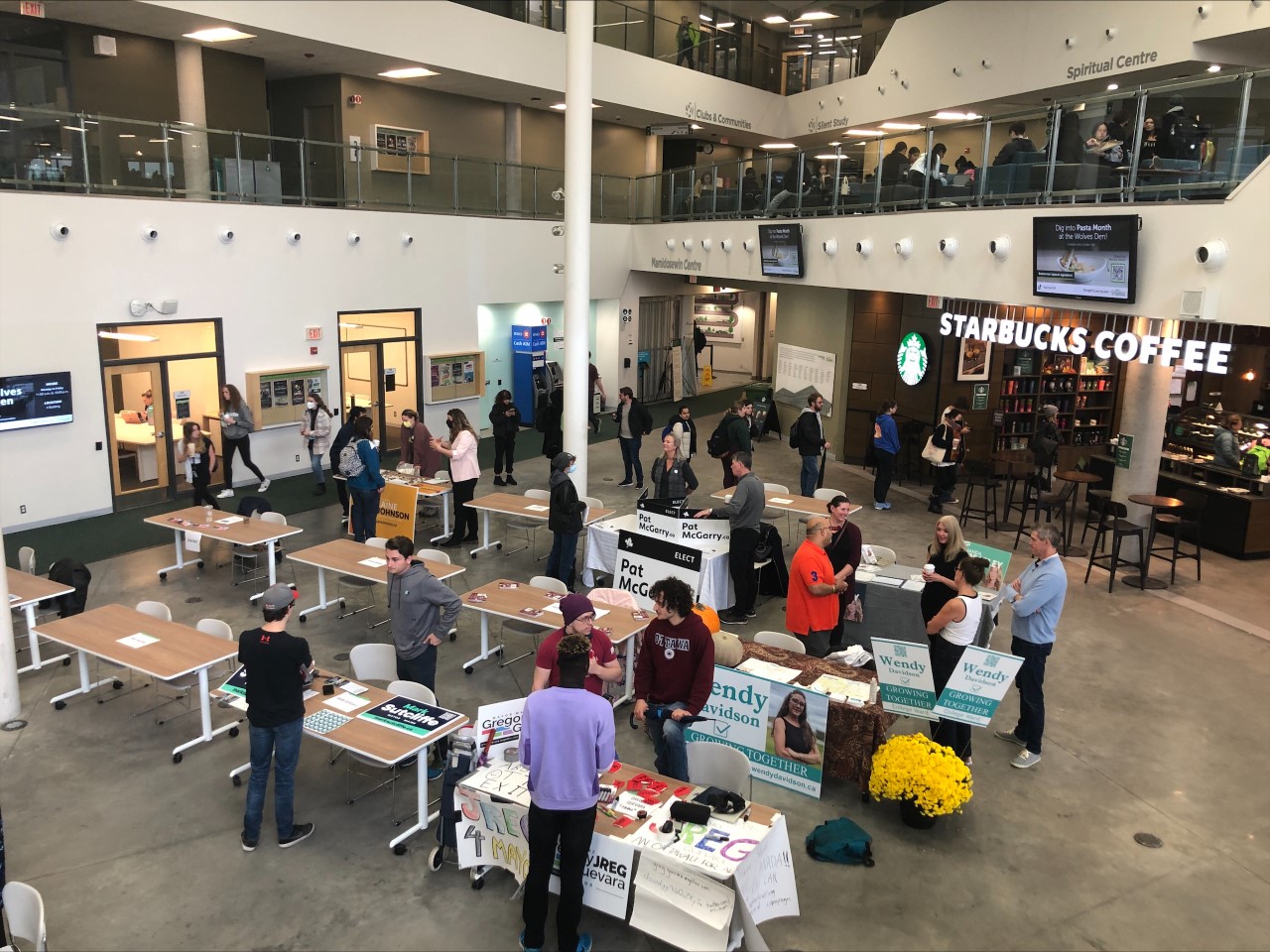
The recent municipal election fair in E building.

The Ontario municipal elections are less than a week away and Ottawa will elect a new mayor for the first time since 2010. The issues in this campaign vary depending on who you talk to, however two main problems have sprouted and they are taking center stage in this election.

Housing and transportation.

These two issues have had the lion’s share of attention since Day 1 of the campaign in Ottawa and that is good news for students.

You’d be hard pressed to find a student in this city who is not affected in some way by these issues. Rent prices are skyrocketing and transit is unreliable, to put it delicately. With inflation soaring, many students cannot afford to see rent prices increase and they must rely on transit to get to and from work and school.

Students have a tremendous opportunity in this election to see action on issues that are important to them but if we do not show up to vote on Monday it’ll be a long four years.

Students are great at generating noise around the issues that matter to us, but when it comes time to vote we couldn’t be any quieter. If candidates were worried about the student vote, you could bet your Apple Watch they’d be listening to our concerns.

Voter turnout in federal elections is always higher among all demographics compared to municipal elections but it is municipal government that affects our lives the most. That message should resonate even more in this election cycle as basic governmental competency is a major issue for voters.

If students don’t show up to vote in an election that focuses on the issues that matter to them the most, our credibility as a voting demographic would be irreparably damaged in this city. Our generation is attracted to protest movements and Instagram activism like flies to honey, but when it comes to marking an ‘X’ on a ballot, oil to water.

There are a lot of things Ottawa could be doing better and if students want to see any meaningful change of circumstances we need to do better.

Research the candidates for mayor and equally as important, the candidates in your ward. Select the candidate that you believe will uphold the values you believe in and will advocate for issues that matter to you and your community.

Most importantly on Monday, Oct. 24, mark an ‘X’ next to your preferred candidates between 10 a.m. and 8 p.m.

This election is a party of student issues and it would be a shame if we didn’t show up.

College Ward Conversations, Ep. 1 – Chiarelli’s Shadow

College Ward Conversations turns up the volume on municipal politics in our own backyard.  Join hosts Kolbe Devaux and Connor Lalande as they explore the good, the bad and the ugly […]

College Ward Conversations turns up the volume on municipal politics in our own backyard. 

Join hosts Kolbe Devaux and Connor Lalande as they explore the good, the bad and the ugly sides of the race for city councillor.

It’s a podcast for voters who want straight talk about their issues, their candidates, and their ward.


Featuring reporting and editing by Connor Lalande, Kolbe Devaux, Liam Fox, Roberto Iraheta, Linda Verreault, Jon Willing and Jessica Brando.

Click here to listen to episode two.

I love school but I hate going to school

It’s Week 6 of my third semester at Algonquin College. I’ve been on campus since 9:16 a.m. when I stumbled in late to my first class without having a coffee, […]
Photo: Magan Carty
Attending school on campus full-time has created accessibility challenges for students with differently wired brains, according to level three journalism student, Magan Carty.

It’s Week 6 of my third semester at Algonquin College. I’ve been on campus since 9:16 a.m. when I stumbled in late to my first class without having a coffee, eating breakfast or taking my meds.

A carnival-like atmosphere has created a consensus that returning to in-person learning warrants a celebration, no matter how introverted you are or how much you enjoy online learning. But I try to make myself invisible as I pass through the crowded hallways, dodging chaotic swarms of laughing 18-year-olds with my head down, actively avoiding eye contact or interaction. Amplified sounds of the hustle and bustle slap down on me from every direction.

I miss when school was a thing I did rather than a place I had to go. I loved my first semester last fall, which was entirely online. Second semester followed a hybrid model, and that was even better. I showed up on time, connected with my teachers and rarely missed class. I wanted to be there.

It’s almost the end of my long day at school and I can barely feel my own feet on the ground when the teacher of my afternoon class asks me a question I cannot answer. I have no idea what we’re even talking about because she’s been on mute in my brain for the last hour. I’ve tuned it all out as a way to cope.

Before my classmates have even closed their laptops, I am gone, rushing home so I can restart this messy attempt at a Wednesday. And when I finally return to my car after seven hours without silence or personal space, there’s another parking ticket — my third this term — flapping under one of the windshield wipers.

It took six weeks for me to admit this but being back on campus full time is not working for all of us. While many of my peers in the crowded hallways or endlessly long Starbucks lines are travelling in herds, socializing and thriving, I am just not feeling it. There are too many people. It’s all so loud and fast and all of a sudden.

Balance is supposed to be restored now that campus has kicked back into high gear, but this jarring return to “normal” is far more discombobulating than locking down ever was.

After two and a half years of the college being a ghost town with guarded entrances, this full return to campus feels like whiplash. Rushed, late, disheveled and distracted, I’m constantly disassociating and running on autopilot. I don’t remember how to regulate my ADHD in this kind of environment; it’s been too long since I’ve had to. The pandemic conditioned me to enjoy experiencing everything from a distance or through a screen. I wasn’t ready for such a harsh transition to everything being so up close and three-dimensional.

I’m not the same student at school as I was at home. On Zoom, in the quiet comfort of my own space, I could focus and hear myself think. I learned faster and participated more. I was productive and efficient with my time because I had better boundaries and spent my breaks recalibrating rather than wandering the halls in an overstimulated coma.

While many students more than a decade younger than me are undoubtedly relieved to return to an alive campus, I believe virtual and hybrid learning benefited differently wired brains like mine.

The delivery of college curriculum models proved to be malleable when students and teachers were abruptly forced online in March 2020. We adapted because we had to, and this resulted in the expansion of our virtual skillsets. It seems counterproductive to return to 2019 mode after all that’s changed. Many workplaces have embraced the energy-efficient hybrid option, so why can’t more programs at the college strike a balance?

I am tired of running on fumes and know I’d be able to absorb more of the learning material if classes that didn’t need to be in person happened online.

As one of my classmates said, “Hybrid is the future. And it’s here. The sooner everyone accepts it, the better.”

I love school, I do. But I don’t have the right kind of brain for this style of learning. A truly accessible workplace would acknowledge that some people learn better on campus whereas others benefit from a more insulated, quiet approach.

“Accessible means everyone with a physical, mental or learning disability is afforded the opportunity to obtain the information fully, equally and independently,” according to the Employer Assistance and Resource Network on Disability Inclusion.

As regulating my emotional well-being becomes increasingly difficult on campus, it would be nice to know the only way out of a bad brain day wasn’t to skip school.

In order for my brain to acquire the same information, engage in the same interactions and enjoy the same services in an equally effective and integrated manner, I need better access to a hybrid option.

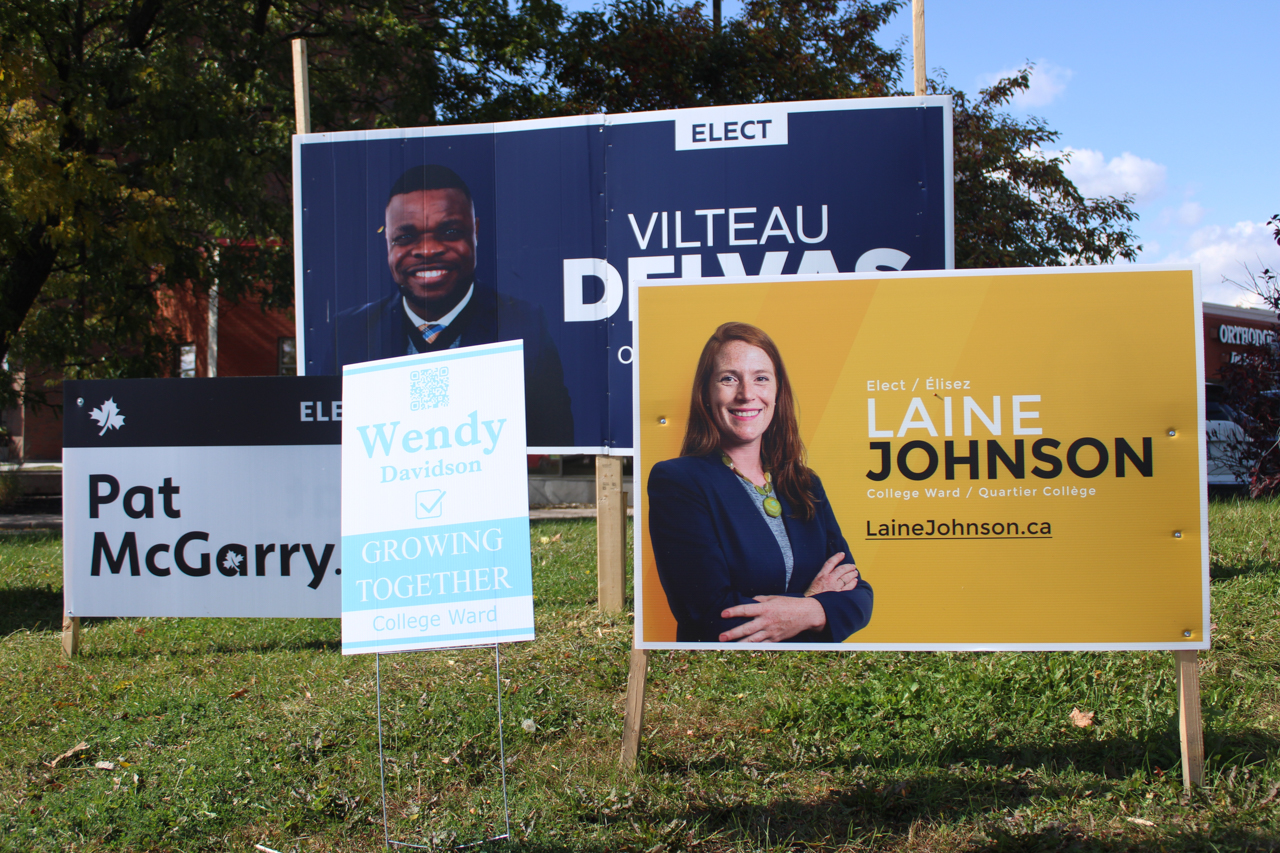
Meet the College ward candidates in Ottawa’s municipal election

The Oct. 24 municipal election is nearly here and a new city councillor for College ward will be elected. The person voters choose will be tasked with handling a few […]
Photo: Nathan Drescher
Five candidates are vying to replace councillor Rick Chiarelli in College ward.

The Oct. 24 municipal election is nearly here and a new city councillor for College ward will be elected. The person voters choose will be tasked with handling a few issues near and dear to the college community.

The Algonquin Times reached out to all five candidates. Here is what they said.

Vilteau Delvas

“I know how hard it is to go to school on only $16,000,” Vilteau Delvas said during a telephone interview. “I used to be a student. I’ve been there.”

Delvas ran as an Ontario Party candidate in the 2022 provincial election. Before that, he worked as a police officer and as a federal employee at Transport Canada.

“I’m pro-ways to help students get to class on time,” he said. “We need new programs, maybe like share a ride, where the more rides you give a student, you will have a tax cut.”

Wendy Davidson

Wendy Davidson bought her first house in College ward and raised a family there. For Davidson, representing College ward is about serving her community.

Transit is a key issue for Davidson. She considers public transit one of the core pillars of any community and one of the primary responsibilities of government.

“Right now our system needs revisiting from within,” she said. “Start at the top. Revisit what has been a norm. Look at fare structures. We really need to clean it up.”

Pat McGarry

“Affordability is one of the largest challenges for students,” Pat McGarry said in an email to the Algonquin Times. “The cost of living and studying in Ottawa is challenging, and I believe the city has a role to play in providing solutions.”

He wants to include the college in any solutions for the ward.

“I will work with Algonquin College to find ways to support more affordable transit for Ottawa campus students,” he said. “To help students navigate to more secure and affordable off-campus housing, and to enhance graduate employment opportunities by leveraging partnerships with the Ottawa Board of Trade, the Ottawa Construction Association and others.”

Granda Kopytko

Granda Kopytko decided to run when she felt her values were not being represented by outgoing city councillor Rick Chiarelli.

“He was isolated, and was ineffective, not engaging well with any of the other councillors nor the mayor,” said Kopytko in an email to the Algonquin Times. She has years of experience volunteering for local organizations, from the school parent’s council to team manager for Ottawa City Soccer.

For Kopytko, the issue closest to her heart is the lack of greenspace in College ward. She believes communities need greenspace where people can relax.

Laine Johnson

The Algonquin Times reached out to Laine Johnson but was unable to get a direct interview with her in time for publication. However, we did receive a copy of her campaign press release.

Johnson’s platform emphasizes safe streets through increased traffic calming, improved snow clearing of sidewalks and enhancing the frequency and reliability of OC Transpo bus service.

When it comes to housing, Johnson hopes to partner with Algonquin College to problem-solve issues related to student housing in the ward.

“The people of College ward deserve a city councillor who is present in the community working every single day to solve the issues we face,” Johnson said in her press release. “College ward deserves to move forward, supported by a strong, collaborative, engaged councillor.”

Algonquin Times podcast

Stay Informed

Sign up for our newsletter

Subscribe

* indicates required