main

Winter 101: Surviving Ottawa’s cold with hot tips
Whether you're braving your first Ottawa winter or just need a refresher, these essential tips will keep you warm, safe and ready for the season
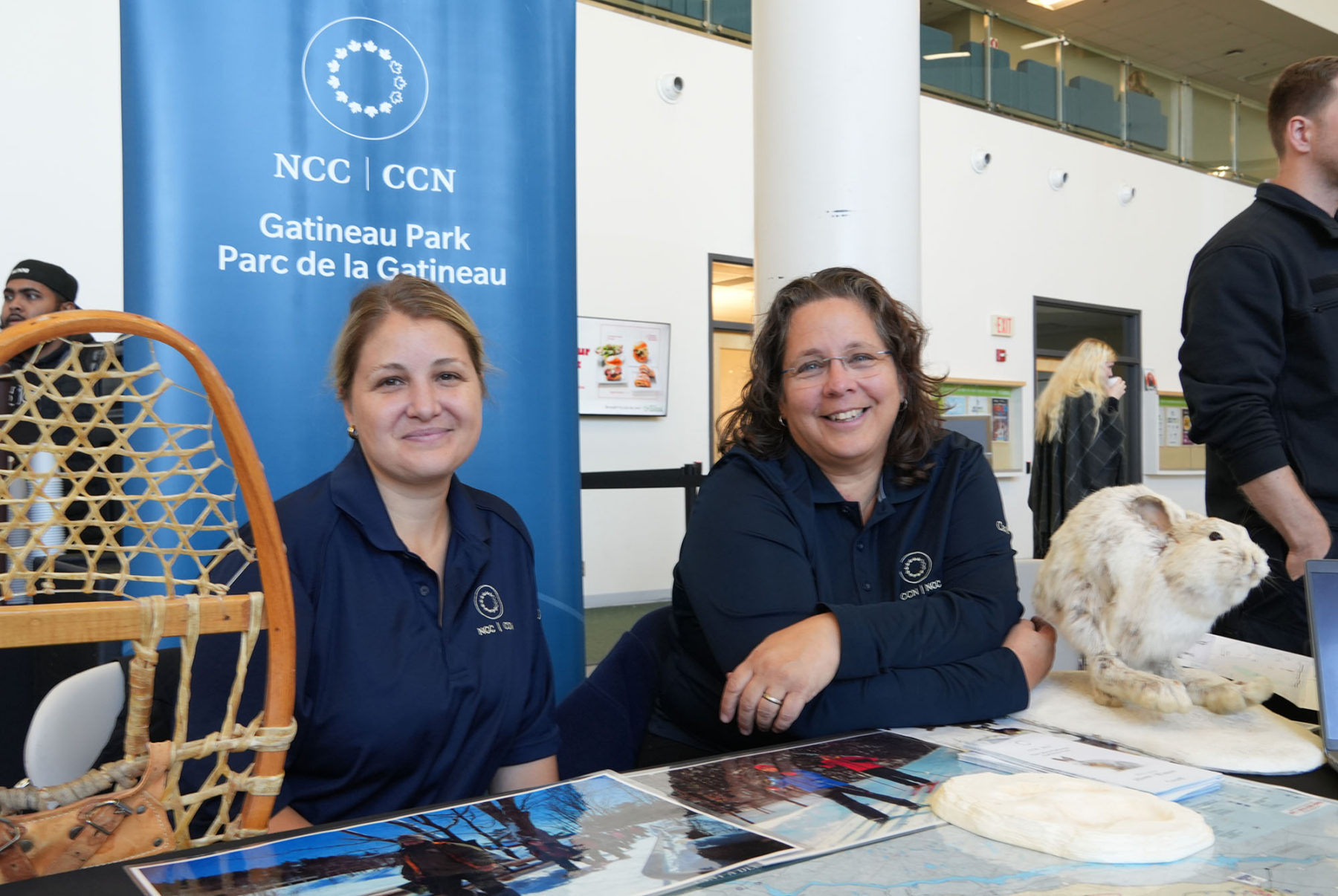
Photo: Caroline Kirkey
The National Capital Commission's Rachel Pocket, right, and Chanelle Lemieux, had helpful information about Gatineau Park's winter trails. "You don’t need to be an elite athlete," said Pocket.

Last winter, Amanda Logan, events programmer for the Students’ Association, had a discussion with a colleague from Colombia about Ottawa’s harsh winters. ‘”No amount of Googling would help her understand just how cold it actually gets here in Ottawa,” Logan said with a chuckle.

The chat they had highlights the need for events like Winter 101 to help international students prepare for their first Canadian winter.

The Winter 101 event held by the SA and the International Education Centre on Oct. 17, had booths from OC Transpo, Ottawa Public Health, Ottawa Fire Department, the Ottawa Senators and the National Capital Commission for Gatineau Park.

Each booth had educational advice for students to understand how harsh Ottawa winters can get and how to prepare. Here are six tips for students on how to prepare for the Ottawa winter.

1. Check your weather app

Did you know that Ottawa Public Health says it is one of the coldest capitals in the world?

“The Ottawa winters are rough, they can be very bipolar,” said Alayna Defreitas, a level-1 advertising and marketing student at Algonquin College.

The colder temperatures in Ottawa can cause frostbite, hypothermia, slips and falls. Ottawa Public Health encourages students to check their weather app every day.

“Always check the weather, like weather apps, because everything can change from 12 to 3 p.m. and it can be a different temperature, ’cause it’s changing all the time,” said Mariana Catstro a level-3 student in biotechnology.

Ottawa Public Health says students have several numbers they can call for cold weather assistance.

You can call 2-1-1 for information about food banks and winter clothing, 3-1-1 for the closest shelter near you and 8-1-1 for non-emergency medical advice.

2. Dress warmly

Checking the weather app is good and all but if you’re not properly dressed the winter can feel frigid.

“If the winter gets really cold and you need to wear winter boots, just bring some extra shoes and place them in your locker, so you can be comfortable walking around the school,” said Laura Agarita a level-3 student studying biotechnology.

Ottawa Public Health advises people to wear waterproof boots, extra layers of socks, neck warmers, and to protect your ears with hats and fingers with gloves so you will not be vulnerable to frostbite.

“Definitely prepare for the cold, it gets pretty cold, so make sure you dress for the winter weather,” said Logan Cklund, a local student in level-2 studying in the Bachelor of Engineering (automation and robotics) program.

For students who may be struggling to afford winter clothes, the Champlain Health Line has several locations across Ottawa on their website for services. The programs and services provide anyone with free or low-cost clothing and household items.

3. Practice safety indoors

“We always see an increase this time of year of indoor house fires, because people are indoors more, they’re cooking and such,” said Barry Furukawia, a fire prevention officer with the City of Ottawa.

Furukawai said one of the major issues they see with indoor fires starting is people leaving their stove on and forgetting about it.

“Make sure you don’t leave things unattended while you’re cooking and try not to use candles,” said Furukawia.

4. Practice safety outdoors

The Ottawa fire department also has services for ice rescue.

“The only advice I would have on that one is to stay off the ice, stay warm, dress well and don’t put your tongue on anything metallic,” said Furukawia, “and know that putting out a fire is a voluntary act, you can always just call the fire department to handle the situation.”

5. Check your commute

“You can always research your commute, especially on our travel planner,” said Sandra Frenette Ryckman, a coordinator for outreach, events and charters with OC Transpo.

Ryckman said students can always check their social media pages as well to find out if there has been any detours or route closures during the winter.

“We also have staff that are available with our information department,” said Ryckman.

6. Have fun!

“Gatineau Park is always there to welcome you, there are activities that are accessible, easy, and fun,” said Rachel Pocket, a worker for the National Capital Commission. “You don’t need to be an elite athlete.”

“We have three guided trails in Gatineau Park that are there for hiking, so you do not need any equipment or a season pass, you can just go for a walk,” said Pocket.

The Gatineau Park also has free guided events for all students on weekends to go on snowshoe trails.

“You can always find information at libraries too for doing the trails in Gatineau,” said Pocket.


Double-header at AC Hub: Songs and oxygen

The "oxygen therapy" booth touted the benefits of inhaling concentrated oxygen, and most participants agreed
Photo: James Gray
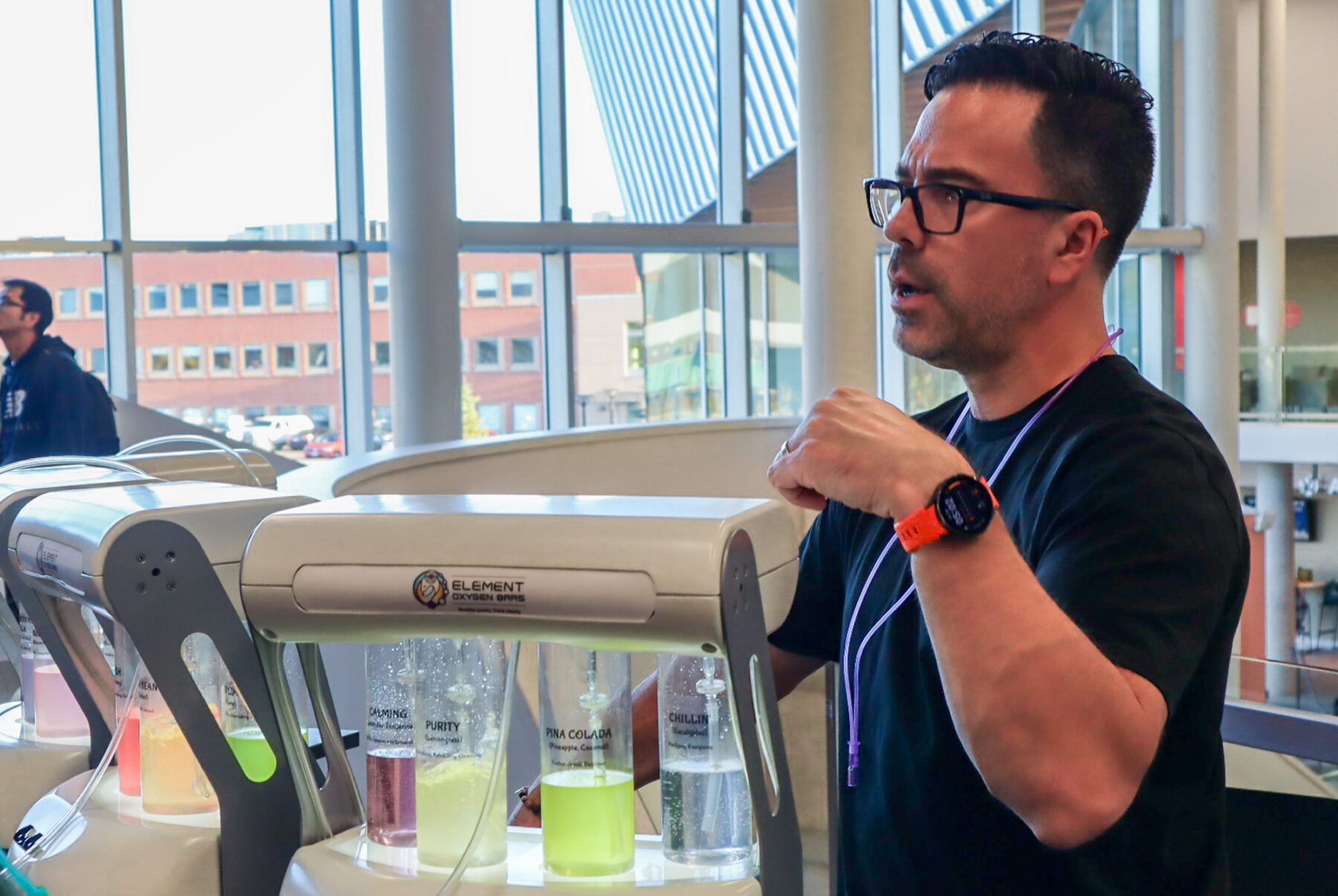
The company's oxygen is kept in liquid form and given flavours before being converted to gas during the breathing process.

One afternoon at the AC Hub, students sat around a machine, listened to live music and inhaled flavoured gas. It was not a vape, nor any other drug — it was pure oxygen.

“When we’re stressed or anxious about something, exams for instance, our body goes into a fight or flight mode,” said Dave McNamara, founder of Element Oxygen Bars, during his visit on the evening of Oct. 18. “In order to produce adrenaline, the body uses oxygen … take into account improper hydration, bad posture, and poor breathing techniques, the symptoms of low oxygen seep into our blood.”

The symptoms supposedly include anxiety, headaches, and “brain fog.”

His business aims to counter that. The product is pure oxygen, condensed into liquid form, flavoured with chemicals, then returned to gas for breathing through a tube.

Students took a few minutes to breathe Element's oxygen via tubes that pushed it into their nose.
Students took a few minutes to breathe Element's oxygen via tubes that pushed it into their nose. Photo credit: James Gray

Over 70 students tried McNamara’s oxygen, which was provided for free as he was paid by the Algonquin Students’ Association. People inhaled for a few minutes each, and many seemed pleased. Others said they felt no different.

Writing for Healthline in 2019, Dr. Deborah Weatherspoon said that when using oxygen bars, “you may experience an improvement in the effects of stress. The positive effects reported by people who frequent oxygen bars may be psychological — known as the placebo effect — or perhaps there are benefits that haven’t yet been studied. The benefits of oxygen bars haven’t really been studied and neither have the risks.”

She also said: “A healthy person’s normal blood oxygen is between 96 and 99 per cent saturated with oxygen when breathing normal air, which makes some experts question what value extra oxygen could have.”

McNamara, on the other hand, said that 96 to 97 per cent is the “not feeling great” level, and his machines aim to produce 99 per cent.

But he added: “I’m not a doctor, so I can’t speak to any kind of miracle happening.”

He takes his own oxygen twice a day: in the morning (“with my coffee”) and around 3 p.m.

He visited the Pembroke campus that morning, and the Perth campus the previous day.

Meanwhile, the other end of the AC Hub hosted student musician Natalia Martinez. She started off with piano, then sang nine songs to recorded backing tracks.

Martinez, an international student from Mexico City, performed in both English and Spanish. Her setlist included Valerie, Fly Me to the Moon and a Spanish version of The Girl from Ipanema. She was chosen for this event after performing in the Wolves Den Patio Singer-Songwriter series in the spring term. She was also paid by the SA.

Martinez has a degree in music from the National Autonomous University of Mexico, having been classically trained on the piano. After coming to Algonquin to study child and youth care, she took up singing and popular music. She works as a piano tutor for children, and hopes to conduct music therapy after graduating.

Martinez and McNamara could both return to events at the AC Hub.

“With the majority of our colleges, we have a two-times-a-year schedule,” McNamara said. “I haven’t been confirmed [to return to Algonquin], the feedback has been excellent.”

He usually visits campuses around exam times.

Martinez, meanwhile, said that she might get hired for a Day of the Dead celebration in November, but hasn’t received confirmation either.

Physique, wellness and bikini: Bodybuilders take on the Commons Theatre

Ottawa Open Classic contestants may be showing off muscles, but they're building much more than that
Photo: Claire Donnan
The Ottawa Open Classic wasn't just a men's competition. Women could also compete in their own categories, including bikini, wellness and figure.

When people think bodybuilding, flexing, spray tan and Speedos may come to mind. But Eric Oneschuk, a men’s physique contestant at the Ottawa Open Classic, is in it for more than that.

“What I decided to do is actually start to raise money for my friend’s charity, in support of trauma survivors that need rehabilitation and fitness training to do things like literally walk again,” said Oneschuk. “Right now we’re raising money for Hit The Ground Running charity and two guys named Gavin and Isaiah.”

Through his bodybuilding, Oneschuk has raised $2,500 so far.

Oneschuk was one of many contestants flexing their muscles at the Ottawa Open Classic, a bodybuilding competition that took place at the Algonquin Commons Theatre on Oct. 19.

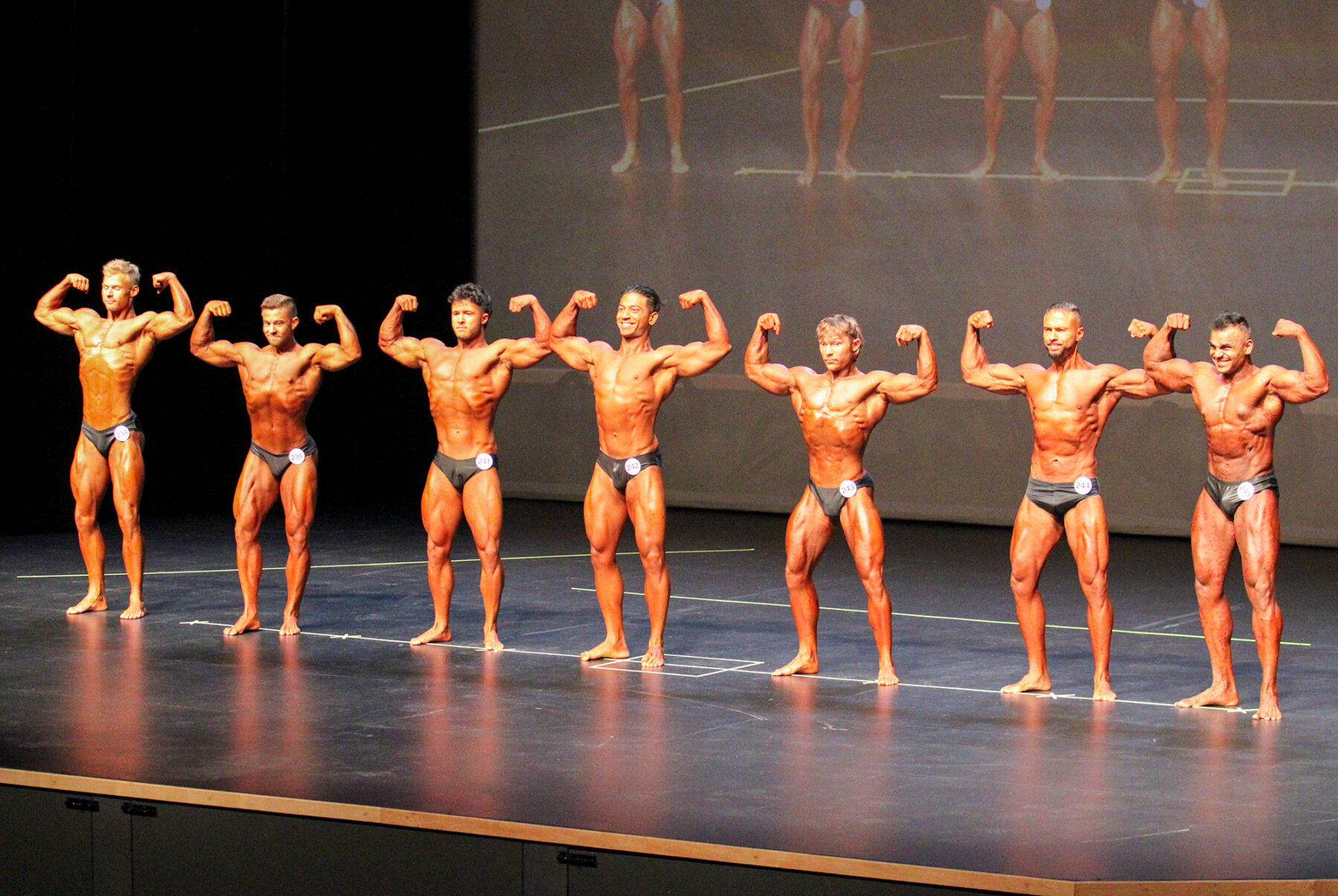
Different bodybuilding categories require different physiques according to Hache. Bodybuilding, for example, looks at muscularity, while physique categories value symmetry.
Different bodybuilding categories require different physiques, according to Hache. Bodybuilding, for example, looks at muscularity, while physique categories value symmetry. Photo credit: Claire Donnan

Contestants competed in a variety of categories of men’s and women’s bodybuilding, including men’s physique, wellness and swimsuit. Head judge and Canadian Physique Alliance president Ronald Hache said he was impressed with the turnout at the event.

“There was a couple of athletes on stage that I noticed, in men’s physique and classic physique that I feel are national quality,” said Hache.

So what does it take to become a bodybuilder? According to two contestants, it’s all about diet.

“I started (getting ready) probably 16 weeks ago, so four months,” said body building contestant Frederich Faust. “We slowly start tapering off the calories, keeping certain macros high like protein, and consistency is key here.”

Oneschuk agreed.

“I did 14 weeks of dieting … I started pretty high on calories so around 4,800 calories, and then cut it down to about 28 (hundred), which is pretty high still. Then, you know, working out six times a week, very detailed regimen,” said Oneschuk.

This was Faust’s first show, and he was pleased with his journey to the stage.

“I’m actually happy with it,” said Faust. “I’ve lost over a hundred pounds in the last year and a bit so no matter what it was a win.” Faust is also looking forward to competing again next year.

As for Oneschuk, his hope was to win a medal and move on to higher levels of competition. He ended up placing first in his category, and will be progressing forward in Men’s Physique, Open Class B, the competitive class for bodybuilders over five feet eight inches tall.

Eric Oneschuk doing his presentation for his category. After these competitions are over, he hopes to expand his workout regimen to potentially include bouldering and CrossFit.
Eric Oneschuk doing his presentation for his category. After these competitions are over, he hopes to expand his workout regimen to potentially include bouldering and CrossFit. Photo credit: Claire Donnan

Ultimately, Hache said he wants people to know bodybuilding is not a sport that’s limited to specific people.

“I wish people knew that it’s open to everyone,” said Hache. “We had competitors from the ages of 18, 19 to over 60. It’s really a transformation for a lot of people, it’s a healthy sport for those who enjoy working out.”

Cybersecurity Awareness Month highlights importance of guarding digital footprints

AC staff remind the community that cybersecurity isn't just about protecting yourself, but also your family and friends.
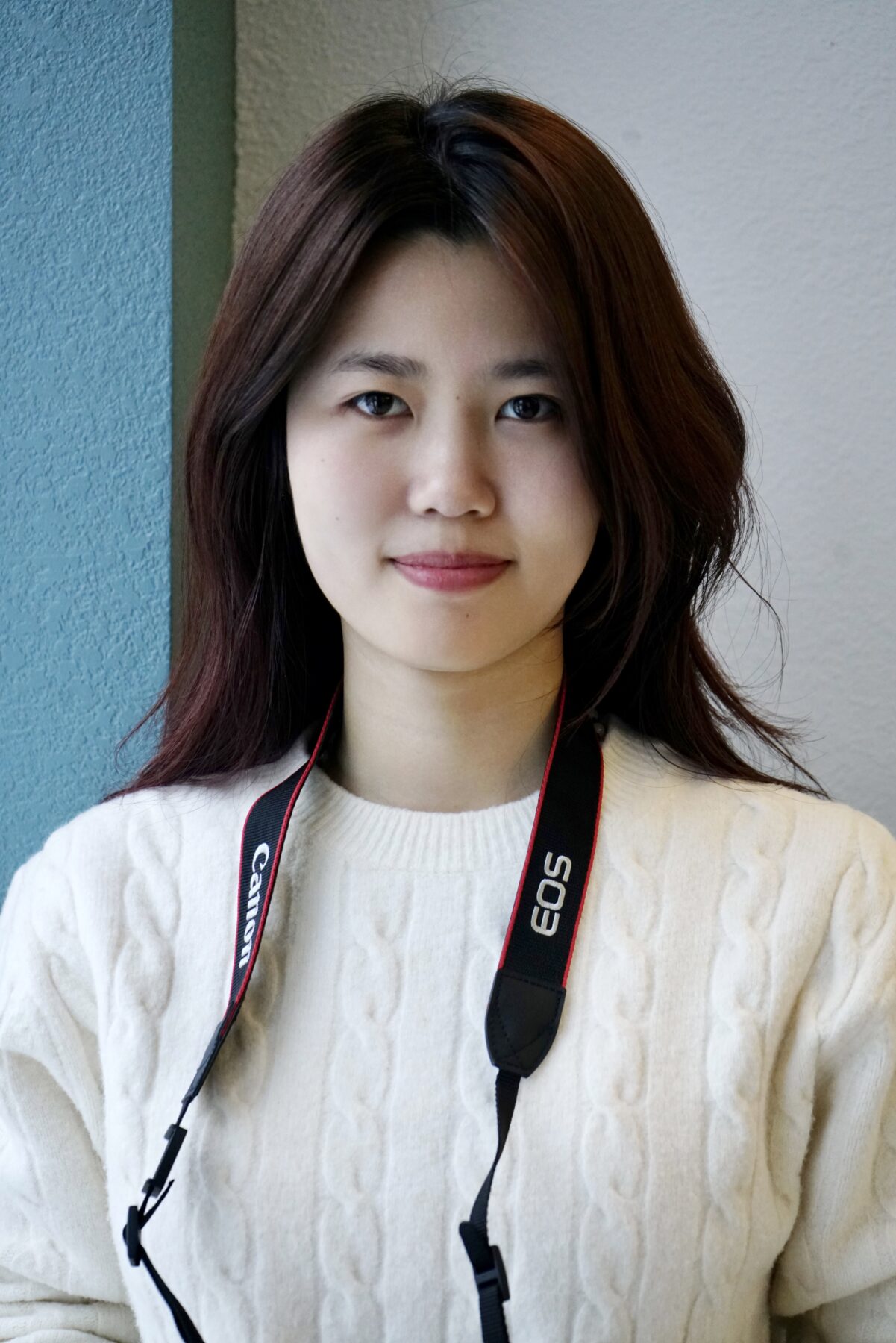
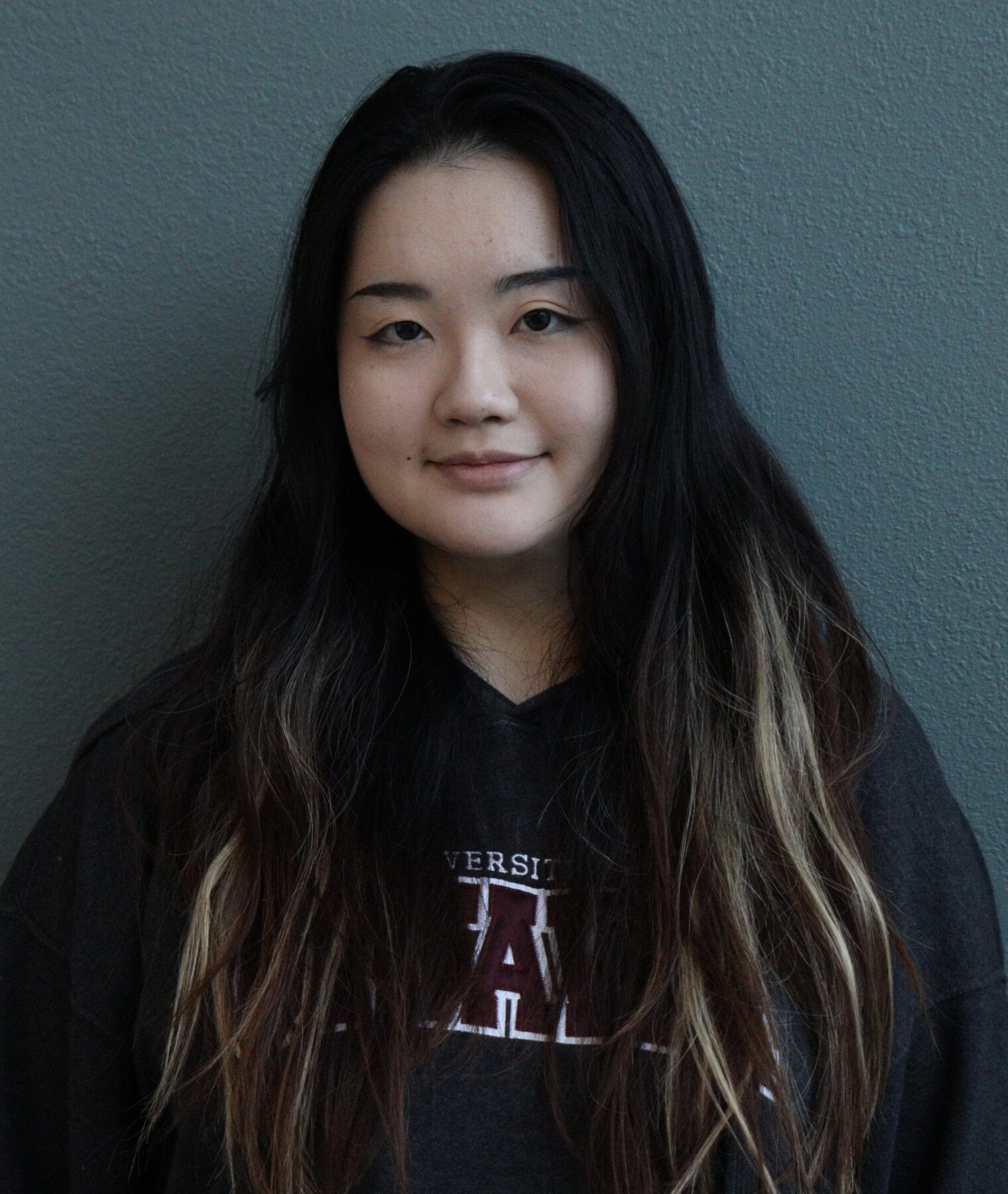
Photo: Zixuan Li
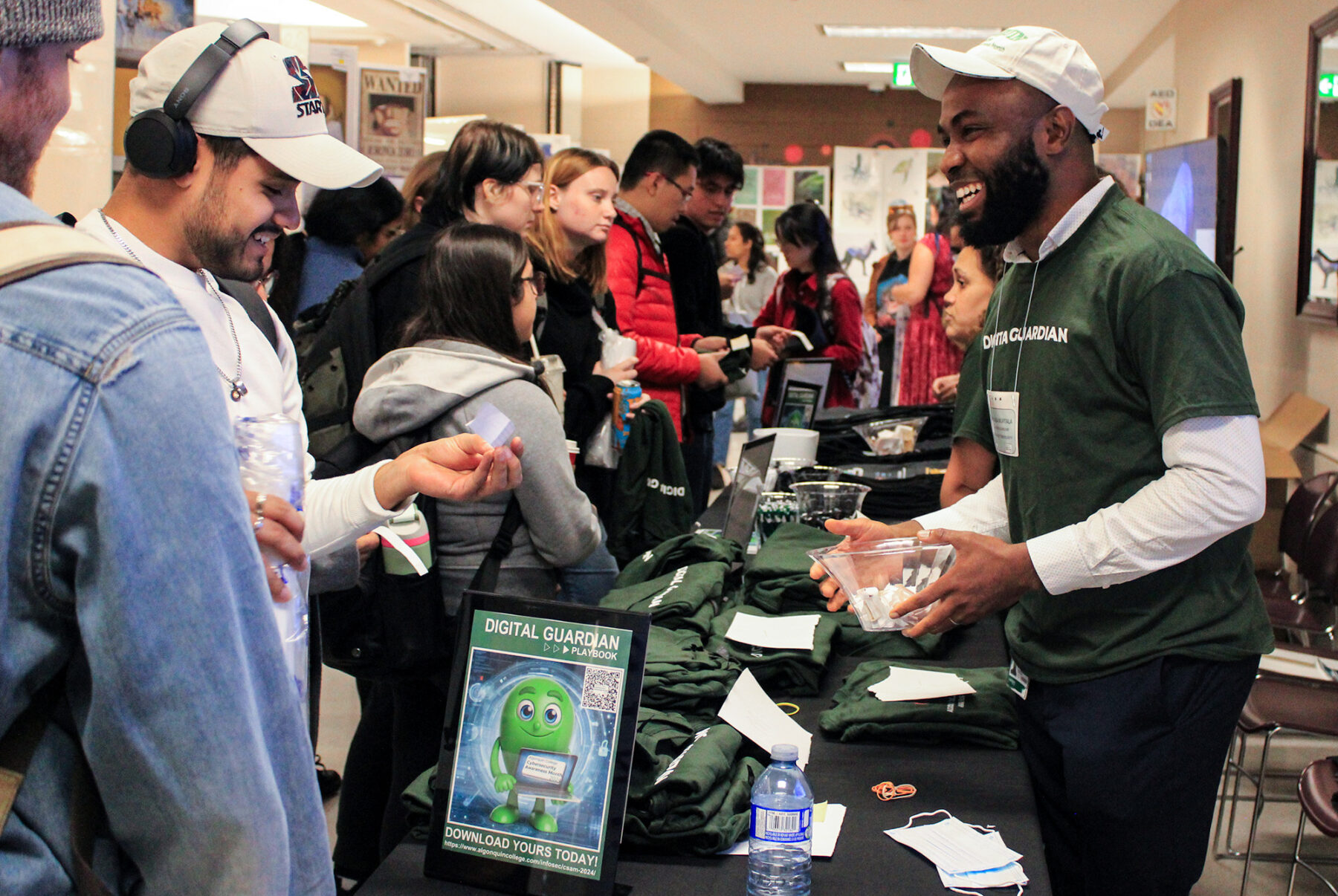
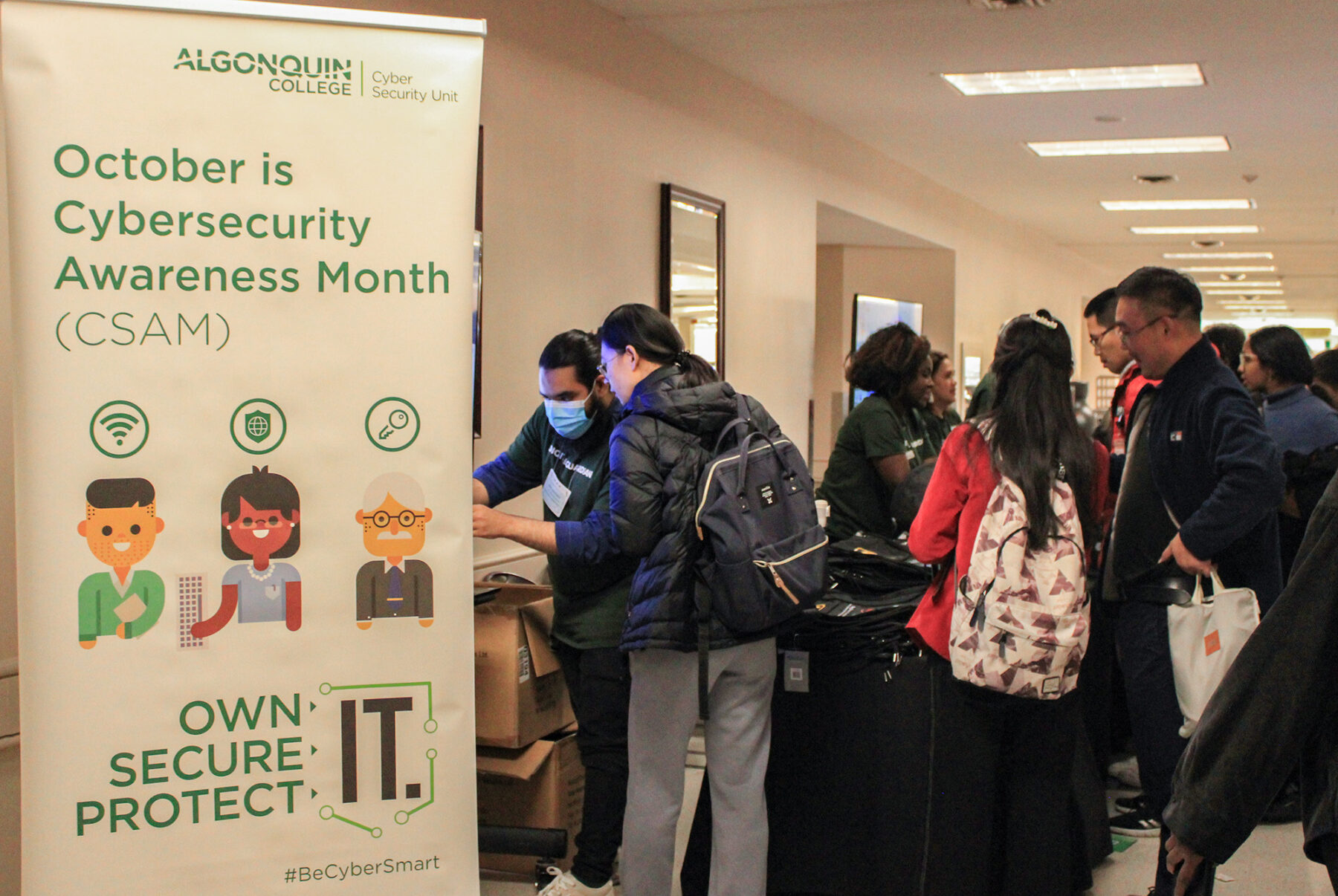
Damilola Murtala invited people to join the Q&A game at the cybersecurity booth at the Marketplace Food Court on Oct. 17.

When Daniel Mooney was a kid, he didn’t think twice about sharing personal details online. Like many people, he assumed the internet was a vast, anonymous space where his information would fade into the background.

But years later, someone who disliked him online called him on his birthday to harass him. The person tracked him down using personal information Mooney had shared in the past, leaving him unnerved.

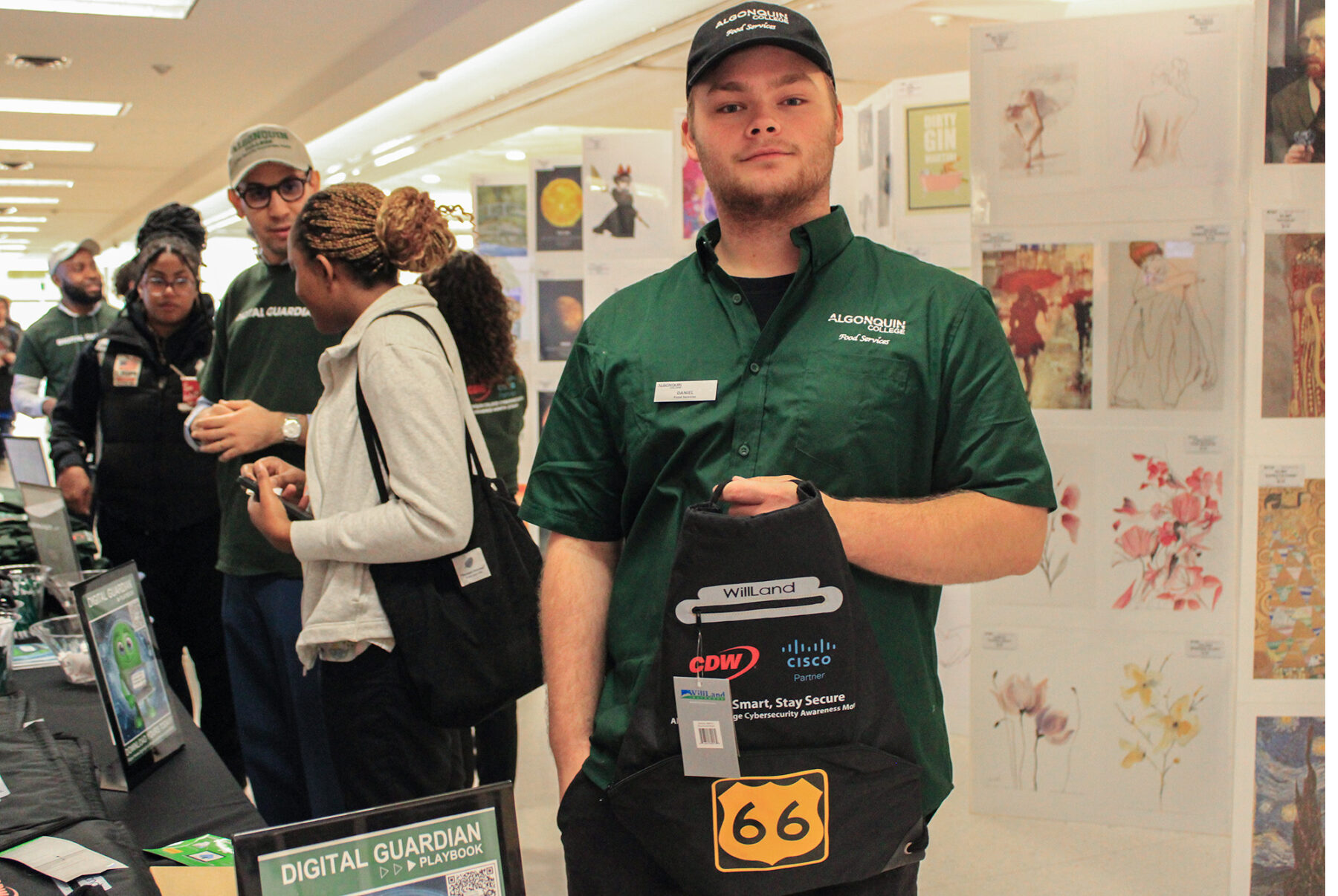
“People get information about you. And even though you don’t think at the time it can be used negatively, it’ll always come back,” said Mooney, a food service staff member at Algonquin College. “Nothing ever leaves the internet.”

Mooney’s experience reflects the consequence of careless digital habits. This October, Algonquin College launched Cybersecurity Awareness Month, aiming to offer students digital guardians and raise awareness about the threats in today’s interconnected world.

Daniel Mooney, a food service worker at the college, stands by the cybersecurity booth with the tote bag he won.
Daniel Mooney, a food service worker at the college, stands by the cybersecurity booth with the tote bag he won. Photo credit: Zixuan Li

Cybersecurity has become increasingly important. The consequences of careless online habits can go beyond a harassing phone call; they also lead to financial losses, data breaches and reputational damage.

Managing the digital footprint plays a key role in staying safe online.

“Your digital footprint essentially is what you leave of yourself when you’re moving around online,” said Yasmin Nissim, a senior privacy specialist at the college. “For students in particular, be really careful about what you’re posting and when you’re posting.”

While social media and online spaces are often seen as fleeting, Nissim said that deleted content is never truly gone.

“People can always take a screenshot. People can always download a photo,” she said. “And people who are your friends today, they may not be your friends tomorrow.”

Many people enjoy the convenience of using free Wi-Fi or leaving the computer alone at the library while going to the bathroom. “As nice as it is, you may end up paying a much higher price down the road,” said Nissim.

Managing digital footprints can help prevent experiences like the one Mooney had, but it is not enough. Always be cautious and think before clicking. Scams usually manipulate and trick people by rousing emotions.

“It’s trying to get you to click on something with urgency, with interest, or with concern, you know, like those calls that say, ‘Hey, we have your brother in jail, and you need to send $50 for bail,’” said Nissim. “It’s trying to get you in a state where your logic is out the window and you’re acting on emotion.”

Having the knowledge of scams helps people stay away from cyber threats. On Oct. 17, Information Security and Privacy, a team within the Information Technology Services Department at the college, hosted cybersecurity booths to educate students.

Algonquin College launched Cybersecurity Awareness Month at this October, promoting awareness of information privacy and cyber threats.
Algonquin College launched Cybersecurity Awareness Month this October, promoting awareness of information privacy and cyber threats. Photo credit: Zixuan Li

The booth invited participants to answer questions related to online privacy and cybersecurity. People who answered correctly got a tote bag or T-shirt and other small accessories. Beyond the prizes, people not only reinforced their existing knowledge but also gained a deeper understanding of cybersecurity.

“When I did the question, it was nice because it makes you recall all the things that you should always be aware of,” said Lorena Arroyo Perez, a Level 1 web development and internet applications student. “And they told me about this little thing that you can cover your webcam with. I didn’t know about that.”

Armed with cybersecurity knowledge, Mooney is not only less likely to receive harassing phone calls, but he and his friends can also enjoy a safer online space

“It’s other people in my friend circle getting hacked and trying to then use those accounts to try and get information off of the person,” said Mooney.

“It’s a very common thing that a lot of people fall for because especially if it’s a friend of yours and they’re sending you information, you’ll generally trust them, which is where those scams come from,” he said.

Men’s soccer Wolves scoop up awards, ground the Falcons and continue quest for medals

After being down 1-0 at halftime, the Wolves came back to win 2-1 and secure their spot in the semifinals
Photo: James Gray
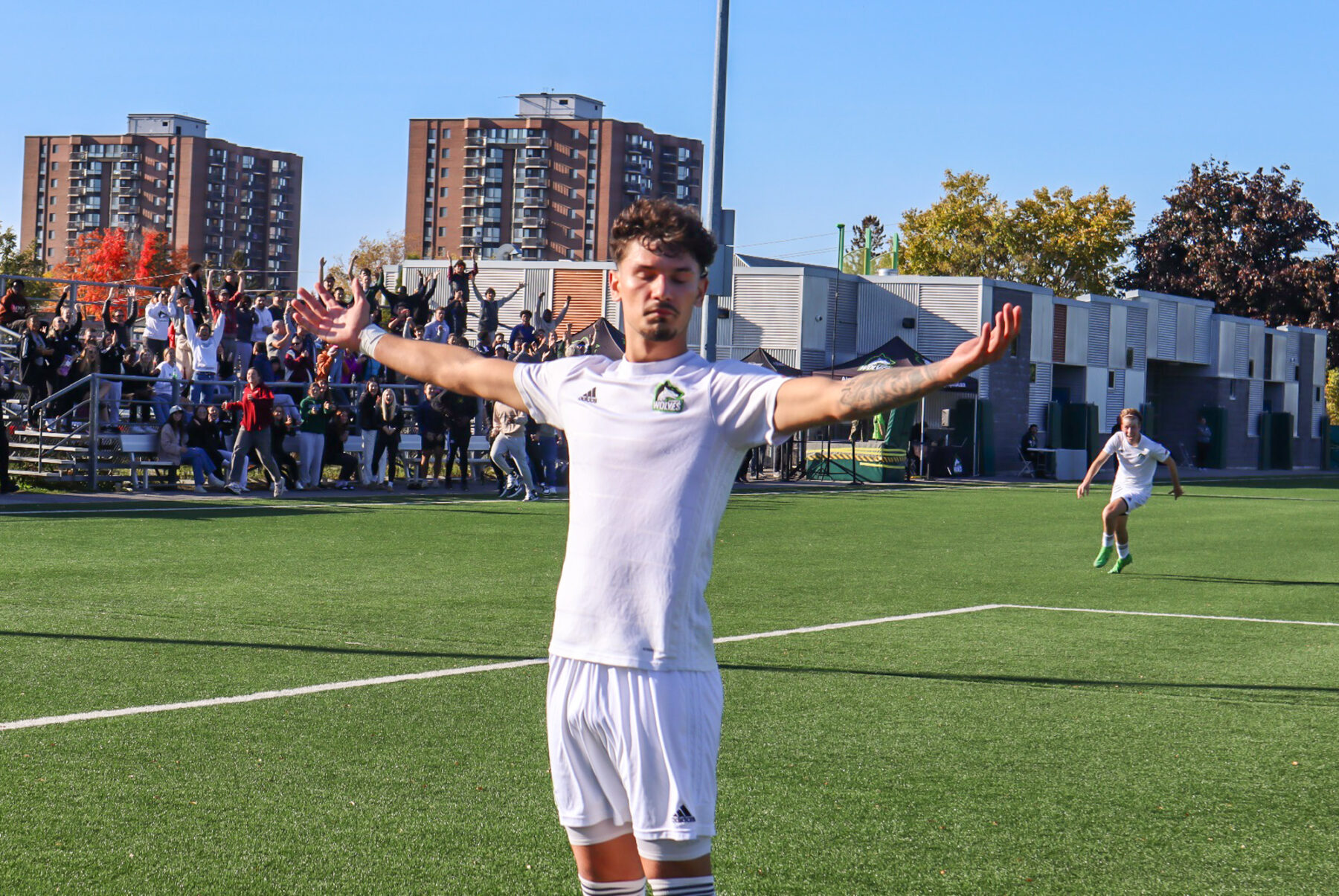
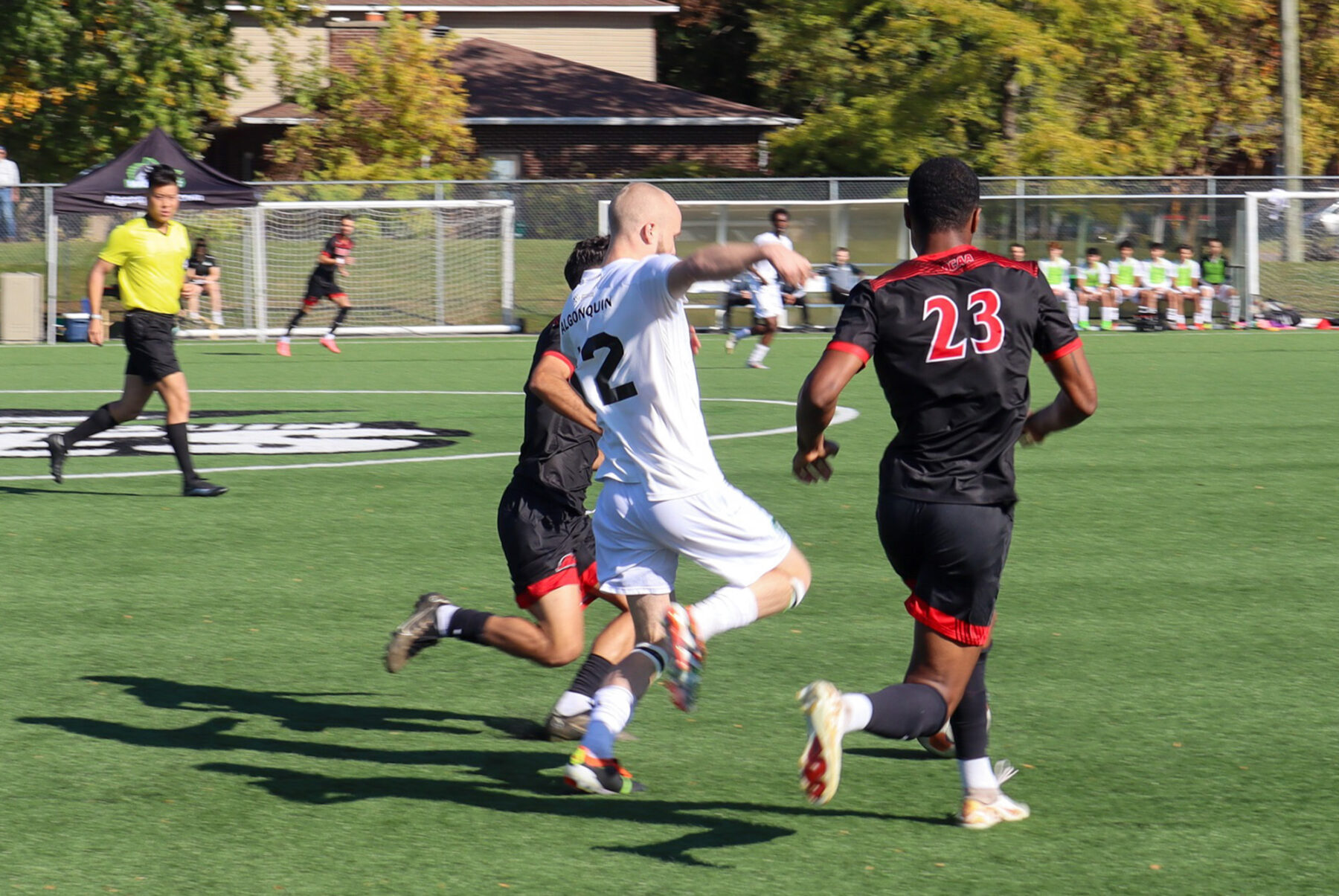
Centreback Alessandro Vivolo poses after scoring the winning goal for the Algonquin Wolves. His teammate Connor David runs up in the background.

After a comeback win against Fanshawe, the Algonquin Wolves have booked their ride to the men’s soccer semifinals.

The quarter-final match on Oct. 19 took place on a warm and dry midday at the Z-building field. The Fanshawe Falcons led for much of the game, but Algonquin walked away as victors with a score of 2-1.

The game saw aggressive play right from the get-go. When Algonquin made an attempt on goal in the third minute, Falcons goalie Dylan DaSilva exhorted his team, “Come on, wake the f— up!”

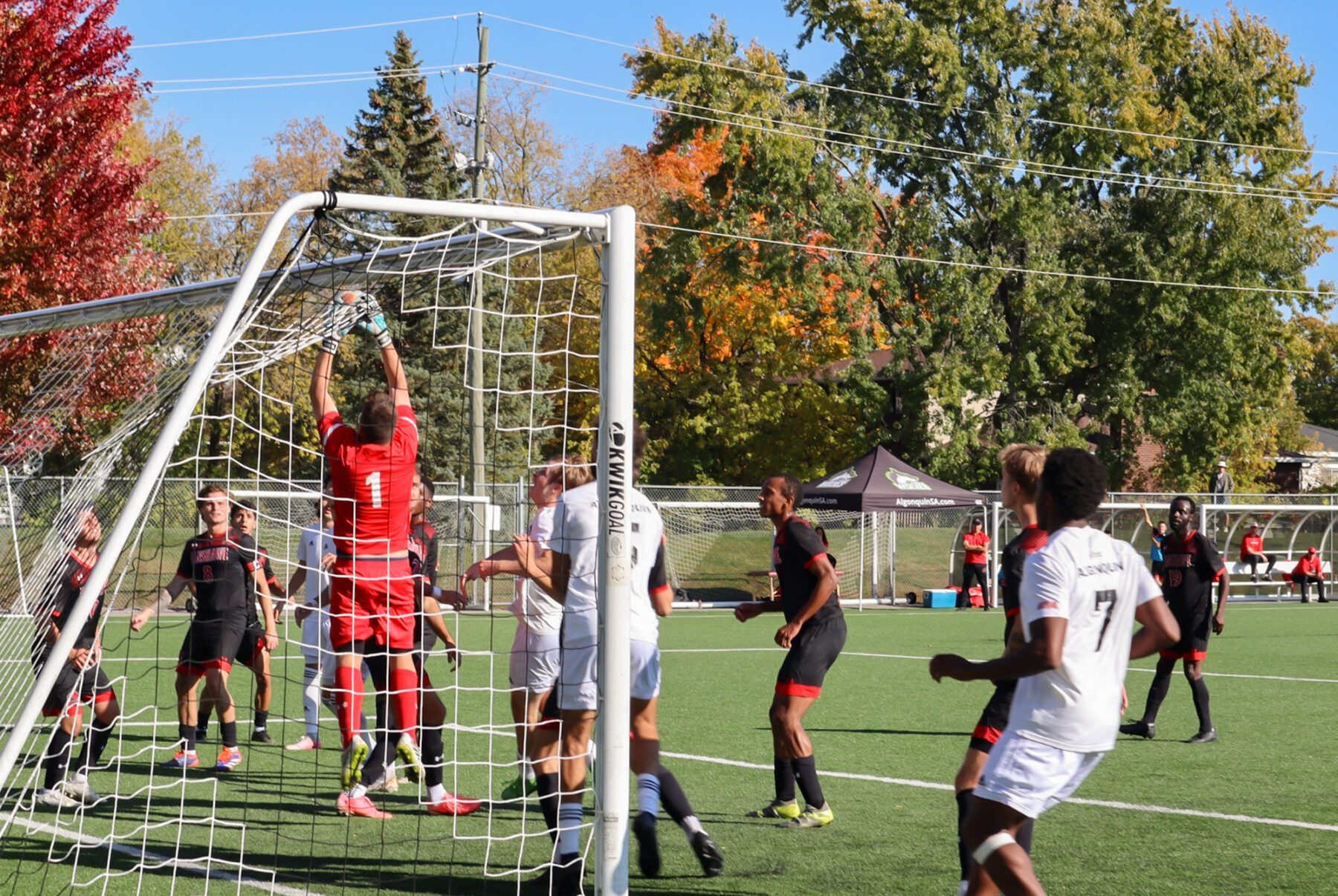
Two minutes later, they proved they listened. From a corner kick by Dante D’Oria, the Falcons’ Mateja Milidrag jumped high and scored with a header to give them the lead.

In the locker room at halftime, Algonquin was down 1-0. But they came back out with new energy, relentlessly pushing into Fanshawe’s half.

At 58 minutes, after four consecutive Algonquin corner kicks and throw-ins, Gershom Dupuy finally headed one in to score for the Wolves.

This gave the team new life and they pressed even more passionately.

Fanshawe's Dylan DaSilva jumps to secure a corner-kicked ball.
Fanshawe's Dylan DaSilva jumps to secure a corner-kicked ball. Photo credit: James Gray

An apparent turning point for the Falcons was at 67 minutes, when defender Carlos Cabral was injured and had to leave the field.

The hammer fell on Fanshawe at 70 minutes. Wolves striker Jaeden Mercure intercepted a flying ball and approached the net while several Falcons moved in on him. Mercure then passed to teammate Alessandro Vivolo, who had slipped his guard, and Vivolo quickly struck a long shot across the box and into the goal.

The Wolves kept up a hearty offence and strong defence to win the game.

“I thought we played a good first half,” said Rob Perreira, head coach of the Fanshawe Falcons. “Second half, we started to succumb to injuries, some of the calls didn’t go our way. It was a good, hard-fought game.”

He said that if he could go back to the start of the match, there’s nothing he would have done differently.

With the victory, the Wolves advance to the semi-finals of the Ontario Colleges Athletic Association Men’s Soccer Championships. Their opponent: the Sheridan Bruins on Oct. 25.

If Algonquin wins, they will face Seneca or Humber for the gold, while if they lose, they will face the other of those for the bronze. The medal games are on Oct. 26, all hosted by Humber College.

Before the game, there was a presentation of awards from the OCAA. Angus Wong, the Wolves’ head coach, was named Men’s Soccer Coach of the Year.

In an interview after the game, Wong was keen to thank his players and fellow coaches: “It’s important to me that the staff is recognized for all the hard work that they do … I’m extremely honoured and happy to share that award with them. I tell the team as well that it’s a team award …(OCAA personnel) see the end product, and that’s the team.”

Algonquin's Oscar Forward (centre) about to kick a ball away from Fanshawe's Bilal El Said (left) and Ethan Gebremicael (right).
Algonquin's Oscar Forward (centre) about to kick a ball away from Fanshawe's Bilal El Said (left) and Ethan Gebremicael (right). Photo credit: James Gray

The Wolves are East Division Champions for having the most wins of the regular season, and were also named the division’s Best Defensive Team.

Algonquin’s Cristian Aviles-Molina, Jaeden Mercure and Nicholas Parry were named to the East Division First Team All-Stars. Claude Byilingiro, Oscar Forward and Kerim Tosun are Second Team All-Stars. Arebi Halab is on the division’s All-Rookie Team.

As the Wolves prepare to visit Humber, they know that the program hasn’t won a medal since 2018, when they took silver. The last gold was in 2015.

When asked about his strategy for the final games, Wong was cagey.

But he did say that “we will try to play with the same identity and principles that we’ve been training with, and that well represents this program.”

Men’s soccer Wolves edge out Cambrian in 1-0 victory

Wolves' second-half goal secures win in hard-fought match
Photo: Korbin Amaya
The Wolves and the Golden Shields leap forward and defend the ball.

In a tightly challenged game on Oct. 12 at the Z-building field, the Algonquin Wolves edged out the Cambrian Golden Shield with a 1-0 victory, securing a vital win in OCAA men’s soccer.

The game remained goalless through the first half, but a second-half strike from Gershom Dupuy, assisted by Jaeden Mercure, sealed the match for the Wolves.

The Wolves and the Golden Shields struggled to find an early rhythm as solid defensive efforts and a series of fouls marked the first half.

The Wolves and the Golden Shields run forward and defend the ball.
The Wolves and the Golden Shields run forward and defend the ball. Photo credit: Korbin Amaya

The teams racked up yellow cards, with the Wolves’ Nicholas Parry, Kerim Tosun and Oscar Forward among those booked.

The Golden Shields were no different, with Michael Karikari, Musa Joof and Nana Wiafe Owusu also receiving cautions.

The match’s decisive moment came in the 70th minute when Jaeden Mercure delivered an assist to Gershom Dupuy, who pushed the ball past Cambrian goalkeeper Aiden Adonu.

Despite 11 shots on goal, the Wolves could only capitalize on this single chance, while Cambrian struggled offensively with only five shots, none of which could breach Algonquin’s goalkeeper, Parry.

Game stats

Shots: Algonquin dominated with eleven shots compared to Cambrian’s five.

Saves: Aiden Adonu made ten saves for Cambrian, keeping his team in the game despite the pressure.

Fouls: The match saw a flurry of yellow cards, with nine cautions issued, adding to the atmosphere.

Corners: Algonquin also held the edge in corner kicks, taking five compared to Cambrian’s three.

First Person: Feeling overwhelmed as an international student is common

If you're feeling the pressure of adapting to life here in Ottawa, take heart: you've been brilliant and brave. While many international students deal with with tough times, helpful people are out there
Zhiqi Zhou, who is in her seventh year of studying in Canada, says she has come a long way. "Every time I think of this experience, I always marvel at my own experience and growth," she writes.

After a 30-hour flight from Beijing to Winnipeg, I arrived at my new study place, a high school beside the Red River. After my parents and auntie talked it over, although I was just15 years old, I would spend time with my cousin studying abroad in Canada.

I was looking forward to meeting my new classmates and began to envision my future life as a high school student in Canada. But things didn’t start out as I thought.

I’m sure every international student goes through the same tough times. While today, I know that there are many people out there who can help you, teenage-me struggled in those early days.

First off, the school wasn’t what I thought it would be. Compared to my school in China, the building of this high school looked short. Also, the hallway was furnished with lockers for students to use, but we don’t have them in China. Students are asked to keep their things neatly in the classroom.

Upon entering the classroom I saw students sitting casually in their chairs and some were eating nachos in their hands. This was another shock to me because it’s not allowed at all in China, well at least in my city. Eating and drinking in class is seen as a sign of not respecting the teacher enough.

I asked the teacher politely for my seat, but he said to sit wherever I wanted. I could feel the teacher’s kindness, but he spoke too quickly for me to fully understand with my sparse English vocabulary and basic grammar.

This day was torturous for me, this was completely different from the first day of school which I was looking forward to. I couldn’t understand what the teachers were saying in class, I didn’t understand the jokes the teachers were telling when they were interacting with the students. I was the only one sitting in silence while everyone was laughing. I felt like I didn’t belong there.

Seeing everyone sitting with their friends at lunch, I had to run to the library and pretend to be busy to ease the embarrassment. When I got home I couldn’t take the overwhelming emotions any longer and broke down crying in my room.

In the evening I got a video call from my mum and I finally got a chance to speak Chinese. I cried to my mum and told her I didn’t like it here and I wanted to go home. While don’t really remember what she said, she just kept comforting me.

Later, I realised how upset she felt when she heard me break down. “I felt so sorry for you,” my mum said. “I made a big decision to let you go to a strange country by yourself at such a young age. I thought you would adapt well to life there but I didn’t realize it would make you so sad.”

Things took a good turn in the next day. When I entered the ESL class I felt a different atmosphere. I saw that there were international students like me in the class, and even though we came from various countries, we seemed to share a common feeling.

I quickly became friends with them, and we expressed our feelings and comforted each other in our poor English. I didn’t worry about saying anything wrong when talking with them because they always understood.

With the help of my ESL teacher, I began to adapt to school life. I started to communicate with other teachers and students, and I completed my first quiz on my own. Although the results were poor, I did it. What went up on the test paper was not only the score but also my confidence in life and learning.

The new term at Algonquin College has started and if you’re a new international student, I know you are probably going through a tough time right now. But the school will offer you a lot of help.

Philip Olayori, an international student in the business management and entrepreneurship program, is now a mentor for the International Peer Mentors program offered by the International Education Centre. He says he understands the stress of this culture shock. The IEC organises a number of activities to help new students settle in more quickly.

“We welcome all international students to join us and take part in our activities such as coffee breaks to enable international students to get to know each other and help each other,” Olayori said.

Please remember: if you’re feeling the pressure of adapting to life here in Ottawa, it’s not your fault. You’ve been brilliant and brave. You’re going through the tough times that all international students are dealing with.

Xinyan Chen, a level-1 student in interactive media design, said she had a similar experience to me when she first came abroad.

“Local students speak very quickly and it can be difficult to fully understand full English lectures at first,” she said. “But this aspect will improve over time as well.”

This is my seventh year studying in Canada, and every time I think of this experience, I always marvel at my own experience and growth. I am now fully settled into life in Canada and have made a lot of friends. Things are already starting to move on in the direction I’m looking forward to, and if I can do it, then you will definitely do fine too.

First Person: Lost in Tijuana

I found myself marooned in the shadow of a dream - the dream of a woman. She moved with a grace and beauty that men would fight wars over
Street art found along the Playas de Tijuana Boardwalk in Tijuana, Mexico. “We sometimes encounter people, even perfect strangers, who begin to interest us at first sight, somehow suddenly, all at once, before a word has been spoken.” - Fyodor Dostoyevsky, Crime and Punishment.

This story doesn’t start the night she spent hours with an incorrectly spelled name trying to find me on social media. It doesn’t start the next morning when I followed her back on Instagram. And it doesn’t start hours later when I sat in the airport making her a playlist on Spotify.

This story begins a week earlier, in the lobby of a Tijuana hotel, when I found myself entranced in the song of a siren named Michelle.

Russian novelist Fyodor Dostoyevsky once penned, “But how could you live and have no story to tell?” His words ring true, as there are many stories contained within the chapters of my life. Those stories, the trials and tales of my existence, likewise with yours, are those of the human condition. For though it may pain me to admit, I am as human as us all.

After travelling to Mexico, I arrived at my hotel. I don’t remember the receptionist who checked me in, but I do remember who was standing beside them. As Michelle walked up to the adjacent counter, her coworker’s voice quickly dampened into Charlie Brown noises. She moved with a grace and beauty that men would fight wars over.

I spent the next week frequenting the front desk to buy candy bars and bottles of water I didn’t need. At the end of my stay, I prepared to head home. If you asked why there was nothing more than a series of three-word exchanges, I could lie but the truth is… goddamn, she was pretty and I was nervous.

Then she found me.

It’d be nice if I could say my intentions were noble from the start, and a better man might be able to. But I’m not a better man. What I can say is that she made me want to be one. I’m not sure the exact moment it happened, but it did.

For weeks I’d stay up till she got off work so we could begin our conversations at 2 a.m. I’d drift away and wake up to her still, there on my screen, asleep in her beauty. Despite the miles and borders between us, she felt closer than I’d ever known.

Now, I’d like to make something clear: this story was never meant to be a fairytale, and I didn’t want it to be. I’m not prince charming, I’m Clyde Barrow. I don’t want a fairytale; I want Bonnie. I want to roll the fuckin bones. I want someone who’s gunna ride.

It seemed I may have found her.

Sometimes time the jagged edges of two broken parts fit together, but sometimes they only create friction. Unfortunately, this isn’t a redemption story of a broken man finding his missing pieces in a woman. It’s a story of him watching the filth seep between his fingers and leak down his arm as his own Midas touch turns what he grasps to shit.

Like so many times before, it ended. Then I burned the bridge. But for reasons I’d yet to discern, this time it hurt.

“Always the same. Now a spark of hope flashes up, then a sea of despair rages, and always pain; always pain, always despair, and always the same.” - Leo Tolstoy, The Death of Ivan Ilych

I needed to think. Calling upon the spirit of mother nature, I consumed 8 grams of her primitive sacrament and embarked on a not so brisk 3 a.m. walk. I left the front door of my home and wandered into the darkness.

With a self awareness only found under the guidance of psilocybin I starred into the abys. Staring back at me I was confronted with the all-too-human voices I’d long buried in my unconscious. Screaming voices, refusing to be ignored, insisted that the Tin Man does have a heart.

In the morning I booked a plane ticket back to Tijuana.

We reconnected and spent the week together in an Airbnb by the beach. But like Chekov’s gun, her words began to betrayed her. Every word, every utterance, spoken or withheld, is a choice. An insight to a thought, a pattern, a behavior.

She shared her city, her spirit and her body, but not her soul. That she kept for herself. It became clear the woman who told me she wanted her other half didn’t know what she wanted. I wasn’t the only one broken. Our jagged parts didn’t fit, so I ended it.

Flying home in the wake of a faded mirage, I questioned what was real and was the product of a lullaby. But while it may be easy to pound my chest and add to the voices in the pit, I felt what I felt, and I know what it was. It seems I’ve simply been confronted with a tragic wisdom contained in the novels of Fyodor Dostoyevsky’s The Brothers Karamazov: “Love in action is a harsh and dreadful thing compared to love in dreams.”

Before I met her I was content with the vapid and meaningless. I’m now more lost then when I started. I don’t think I want someone else, and I don’t know if I want her. But I do know I can’t have her, because she has herself.

I miss the smell of her hair, and the warmth of her body. I miss the way she talks, her voice, her accent. I miss the way she moves. I miss her touch. I miss talking on the phone until daylight reminds me to sleep. I miss hope. I miss waking up happy. I miss what I remember, and I’m enticed to wish I could forget. But I don’t.

A view of the city from the Airbnb.
"As far as we can discern, the sole purpose of human existence is to kindle a light in the darkness of mere being" - Carl Jung
A view of the city from the Airbnb.

"As far as we can discern, the sole purpose of human existence is to kindle a light in the darkness of mere being" - Carl Jung

Board of Directors releases priorities for the 2024-25 academic period

Academics, transportation and mental health are among the top priorities for students
Photo: Francois Belanger, Marilena Postolache, Josh Ansaldo, Maria Silveira, Emily MacDonald, Kaitlynd Richard, Yannis Affoum Photo credit
The SA Board of Directors from left to right

Over the summer, the Algonquin College Students’ Association Board of Directors spent over 150 hours collecting feedback from students to see what issues they care about most.

They then discussed the results and decided on three priorities for the 2024-25 academic year: academics, transportation and mental health. Here’s what you need to know:

Academic Quality

The BOD will work closely with Julie Beauchamp, senior vice president academic at Algonquin College, to ensure the curriculum is updated and that students have the proper knowledge to gain employment in an evolving job market.

Maria Silveira, president of the SA, said the BOD will focus on resources the college can provide for co-op and job support programs, based on feedback from students.

“We hope that in the near future we will have a progress report or information to share with the students,” Silveira said.

Transportation Availability

Transportation is an issue that affects many students because it impacts the overall student experience, according to Silveira.

“Myself, I rely on OC Transpo and we know it can be unreliable and we can struggle with it sometimes, and in Perth and Pembroke, our smaller campuses, there are no public transit options at all,” said Silveira.

Because of the lack of transportation in Perth and Pembroke, those students are required to get to campus using other methods, including driving and walking.

The BOD will work with community leaders to advocate for transit options for those campuses, as well as OC Transpo for more reliable transportation in Ottawa.

Ayden Dorman, a first-year computer engineering technology student at the Ottawa campus, said transportation would be his top priority of the three.

“I’ve got a few people in my class who’ve complained about having trouble getting to school on time,” Dorman said.

Mental Wellness

The BOD wants to make sure the support services being offered match the specific needs of students.

They will work on a system to lower wait times for counselling services and provide more effective support to all students.

Arlo Jordan, a second-year business management and entrepreneurship student, believes mental health is an important issue for the SA to address because it’s been a growing problem since the COVID-19 pandemic.

“The mere fact that they’re going to address mental health is really awesome, because many students have had mental health problems as of late,” Jordan said.

International students, far from home, grateful for harvest dinner on campus

The Thanksgiving dinner was a celebration of a Canadian cultural experience
Photo: Linda Verreault
A group of Intenational students that quickly became friends at the dinner.

InterVarsity hosted a Thanksgiving dinner for international students in the AC Hub on Oct. 11, creating a warm, welcoming atmosphere to celebrate a Canadian cultural experience.

Carmen Hurst, 61, is a volunteer at the college and a former teacher in the nursing program.

“They are international students who are far from home and so having a traditional meal…(and) Thanksgiving tradition is just exciting,” said Hurst.

InterVarsity held a contest to see which student was farthest from home. Some students from Hong Kong were 12,400 kilometers from home.

“We had lots of fun. Awesome. It’s a good place to make friends. It was a great dinner,” said CiCi Ruan, 36, a construction engineering student.

Christy Dagenais, 41, is a campus minister with InterVarsity, a non-profit organization that is a faith community on campus. It’s an official club that is student-led and gets involved through the Spiritual Centre with college departments.

InterVarsity is active on campus and provides creative prayer and discussions on faith that allows for dialogue and shared opinions. They also provide a traditional Bible study.

“Intervarsity is both active for students that are practising the Christian faith and those that are also curious about faith and want a safe place to talk about it,” said Dagenais.

Thanksgiving is a time to be grateful and students sat in a gratitude circle to share what they were thankful for.

“Family, because they were always there for me and I was there for them,” said Mohamed Taous, 23, a student in the web design program.

Students who are far from home expressed their gratitude for the event.

“I think events like this are important for the international community. It’s like a door that opens into this new country… it’s like a hug,” said Abigail Soto, a computer system technician programming student.

Beautifully decorated pie entered in the pie tasting contest.
A beautifully decorated pie entered in the pie tasting contest. Photo credit: Linda Verreault

They also held a pie-making contest with prizes for the best looking and best tasting pie. This was hilarious as some rushed to make their pie only to realize they had 15 minutes to make it. The crowd was boisterous as they drummed on the tabletops waiting for the announcement of who won. There were prizes of Tim Horton gift cards.

The event was a huge success, and some participants even got to leave with a pumpkin pie at the end of the evening.

Algonquin Times podcast

Stay Informed

Sign up for our newsletter

Subscribe

* indicates required