main

What Algonquin College students should know about the Indian farmer protests

For months now, thousands of peaceful protesters have been spotted at large intersections around Ottawa to oppose the Indian agricultural acts that received parliamentary assent this past fall. Among them […]
Photo: Tamara Condie
Guru Boparai, right, an Algonquin College graduate, and fellow protesters across from the High Commission of India on Springfield Road.

For months now, thousands of peaceful protesters have been spotted at large intersections around Ottawa to oppose the Indian agricultural acts that received parliamentary assent this past fall.

Among them are members of the Algonquin College community.

“On weekends there are different intersections where people stand with banners in their hands — mostly at Greenbank and Strandherd, and the High Commission of India,” said 26-year-old Gehargeet Grewal who is completing his paralegal graduate certificate at Algonquin College.

What has protesters upset, explains Grewal, is that for the past half-century India has had a marketplace system in place called a “mandi,” where farmers went to buy and sell crops as a Minimum Support Price (MSP). Now, privatization will change this agrarian economy and leave Indian farmers at a disadvantage.

“Farmers won’t be getting their set price for the growing of the crop they have invested so much into and the government isn’t doing anything about it,” said Grewal.

The three new farming bills affecting this change were passed through the lower and upper parliamentary houses of India on Sept. 20, 2020 — the former house is called the Lok Sabha and the latter house is called the Rajya Sabha.

These bills have created a watershed moment for the agricultural sales landscape in India. They consist of the three sections. The first, the Farmers’ Produce Trade and Commerce Act, expands the scope of farmers’ trading and levies market fees from the government. The second, the Farmers’ Agreement on Price Assurance and Farm Services Act, highlights the legal framework for farmers entering into contracts with private companies. And the third, the Essential Commodities Act, allows the government to regulate the price of essential commodities in the case of a state emergency.

According to Rishabh Verma, an 18-year-old level one business administration student at Algonquin College, the main concern for farmers is that these new bills scrapped the MSP that provided especially smaller farmers with some degree of financial security under the mandi system.

“The Indian government is giving all of the power to industry houses so that they can own more profits and it will ultimately hurt the common public of India,” said Verma.

Verma is completing his Algonquin College diploma remotely from his hometown, Khanna, in Punjab amid the largest hub of protesting action in India.

“I got involved, along with many youth, in the protests for almost two days,” said Verma. “The protests are happening on our main national highway — Grand Trunk Road — which connects all the parts of the country to Delhi, where people can protest near politicians and Prime Minister Modi.”

According to Verma, these protests are far from wrapping up. The government, he explains, has yet to respond to the demands of the protesters and the contentious relationship between the government and protesters continues to elevate.

Here in Canada, Grewal is watching the events unfold from afar.

“The government is asking the police to fire tear gas and water cannons on the protesters to try and evacuate them,” said Grewal. “The situation keeps getting worse and worse in order to put the blame on the farmers.”

In light of the worsening situation in India, many international students and other protesters located in Ottawa have shown their support to Indian farmers from abroad.

International support, Grewal and Verma both explained, is at the heart of the success of these protests and that participating Canadians should continue to do what they’re doing to help raise awareness for this significant human rights demonstration.

“Silence is the best weapon,” said Grewal. “If a person is silently sitting and protesting and not causing harm you can’t use force on them.”

Verma believes that Canada has the potential to be a huge asset for affecting change in India.

“Canada is the main hub for this rally right now,” said Verma. “It is very difficult for Indian protesters here to live on the roads in 2 C weather — if the laws are not abolished, then the farming industry in India will be finished.”

No decisions yet about mandatory vaccines for healthcare staff and students

Medical students studying and working in high-risk areas of hospitals and long-term health care have been included in Phase One of the vaccine rollout, however a decision to make vaccinations […]
Photo: Roberto Iraheta
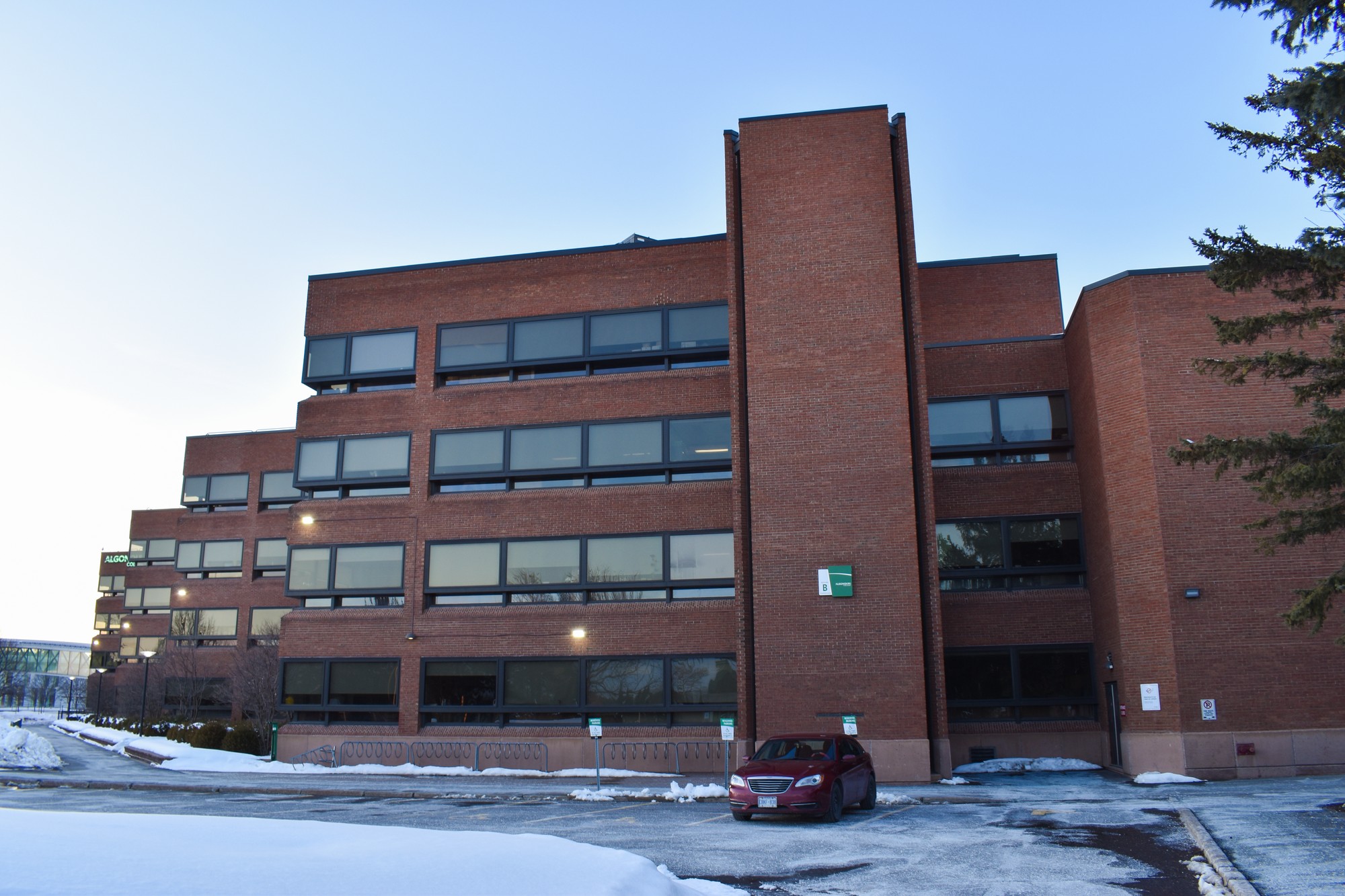
The B-building is where many nursing students study and prepare for their future careers.

Medical students studying and working in high-risk areas of hospitals and long-term health care have been included in Phase One of the vaccine rollout, however a decision to make vaccinations mandatory remains unclear.

Currently this term Algonquin College has 461 practical nursing students and 420 Bachelor of Science Nursing students enrolled in placements.

Karen Ball, chair of nursing at Algonquin College, and member of the Eastern Ontario Academic Health Sciences Network Task Force, said health officials have begun to discuss whether this will be something to consider in the future for all healthcare workers.

“They haven’t decided if it’s going to be if you work in long-term care you’re required to have it like they do for the flu shot or if it’s going to be something that you don’t have to have,” said Ball. “But if you don’t have it then you can’t work in certain places. They haven’t figured that out yet.”

The Ottawa Hospital following guidance from the Ministry of Health and Ottawa Public Health, currently oversee the rolling out of vaccinations and administer shots to any medical students who fall under the high-risk category.

The rollout will continue to remain focused towards those considered at highest risk of exposure to COVID-19 until Phase Two, which is set to begin in April 2021.

Those who are currently considered to be high-risk are those in critical care units, emergency departments, COVID-19 medical units, rapid response teams, general internal medicine, and all patient-facing health care workers involved in the COVID-19 response.

“The prioritization is based on risk to the individual,” said Dr. Regis Vaillancourt, director of pharmacy at CHEO and a member of the COVID-19 Task Force.

“They have put the very high-risk units – which are the units that will receive COVID positive patients and everybody who works in that unit to be on high priority to get the vaccine,” said Vaillancourt.

There is also the issue of privacy – another aspect that will need to be reviewed and considered when discussing vaccinations, said Ball.

“There are a lot of legal issues around that and people’s right to refuse. I’m sure there are a lot of very highly paid people right now trying to sort that out,” said Ball.

Currently the Ministry of Health has mapped out a ethical framework for the COVID-19 vaccine distribution following five different principles: Minimizing harm and maximizing benefits, equity, fairness, transparency and legitimacy.

As second-year nursing students prepare for the real world through placement, some feel that vaccines should be mandatory.

“We’re working with the same people that full-time staff are, said Chris Hammar, 27, a second-year nursing student. “Obviously we aren’t there the same amount, but viruses don’t care how long you’re somewhere.”

And as the warmer months approach, many students will spend even more time in health care settings.

“As summer approaches and for us to continue to train and to be the best nurse that we can be and provide our skill set to a vulnerable population – I think the faster we can get vaccinated the better off it’s going to be,” said Hammar.

Ottawa Public Health has received 69,187 doses with 80,540 shots administered to date.

Three candidates in the running for academic staff position on board

Community members will have the opportunity to vote for one of three candidates running for the position of academic staff representative to the Algonquin board of governors between March 10 […]
There are three candidates for academic representative for the Algonquin board of governors.

Community members will have the opportunity to vote for one of three candidates running for the position of academic staff representative to the Algonquin board of governors between March 10 and March 11.

In order to help the community get to know Anna Labelle, Jonathan Parker and Rebecca Wakelin, the candidates running for the position, The Algonquin Times interviewed them in late February.

We asked each person why they are running, what issues are important to them and what distinguishes them in the race to be the faculty’s choice as the academic staff representative.

Anna Labelle, professor in the school of Media and Design.  " I want to help fulfill the college’s mission of becoming a global leader in personalized, digitally connected, experiential learning, so that we can keep transforming hopes and dreams into lifelong success."
Anna Labelle, professor in the school of Media and Design. "I want to help fulfill the college’s mission of becoming a global leader in personalized, digitally connected, experiential learning, so that we can keep transforming hopes and dreams into lifelong success."

Anna Labelle, professor

Anna Labelle is running because she wants to be a part of the decision-making process as the college transitions back to face-to-face learning post-pandemic. She says she is suited for the role.

“My greatest strength and my greatest interest in this is that I have this innovative mindset,” Labelle said in an interview over Zoom. “I’m able to see outside the box to find new solutions to problems that we never faced before.”

Her issues of greatest concern:

· Staying afloat through COVID-19

· Maintaining student enrolment and satisfaction

· Having reasonable expectations for Algonquin employees

· Remaining equitable, accessible and diverse

· Balancing the budget

“While it’s hard to make specific promises due to the rapidly evolving nature of our situation, my goal is to help find the innovative win-win solutions that will allow all members of the college community to get through these difficult times,” Labelle said in an email.

What distinguishes her from the other candidates?

The main point of distinction she brings to the race is that she represents the unique perspective of part-time and partial load teachers, as she is a partial-load employee herself.

Jonathan Parker a professor from the media and communication studies program. "People can strong advocates for their position, and I intend to be a strong advocate of my position, but it&squot;s also important to be diplomatic."
Jonathan Parker a professor from the media and communication studies program. "People can strong advocates for their position, and I intend to be a strong advocate of my position, but it's also important to be diplomatic."

Jonathan Parker, professor

Jonathan Parker is running because he believes that serving on the board will give him the opportunity to serve his community, which is a central motivator in his life.

“The next number of years at the college, it’s my belief, are going to be shaped by the strategy to address the challenges presented by the pandemic,” Parker said in a Zoom interview. “I want to make sure that the board of governors understands as much as possible the faculty perspective and the importance of maintaining the integrity of what we do in the classroom.”

His issues of greatest concern:

· Dealing with operational deficit

· Bringing faculty perspectives to the vague language in the college’s learner driven plan

· Advocating that class sizes do not expand due of financial pressure

· Guarding against program elimination due to financial constraints

· Opposition to college privatization

What distinguishes him from the other candidates?

He believes that his experience serving on committees both in academic and in political settings has familiarized him with the work he would doing on the board if elected.

Rebecca Wakelin chair of the Teaching and Learning Advisory Group." I&squot;m living proof of the transformative nature of higher education."
Rebecca Wakelin chair of the Teaching and Learning Advisory Group." I'm living proof of the transformative nature of higher education."

Rebecca Wakelin, chair of the Teaching and Learning Advisory Group

Rebecca Wakelin is strong believer in transformative nature of post-secondary education. Her work in the Ontario college system has given her the opportunity become a professional even though she came from humble beginnings, she says. She also wants to advocate for teachers.

Wakelin feels that teachers are not always listened to, which can cause college leaders to make decisions that harm teaching.

Her issues of greatest concern:

· Refocus on the classroom post-pandemic

· Focus on faculty by advocating for firm commitments to reduce precarious labour among part-time and partial-load teachers, such as a roadmap for how part-time teachers can transition to full-time

· Focus on teaching by advocating for solid plans to improve teaching, such as a concrete plan focusing on the faculty’s professional development

What distinguishes her from the other candidates?

“I’m unique in that I have experience working for a lot of years over two different colleges,” said Wakelin, who has also worked at at Georgian College. “I think that gives me a long view point of the Ontario college system.”

Wakelin says she is also proud of her her established relationships with faculty and management and her experience with Indigenization efforts.

March Horoscope

St. Patty’s Activities

Please print and enjoy! Answers:

Please print and enjoy!

Answers:

College Supporting Women in Leadership and STEM

On March 8 we celebrated International Womenโ€™s Day, with a key theme this year centred around โ€˜Women in Leadership: Achieving an equal future in a COVID-19 world.โ€™ The occasion provides the […]

On March 8 we celebrated International Womenโ€™s Day, with a key theme this year centred around โ€˜Women in Leadership: Achieving an equal future in a COVID-19 world.โ€™

The occasion provides the opportunity to reflect on where our College community is situated on this important issue. What goals have we set for ourselves? Have we been working hard enough to achieve them? What are our aspirations and are we leading the way forward in the post-secondary sector?

The College is filled with brilliant women leaders at all levels โ€“ from our Studentsโ€™ Association President, Emily Ferguson, to our support, academic, management and executive teams. The College has long endeavoured to be progressive on this front, and on a personal note, I was honoured to have followed in the footsteps of Algonquinโ€™s past President, Cheryl Jensen.

When we look across the current landscape with the added lens of the pandemic, it is clear that there are both unresolved and new challenges to building equality for women in the workplace, the classroom and in leadership roles. 

Recent media reports citing how womenโ€™s participation in the workforce has dropped to levels not seen in decades are alarming. Working moms are one of the hardest hit groups. We know from experience that these same trends can translate to mothers who work and learn at post-secondary institutions, and those who aspire to do so. 

Having the perspective of strong women leaders at the College helps us ensure that the issues around equality and access for women are top of mind in our decision-making. We are also striving to enhance our learning environment such that itโ€™s inviting, supportive and provides more space for women learners, and fosters their leadership aspirations.

We have a Leadership Development for Women initiative, including an in-development Future Leaders Award that will recognize and reward a female student who has shown outstanding leadership within her academic studies and/or community. Recently we announced that the Leacross Foundation has donated $60,000 toโ€ฏsupport women in Science, Technology, Engineering and Mathematics (STEM) programs atโ€ฏAlgonquin College.โ€ฏ 

We are also beginning to see the results of the We Saved You a Seat pilot we launched in 2018. The program actively recruits women in STEM fields and serves to allocate 30 per cent of available seats for women in five programs: Electrical Engineering Technician, Mechanical Engineering Technology, Electro-Mechanical Engineering Technician, Computer Systems Technician, and Powerline Technician. 

The initiative, which recently expanded to the Pembroke campus for the Computer System Technician program, has been generously supported by Scotiabank, which includes the Scotiabank Women in Tech Award. 

Society moves forward when it removes barriers and opens doors to different perspectives. Algonquin College is proud to be a place where women thrive in leadership positions and a place that continues to provide pathways for female learners dreaming to make a contribution and achieve lifelong success.

Food insecurity during the pandemic puts students’ health at risk

The Algonquin College Food Cupboard saw an 84 per cent increase in the number of students being helped in January 2021 compared to January 2020, according to Jessica McCabe, Students’ […]
Photo: Jessica McCabe
The Food Cupboard operates as an emergency food source for students in financial distress, offering a three-day supply of food once per month as needed

The Algonquin College Food Cupboard saw an 84 per cent increase in the number of students being helped in January 2021 compared to January 2020, according to Jessica McCabe, Students’ Association Food Cupboard coordinator.

Specifically, 105 individuals sought support, up from 57 the previous January.

“In the September 2019 to August 2020 time frame, 620 students were helped compared to 402 students so far from September 2020 to January 2021,” said McCabe in an email interview.

A recent check-in with the Algonquin College Food Cupboard and the Ottawa Food Bank reveals the pandemic has threatened food security in the community, leaving health and academic performance vulnerable.

Food security is “when all people, at all times, have physical and economic access to sufficient, safe and nutritious food to meet their dietary needs and food preferences for an active and healthy life,” according to the UN Food and Agriculture Organization.

“Many students have expressed the difficulties they have been facing since COVID,” said McCabe. “Whether they lost their jobs, or parents who were supporting them lost their jobs and are no longer financially stable enough to help them with food, bills, etcetera.”

Students needing resources beyond what the AC Food Cupboard can provide are referred to the Ottawa Food Bank and other community services.

“I have had more students needing and requesting the extra support,” said McCabe.

The Ottawa Food Bank provides food to 39,000 people per month through its 112 community programs, according to Samantha Ingram, communications manager for the Ottawa Food Bank and an Algonquin College alumnus.

The number of calls for emergency support increased 500 per cent in the first five weeks of COVID-19, said the Ottawa Food Bank 2019-2020 annual report.

“When CERB and other social supports kicked in, the phone lines started to quiet a bit,” said Ingram. “The numbers are still about 100 per cent higher than they were at the same time last year. No doubt it is related to the pandemic.”

The Ontario Association of Food Banks points to post-secondary students and recent university graduates as one of the fastest growing groups using food banks in the province.

“The prevalence of student food insecurity is higher than is experienced by Canadian society at large,” according to research at the University of Manitoba. “Studies consistently find student food insecurity rates range from 30 percent to 40 percent.”

Students living in food-insecure households experience lower grade point averages and difficulties concentrating at school, according to the Canadian study Food Insecurity in Higher Education.

But food banks are a short-term solution.

“All of the root causes of poverty need to be addressed before food banks can close,” said Ingram. “It’s complex and truthfully, I don’t have all the answers.”

She points to government responsibility saying there is a need for more affordable housing, increased social assistance that keeps up with inflation and higher numbers of stable jobs with sick leave as some potential solutions.

On Algonquin’s campuses, McCabe has a suggestion for how the college community can encourage change.

“We can help ensure food security by talking about it,” she said. “Not everyone is aware of the struggles that some students face in their inability to purchase food or having to pay rent over buying groceries for their household.

“There is still a stigma about accessing food banks. The more we talk about it the more “normal” it will be,” she said. “Access to food is a right and should not be a privilege.”

Where to find emergency food:

https://www.algonquinsa.com/services/food-cupboard/

The Food Cupboard is open for food pickups on Mondays and Wednesdays by appointment only.

To donate:

Donate goods to AC Food Cupboard

https://www.algonquinsa.com/services/food-cupboard/

Donate money to AC Food Cupboard

Algonquin College Advancement website

Algonquin athletes eager to return to the court

Liam Hickey, a student at Algonquin College and a guard on the Algonquin Thunder men’s basketball team, is excited to return to basketball for the Thunder. Before the lockdown, he […]
Photo: Connor Black
Algonquin College athletes look forward to returning to sports in the near future.

Liam Hickey, a student at Algonquin College and a guard on the Algonquin Thunder men’s basketball team, is excited to return to basketball for the Thunder.

Before the lockdown, he was on campus from 9 a.m. to 11 a.m. on weekdays and at 8 a.m. on Saturdays.

“Working on my shot, working on my game. Trying to stay active,” Hickey said. “I think all the guys are hungry and we want to just get back in the gym.”

Hickey also continuously keeps in touch with his fellow teammates.

“I keep in contact with pretty much all the guys. We have a group chat on social media so we keep in contact pretty much every day,” said Hickey.

The Algonquin Thunder have now been off the fields and courts for 10 long months, with the last game having been on Mar. 8, 2020, when the college women’s basketball team played their last game.

With Ontario Colleges Athletic Association’s (OCAA) varsity program shut down for the foreseeable future, many college coaches and athletes have been left without access to fields, courts and gyms to hone their skills through coaching and playing their respective sports.

“Coaches have always had their mind on the sport,” said Ian Campbell, the athletics communication and events coordinator at Algonquin College. “It is what they love and it is always running through their minds.”

When the Thunder does get the green light from the OCAA to get back unto the fields, courts and gyms, Campbell says, “it will be a scramble for all the OCAA teams, not just the Thunder.”

However, the Thunder has a lot to look forward to in the near future. The ARC, Athletics and Recreation Centre, is scheduled to open at the end of August 2021, which offers a fitness zone, fitness classes amongst other training facilities.

But for now, Algonquin’s athletes are keen to get back to the game.

“We’re excited to get in there and get back to work,” said Hickey. “We’re also looking forward to being the first team playing in that gym.”

“Some will be a bit tentative about it all,” said Campbell. “There will be some of the athletes chomping at the bit to get back to doing what they love most.”

Brian Fraser’s friends and colleagues remember his passion for helping

Brian Fraser, a former technical producer for The Morning Rush with Bill Carroll on 580 CFRA and an Algonquin College radio broadcasting graduate, died Thursday, Feb. 25 after a two-year […]
Photo: Provided by Dan Mellon
Brian Fraser, left, would visit Algonquin as a working grad to guest lecture for classes in the radio broadcasting program.

Brian Fraser, a former technical producer for The Morning Rush with Bill Carroll on 580 CFRA and an Algonquin College radio broadcasting graduate, died Thursday, Feb. 25 after a two-year battle with leukemia.

He was 26.

Fraser used his struggle with leukemia to raise awareness about the importance of donating blood, using his following on social media to spread the word.

Friends and professors describe him as humble and helpful.

Dan Mellon, a professor in the radio broadcasting program and program coordinator, says that Fraser had a passion for radio, but like many students who come in their first year, he had a bit of a rough start in the program.

“I said to Brian after the first semester: ‘You know what? Come back again next year. Reset. You obviously have a passion for this,'” Mellon said. Brian did and the second time around he knocked it out of the park. Mellon explains that upon graduating he got a job at Bell Media in Ottawa for 580 CFRA and TSN.

“He was a great guy, very helpful. You know, he was liked by all his classmates,” Mellon said. “He would often try to make himself available to the newer students just to help mentor. Anything that was ever asked of him – whether, by teachers or students – he was always the first to volunteer.”

Callum Fraser, a news anchor and producer at 580 CFRA who is not related to Brian, believes that his co-worker was the best technical producer at CFRA. He could manage many different things at once all while paying close attention to detail.

“Whether it’s playing clips, getting audio, talking to people on the phone, joining in on the conversation, posting audio, or tweeting out things,” said Fraser. “They may seem like mundane things, but to do all those things at the exact same time, while actually listening to the show and making sure you’re engaged was incredible.”

Callum Fraser(right) mentions that regardless of the circumstance if Brian was with friends, family, or people he was close to; he was the happiest human being.
Callum Fraser, right, says that regardless of the circumstance if Brian was with friends, family, or people he was close to; he was the happiest human being. Photo credit: Provided by Callum Fraser

In fact, Fraser, who is a graduate of Algonquin’s journalism program, says the reason he is able to work as a technical producer at CFRA today, is because he was able to watch Brian and learn from him.

David Smith, the producer for The Rob Snow Show for City News Ottawa, says the Brian influenced his career as well. Smith first met Brian during his internship with Algonquin’s journalism program. He did three weeks at 580 CFRA on The Morning Rush with Bill Carroll where he worked closely with Brian. After his internship ended the station offered him a job as a radio board operator – a technical producer.

“I talked to Brian about it and I was like: I’m kind of on the fence about taking this job because I don’t really know what I’m doing,” Smith said. “This isn’t something I really envisioned for myself, I’m not really sure what the job entails. Brian said: ‘look you’ll come and do all your training with me and I’ll teach you everything you need to know and I think you’d be really good at this.'”

When Smith finished all his training, he became the guy who could fill in for Brian if he needed a vacation. Over text or in person, Smith said Brian was a mentor to him.

Zach McGibbon, a news writer and anchor for 580 CFRA and an Algonquin radio broadcasting alumnus, met Brian during their time at Algonquin College.

“We were both sports guys,” McGibbon said. “In our first year, we broadcasted Nepean Raiders games. He was the guy who made sure everything was set up technically, he showed me different tricks. He was that sort of guy who was just a friendly voice. You could always go to him. Just a tremendous dude.”

Brian Fraser(right) had a passion for sports and brought that in his play-by-play commentary for Nepean Raiders games
Brian Fraser, right, had a passion for sports and brought that in his play-by-play commentary for Nepean Raiders games Photo credit: Provided by Dan Mellon

Brian had a passion for sports which he also carried over to everything he did.

“His passion went through not only just sports but also when he was doing radio,” said McGibbon. “When he put his mind to something he gave it 110 per cent. He put that with spreading of the message of blood donations and being so open he really inspired a lot of people.”

David Smith can’t overstate how passionate Brian was about helping people and being involved.

“The blood donation thing stemmed from – as previously mentioned, his desire to be doing productive things and helping people,” he said.

Brian’s efforts to spread the message of blood donations eventually led to him appearing on CTV National News for an interview with news anchor Lisa LaFlamme.

Callum Fraser remembers watching his friend and coworker appear on CTV a month into the pandemic’s arrival.

“I remember one morning he popped on my screen as they were waiting for Trudeau to start speaking,” he said. “That was just incredible. I remember he was in the hospital I’m pretty sure. I think it was the second time the leukemia came back. I just remember the poise and grace he was able to show in that interview with Lisa.”

Brian is survived by his father Rick, mother Sheila, and his brothers Ian and Tait.

AC Dog Squad still helping out one student at a time through social media

Before the COVID-19 pandemic, the AC Dog Squad was formed as a mental health resource for students and staff in need of a furry pick-me-up while participating in events or […]
Ricky, a husky, boosted students' morale when he visited them on campus before the pandemic.

Before the COVID-19 pandemic, the AC Dog Squad was formed as a mental health resource for students and staff in need of a furry pick-me-up while participating in events or simply roaming the college halls.

Although the squad is not active on campus just now and are working from home, they have kept their fans up to date on their many dogs through both their Twitter and Instagram accounts.

Since the creation of the AC Dog Squad in 2019, they have recruited over 15 dogs that have received their certifications for both the assessment and training program.

“It was unheard of at the time to have this kind of initiative on campus,” said Tracy McDougall, director of the president’s office and communications, when the project was first introduced.

McDougall is a member of the AC Dog Squad with her dog Monte, a four-and-a-half-year-old golden doodle. McDougall and her dog were one of the first to take part of the AC Dog Squad.

“When we brought the idea of the dog squad, I thought ‘Wow, this is interesting! Hey, I have a dog, wouldn’t it be fun to be part of something new to the college and that can help me interact with students more,’” said McDougall.

“In my position, I don’t get away from my desk very often since I’m in meetings constantly. I’m not the kind of person to go get coffee or go out for lunch,” she said. “So, joining the dog squad forced me to get out and engage with the student body.”

Tracy McDougall and Monte, golden doodle, are working from home and keeping in touch with students trough virtual meetings.
Tracy McDougall and Monte, a golden doodle, are working from home and keeping in touch with students trough virtual meetings.

Ben Schizkoske, 19, a business administration student, first met the squad at AC Day 1 during his first semester back in 2019, where the COVID-19 pandemic was not yet in view. The AC Dog Squad was stationed in front of the Algonquin Commons Theatre.

“They directed me to their Instagram account, so whenever they posted that there were on campus I would know immediately and meet them,” said Schizkoske.

Out of all the dogs he had met, Schizkoske preferred both Ricky, a five-year-old husky, and Jessie, the seven-year-old bulldog.

“The dog squad is awesome,” said Schizkoske. “They helped me get through study sessions and homework. Without them, it would have been a lot harder to stay on track with my homework.”

Claire van Eeghen, a 28-year-old 2020 graduate in the event management program, is also a fan.

“I met the dog squad like a lot of other students, just by wandering the halls and seeing all these friendly canines wandering around and being curious,” she said. “I talked to the person who was with the dogs. Hearing that they were a mental health initiative on campus, I thought that was really awesome.”

Although van Eeghen would not choose a favourite dog, she remembers the positive impression Fozzie, a five-year-old mix, and Ricky, a five-year-old husky left with her.

“I always took every opportunity to hang out with the dogs,” said van Eeghen. “I think it’s great that even if we can’t have students on campus, the dog squad is still thriving to have that mental health initiative continue by putting content up on social media.”

Algonquin Times podcast

Stay Informed

Sign up for our newsletter

Subscribe

* indicates required