Federal minister reacts to Alberta’s new gender identity policies

Local: CBC: A low-rise building in Sandy Hill was on fire Thursday morning, with flames lasting for hours. One person was rescued from the building in the 100 block of Osgoode Street. One firefighter was injured from falling through the floor of the low rise, according to the Ottawa Fire Services. However, a paramedic spokesperson […]

Local:

CBC: A low-rise building in Sandy Hill was on fire Thursday morning, with flames lasting for hours. One person was rescued from the building in the 100 block of Osgoode Street.

One firefighter was injured from falling through the floor of the low rise, according to the Ottawa Fire Services. However, a paramedic spokesperson said no firefighters were taken to the hospital.

Another adult was taken to the hospital to be treated for minor smoke inhalation.

The Ottawa Police and firefighters asked people to avoid the area and closed Sweetland and Osgoode around the fire.

Hundreds of people in the area were out of power, however, Hydro Ottawa’s outage map said those outages were because of a different fire.

National:

National Post: The federal health minister, Mark Holland, says he is bothered by Alberta Premier Danielle Smith’s video posted to X revealing new transgender rules.

Alberta policies would ban gender reassignment surgery and limit access to hormone therapy for children who are under 16 years old. The changes also include new pronoun-related rules for minors.

“The decision that was made by Alberta places kids at risk,” Holland said. “I think it’s extremely dangerous to engage in this kind of thing, which is, I think playing politics when you’re talking about children’s lives.”

Smith posted a seven-minute video to X on Wednesday explaining the new rules. These include the changes in access to gender-affirming care for minors, requiring parents’ consent for children to attend sexual education in school and creating biological female-only sports leagues.

International:

CBC: Farmers are angry at European leaders for change in agriculture rules. The farmers threw eggs and stones and set off fireworks and fires near European Parliament in Brussels on Thursday.

The farmers are reacting to a loosening of the rules that govern agricultural policies, indicating that they are not paid enough.

They are having trouble with environmental restrictions and are seeing issues come from competition with cheap imports from Ukraine.

“Those farmers, they would like to get some form of exemption from that, some form of compensation,” said to Renaud Foucart, senior economics lecturer at Lancaster University in England.

Regulating your emotions as a student 101

At times students can feel stressed and not really know how to manage it. On the second floor in the AC Hub on Jan. 23 at one of the space’s tables, an event called Adulting 101: Emotional Regulation offered tools to help with this issue. During the event, all eight to ten attendees were given […]
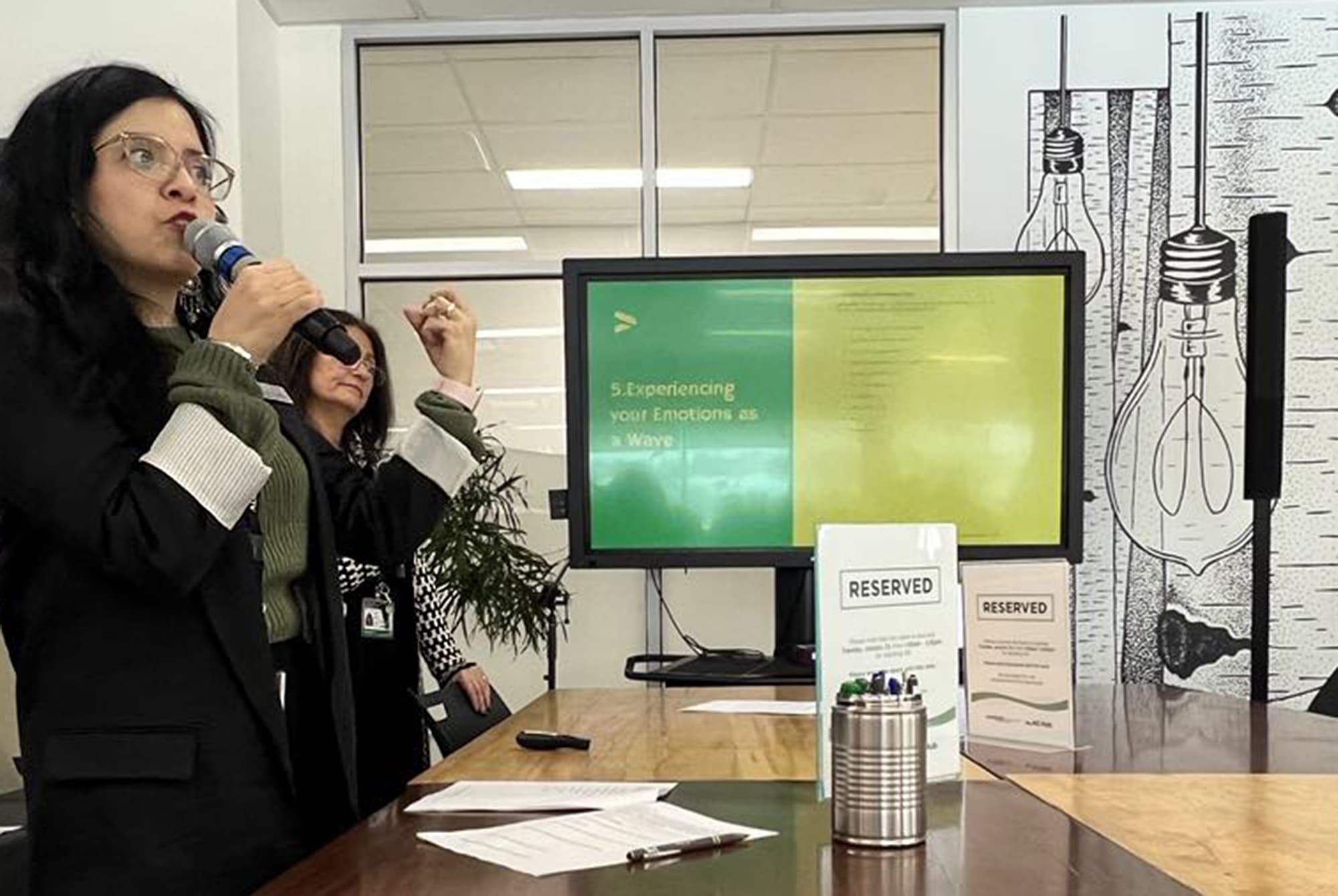
Photo: Emotional Regulation was hosted by Elizabeth Pena Fernandez and Christina Latifi. Photo credit
Adulting 101

At times students can feel stressed and not really know how to manage it.

On the second floor in the AC Hub on Jan. 23 at one of the space’s tables, an event called Adulting 101: Emotional Regulation offered tools to help with this issue.

During the event, all eight to ten attendees were given an emotional log and a mood score chart. These can be used as tools to help identify emotions in terms of being able to regulate and control them.

Hosted by Elizabeth Pena Fernandez, the college’s health promotion and education coordinator, Christina Latifi, with counselling services, and Raivyn Halcro, an events programmer, the event covered ways to regulate your emotions and how to do so.

“Emotions give us information, and we need them for safety it’s important to be aware of these,” said Latifi.

The hosts explained that emotions are temporary, but an emotion that persists for days is a mood.

Sadness is an emotion; depression is a mood disorder. Your emotions and thoughts affect you and your behaviour, which is why it is so important to regulate them.

Latifi and Fernandez explained that we can simply do that by trying to name that emotion, and asking ourselves, “why am I feeling this way?”

Self-reflect. Be mindful and aware of how intense is this emotion. Is the emotion valid? Regulate the emotions and correspond to the situation.

“Your thoughts are strongly connected to your emotions,” said Fernandez.

During the event, one of the greatest tips for regulating your emotions participants learned about was is to experience them as waves.

Neither emotion nor waves are constant, they come and go. We should recognize what we feel, experience it, and know it is only temporary, explained the hosts.

Understanding that can be very self-perpetuating, overthinking can be when your thoughts and worries are in an endless loop, which can then make you feel overwhelmed by fear, and set you up for a vicious cycle that is hard to break.

“Emotions aren’t in the driving seat, we are taking control,” said Latifi.

Climate change impacting worldwide wine production hits close to home in the Ottawa Valley

Unpredictable weather presents challenges for delicate process

Around the world, wine production has fallen to a 60-year low and experts are saying climate change is to blame.

The International Organization of Vine and Wine (OIV) looks at data from 94 per cent of the world’s wine harvest for the year and found the season of 2023 had the lowest grape production since 1961.

The OIV blames the bad weather of climate change, including frost, heavy rainfall and drought.

Ottawa Valley winemakers are also feeling the impact.

KIN Vineyards stands on a hillside in the Ottawa Valley in the Carp area and grows nine different varieties of grapes for winemaking on-site at the vineyard. Some of those wines include Chardonnay and Pinot Noir, with the latter being notoriously difficult to perfect.

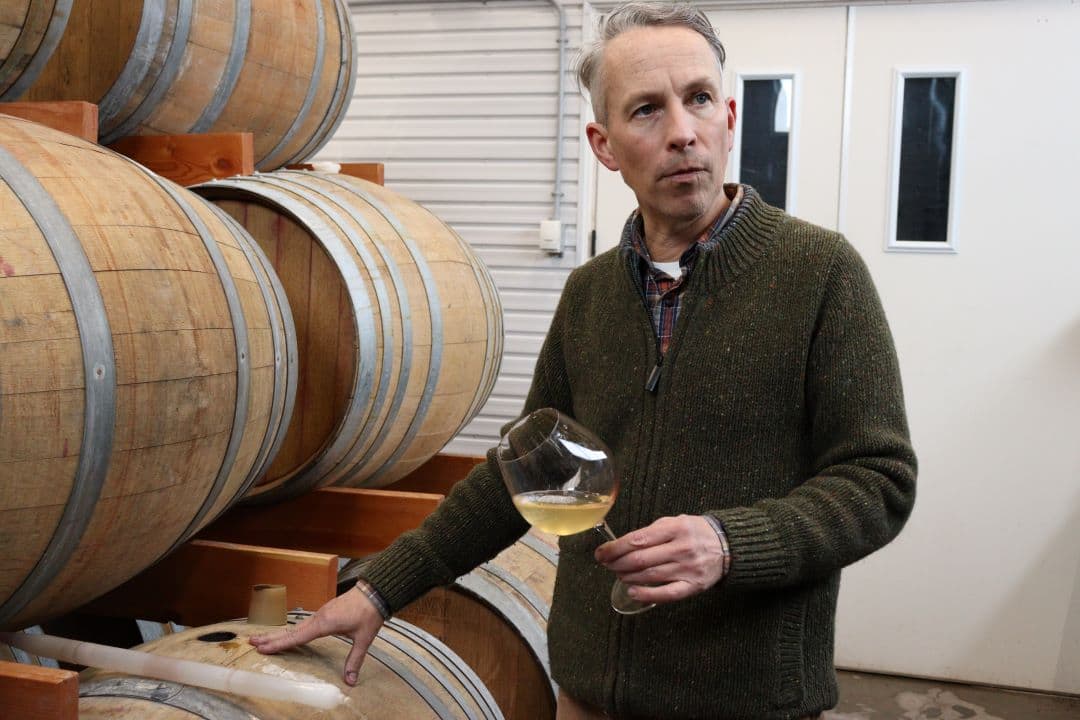
Brian Hamilton is the current winemaker and manager of KIN Vineyards and has been working with grapes and the changing weather for over 20 years across many places and continents, including New Zealand and California.

Hamilton, who teaches part-time at Algonquin College to students pursuing a sommelier college certificate in the New World Wines course, says not a lot of people are aware wine can be made in the Ottawa area.

He adds it is not the easiest job, as growing the right grapes for making wine is a delicate process the changing weather is making it more unpredictable, especially when working with a wine Hamilton and winemakers around the world call “the heartbreaker grape.”

“It’s hard to grow, it’s even more difficult to make wine out of, so when you are a winemaker and you make good Pinot, it’s a badge of honour, so to speak,” says Hamilton.

He says that while more heat and a longer growing season is nice, the other effects of a changing planet are not welcome.

“It’s not all good, it’s not just about heat. When you talk about climate change, it’s about climate extremes,” says Hamilton.

“So, yes, heat units and sunshine might be one benefit to the change in climate, but certainly there are lots of negatives. The intensity of whatever weather you’ve got can be problematic.”

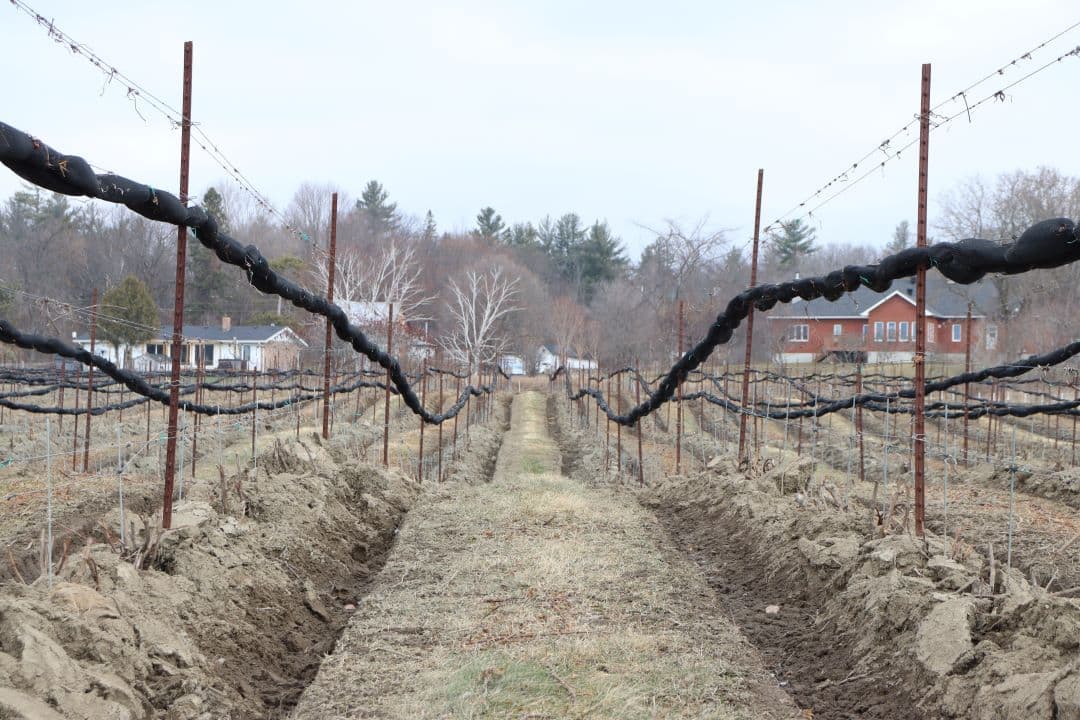
One of the vineyards at KIN Vineyards, all vines pruned, buried and ready for a long winter in the Ottawa Valley.

As the winters become milder, the grapes come out of dormancy a little early and begin to flower, becoming at risk for late frost, and if caught in a cold snap or freezing rain, they die and no longer make fruit.

To help protect the plants during the winter, the vines themselves are pruned down every year and covered with soil to protect them from the cold.

“It’s a very time-consuming, very labour-intensive and expensive process,” says Hamilton about the whole winemaking process.

Science advisor Renée-Claude Goulet from the Canada Agriculture and Food Museum says there’s another problem when the weather is poor: bees and other insects stay home and the pollination rates go down, affecting the quality of crops.

“There’s a lot of issues that are coming about with climate change. So one of them is obviously climate variability. So, not so much that it’s getting warmer, but it’s just becoming more unpredictable,” says Goulet.

“This is really affecting a lot of the crops that rely on flowering, like apple trees, grapes, anything that you know has a dormancy, a perennial that lives through winter, comes out of dormancy in the spring makes flowers and the whole crop is reliant on that one, like those 10 days where the crop is in flower.”

Climate change is both increasing the likeliness of extreme weather around the world, such as tornados and wildfires, and the subtle shifting of seasons, according to Agriculture Canada.

Winemaker Brian Hamilton, who teaches at Algonquin College for the Sommelier College Certificate, shows how vines are buried with soil to protect them from the cold winter.

“Just as the vine starts to grow, the shoots can maybe be six inches long. They’re still extremely fragile and the wind can blow the shoots right off and there goes your crop,” says Hamilton, adding that heavy rain and water events can lead to damage as well, especially when hail falls.

“If you are far enough along in your growing season that the fruit has set and has started to expand and you’ve reached the stage in the vine called veraison,” he says. “This is where the red grapes start to turn from green to red then they start to soft and the sugar starts to build and the fruit starts to expand and the skins get thinner, hail can destroy your crop. They’ve had that in Ontario this year.”

The future of farming has depended on the weather since humanity first began planting seeds in the ground millennia ago, and the changing weather isn’t a new topic, but Goulet says the future of climate change on all types of farming is a major concern.

“It’s in a very critical time period that can really affect the crop for the rest of the season and really affect the harvest,” says Goulet. “Really, it’s the variability and the unpredictability that’s really causing a lot of issues.”

Hamilton says though the weather is shifting, KIN Valley is in a unique location for growing grapes as the hill is made from limestone and holds water even in a dry spell, to the point where the vineyard operates as a dry farm, meaning no irrigation is needed.

The vines then are forced to grow deeper to get water, something Hamilton says will make the plants stronger in the end, both against the wind and as they access more salt and minerals buried deep in the earth.

“That’s one of the age-old understandings about vines, if you want to make fine wine you need to make the vine struggle,” says Hamilton.

“Think of it like people. I think it’s the best analogy. Adversity in our own lives builds character, like what doesn’t kill you makes you stronger and vines are exactly like that.”

Algonquin College first school in Ottawa named as Moose Hide Campaign ambassador

Campaign created to engage men and boys in ending violence affecting women

Algonquin College is the first school in Ottawa to be an ambassador for the Moose Hide Campaign for creating safer campus communities.

The Moose Hide Campaign began over 10 years ago in British Columbia when Raven Lacerte and her father Paul Lacerte were hunting moose as part of their Indigenous culture along Highway 16 in the northern part of the province, otherwise known as the Highway of Tears, named after the women (mostly Indigenous) who have gone missing or have been found murdered along the 724-kilometre roadway.

When they caught their first moose, the idea to repurpose the hide into a social innovation has seen over 4 million moose hide patches distributed with a campaign created to engage men and boys in ending the violence affecting women and has grown Canada-wide to both Indigenous and non-Indigenous women and girls.

In a press release from Algonquin College, president and CEO Claude Brulé said the college “remains committed to creating awareness of gender-based violence” after this recognition.

Omar Karim, the national director of post-secondary engagement and initiatives at the Moose Hide Campaign, said while there are no rules to becoming an ambassador, you need to spend effort and time as an organization spreading awareness and participating in or hosting events to educate people.

“We try to just keep it very open and dynamic,” said Karim. “Numbers are great, but really it’s about the relationships and really the awareness and educating as many people on campus about why violence is not okay and what can we be doing and it’s empowering institutions to be creative and innovative, to create their own initiatives that become a legacy in their own campus and then Moose Hide Campaign is here as our post-secondary team to support those legacy initiatives.”

He said the idea is not to call men out but to call them in, to change the behaviour in creating safer and healthier relationships.

“I find it humbling and I find it enriching in terms of the role that we have to play in working collaboration as an allyship in ensuring that we can hold other men accountable and support people through that process and educate people to that process that, you know, violence is not okay and so whether you know, it’s violence in general, is not okay,” said Karim.

“It feels great, honestly,” said Summer Wabasse, an Anishinaabe event co-ordinator at the Mamidosewin Centre.

“I know that I can feel proud of the work that I do here for all of our students, and as an Indigenous woman myself, it makes me feel so safe and just proud that we have a campus that cares so much about this type of thing,” she said.

“I think there are some people who, unfortunately, they are coming to these events and they themselves are family members, have experienced gender-based violence or like they might have a family member that’s part of the missing and murdered Indigenous women,” said Wabasse.

“And then there are some people who come here and they’re like, I didn’t even know that this was a thing.”

Statistics Canada reported 71 per cent of students in 2019, both male and female, have experienced or witnessed unwanted sexual behaviors during their time at a post-secondary school, with 1 in 10 women experiencing sexual assault in the same time frame.

At Algonquin, data collected from the college from 2018-2022 had 114 reported cases of sexual assault.

Across Canada, one in two women have experienced one or more incidents of sexual or physical violence since the age of 16, with a woman murdered every 2.5 days. From those numbers, Indigenous women were six times more likely to be affected than non-Indigenous women, according to the campaign’s website.

The college has worked with the campaign since 2017 to show how these numbers are more than just facts in a database.

“In order to become an ambassador campus, you have to participate in activities and events that work with Moose Hide or are contributing to ending gender-based violence,” said Sarah Crawford, the manager of sexual violence prevention and harm reduction for Algonquin. “So, it’s really just a recognition of the fact that we’ve done all of this work.”

She added there are events planned to continue education about gender-based violence and how it is an issue everywhere in the world and as students exist in this world, violence against women needs to be talked about.

“Education is good. I have a lot of hopes for, you know, the next generation. Every time we talk to students, they seem to be more aware of stuff. And so, I feel positive,” said Crawford.

“It’s an important issue,” said Randy Kakegamic about the Moose Hide Campaign.

“I think the whole issue stems from colonization, it all got mixed up from residential schools.”

Residential schools, which operated between 1874 and 1998, were created when the Canadian government took indigenous children from their families and culture and placed them in schools to educate, convert and assimilate them into Canadian society. An estimated 150,000 children attended these schools, according to the Canadian Encyclopedia.

When Kakegamic’s parents were taken to residential schools as children, the knowledge his grandparents knew and should have taught them was never passed down, and parts of the culture were lost.

“It’s a break in our values, our teaching,” he said.

Kakegamic acknowledged he had been part of the problem in the past, even up to jail time. He has now been sober for the past seven years and is working on getting a pardon and spends his spare time educating others by speaking to groups, singing and dancing.

“I’m taking the right path,” said Kakagamic. His goal in teaching younger men who are heading down the same path as he did is to know that “you don’t need to go down the way I did, there is a better way.”

If you are interested in learning more about the Moose Hide Campaign or how you can help end violence against women, you can order and wear a Moose Hide pin to get involved and support this campaign or register for National Moose Hide Day on May 16.

If you are someone you know who has been affected by violence or needs help, the Moose Hide Campaign’s help button on their website has resources and links, or you reach out to Algonquin’s security office at 613-727-4723, ext. 5010.


ARC bridge glows red for Heart Month

Cardiovascular students watch as Algonquin College becomes the first location in Ottawa to 'Light the Capital Red'
Photo: Kaitlyn Lemay
Mayor Mark Sutcliffe (right) presenting the official Heart Month proclamation to Claude Brulé (left) and Lianne Laing (middle).

Caitlyn Drury knows firsthand how important the University of Ottawa Heart Institute and the Heart Month campaign are to the community.

“I had several open-heart surgeries, so I wanted to come in and give back in a less invasive way than a surgeon,” said Drury, a cardiovascular technology student at Algonquin College, as the UOHI launched the Light the Capital Red campaign on Jan. 31.

“I wanted to help other children that had the same problem as I.”

The Jack Doyle Athletics and Recreation Centre pedestrian bridge will illuminate red throughout February as part of the campaign.

Mayor Mark Sutcliffe attended the event on campus, gave a proclamation on the importance of the campaign and cut a ceremonial ribbon under the new red lighting of the pedestrian bridge.

“Seeing all these young people who are choosing a career in healthcare is really amazing,” said Sutcliffe. “For Algonquin to be so supportive and to do this symbolic gesture to support Heart Month is really amazing.”

The event opened with an introduction from Claude Brulé, Algonquin College’s president and CEO, while students from the diagnostic cardiac sonography and cardiovascular technology programs stood around the podium.

Lianne Laing, the University of Ottawa Heart Institute Foundation’s president, praised the students for their dedication to cardiovascular patients.

“To see [students] and [their] scrubs and just excited to be here, it makes us really proud, and this was a wonderful example of what Heart Month is all about,” Laing said.

Mayor Mark Sutcliffe posing with Health Sciences Program Coordinator Karen Tran and students in the Cardiovascular Technology and Diagnostic Cardiac Sonography program in the ARC bridge
Mayor Mark Sutcliffe posing with Health Sciences Program Coordinator Karen Tran and students in the cardiovascular technology and diagnostic cardiac sonography program in the ARC bridge Photo credit: Kaitlyn Lemay

Several students entered the program with personal connections to cardiovascular health and were thrilled to participate in the symbolic lighting of the bridge and be involved with the campaign.

“I think it’s a really great opportunity to just bring awareness to heart programs at Algonquin College because there are only a couple,” said Felicity Andrews, another cardiovascular technology student.

The group made its way to the ARC bridge to watch as Sutcliffe, Laing and Brulé cut the ribbon, officially launching the campaign in Ottawa.

Algonquin College and the UOHI have an important relationship that offers students practical applications in their programs and a place to amplify the skills they are learning.

According to School of Health Studies program coordinator Karen Tran, students in the two cardiovascular programs benefit from the partnership since they often do their clinical placements with the UOHI and even go on to work for the institution after graduation.

“As a professor, to see them with the confidence in the lab, after they’ve done a clinical, the growth is incredible,” Tran said.

Heart Health Month highlights the importance of keeping track of your own heart health and maintaining healthy habits.

While the UOHI hopes to raise over $1.2 million, awareness is the main goal of the campaign.

Canada can expect increasing use of new 988 suicide prevention helpline

Local CTV: Twenty-four calves died in a fire early Wednesday morning at a dairy farm on Mansfield Road near Richmond. The owner of the farm called 911 just before 2:30 a.m. reporting a barn on the property was on fire, Ottawa Fire Services said. The fire was in an area of the city with no […]

Local

CTV: Twenty-four calves died in a fire early Wednesday morning at a dairy farm on Mansfield Road near Richmond.

The owner of the farm called 911 just before 2:30 a.m. reporting a barn on the property was on fire, Ottawa Fire Services said.

The fire was in an area of the city with no hydrants. Firefighters used tanker trucks to shuttle in water. Crews requested additional resources due to heavy smoke and flames.

“Firefighters made it a priority to get hose lines on the silos that were at risk of catching fire. The roof of the barn eventually collapsed,” Ottawa Fire Services said.

The cause of the fire is under investigation.

National

CTV: Since the 988 suicide prevention helpline was launched in November 2023, it has received 1,000 calls and 450 texts per day, according to the Centre for Addiction and Mental Health.

The CAMH anticipates the volume of calls and texts will increase over time and they’re prepared, said Allison Crawford, a chief medical officer and psychiatrist.

“We already had a national 10 digit phone number and service. But with three digits, we know that that increases access to care because it’s easier to remember, especially in a time of crisis,” said Crawford.

Those who call the 988 helpline will be offered service in English or French, then will be routed to a 988 provider that is the closest to them.

International

CBC: The CEOs of Meta, X, TikTok and other social media platforms went before the U.S. Senate judiciary committee on Wednesday to testify because parents are expressing concern regarding the effects of social media on their children.

Parents who lost children to suicide testified their kids were exploited on social media, while others held up pictures of family members they’ve lost.

Mark Zuckerberg, Meta’s CEO, was asked if he’s compensated any of the victims and their families.

“I don’t think so,” Zuckerberg said.

“There’s families of victims here,” said Republican Sen. Josh Hawley. “Would you like to apologize to them?”

“I’m sorry for everything you have all been through. No one should go through the things that your families have suffered,” Zuckerberg said.

Meta is being sued for their design features on their platforms for allegedly failing to protect children from online predators.

The tech giant has recently increased child safety features. Posts about suicide, self-harm, and eating disorders will now be hidden from young people using Meta platforms.

Shelter animals hope to find forever homes thanks to college students

Veterinary Learning Centre and Clinic gives students hands-on experience making animals adoption-ready
Photo: Stephanie Taylor
Registered veterinary technician Madison Hamilton shows off Taco, one of the kittens available for adoption at the Veterinary Learning Centre and Clinic.

Taco, a six-month-old orange tabby, has found himself in the care of Algonquin College students at the Veterinary Learning Centre and Clinic. He will stay there until he is either returned to the SPCA de l’Outaouais or he finds his forever home.

The winter semester brought a new batch of pets available for adoption, Taco being one of them. The pet adoption program is done through the VLCC, located in V-building on Algonquin College’s Woodroffe campus. The adoption program closes at the end of the winter semester but will return for the fall semester.

Madison Hamilton, a graduate of the vet tech program at Algonquin College and a current registered veterinary technician at the VLCC, believes the pet adoption program is a win-win for students and animals.

“It kind of helps with the program when the students can get hands-on learning,” said Hamilton. “It’s good for the animals because the shelters are always so full with pets, and at least when they’re here they get lots of extra loving.”

“We chose to work with animal charities to help animals as we hone our skills so helping them get homes makes sense and helping people who love animals find them is very rewarding,” said Emma Slater, a registered veterinary technician at the VLCC.

Students in their second semester of the vet tech program begin to help provide medical care to the animals. The pets are all spayed and neutered, given their vaccines, and microchipped at the VLCC.

“They give you a lot of opportunities in your second semester, so I got to watch a surgery lab, which was awesome,” said Emma MacKinlay, a second-semester vet tech student. “In the fall, I get to start doing surgeries myself, so we get to assist and start helping with anesthesia, making sure pre-labs are all finished and things like that.”

Taco and his assumed brother, Odin, were found living on the streets. Dolly, a six-month-old shepherd cross dog, was surrendered to the SPCA by her first family. Helping animals like Taco, Odin, and Dolly find their forever homes is another one of the VLCC’s goals.

Dolly went home with her new family on Jan. 26.

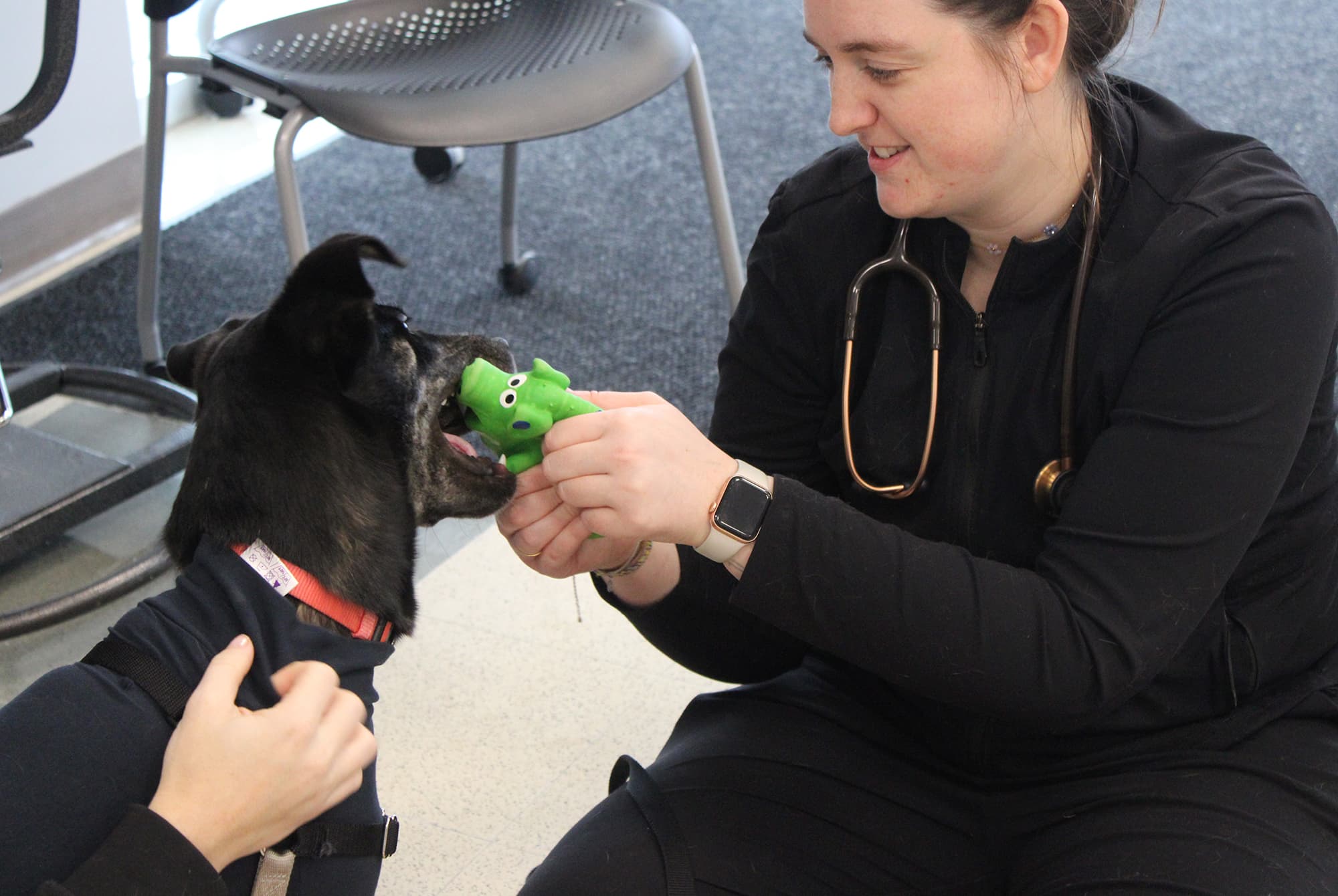
Dolly and RVT Madison Hamilton playing tug-of-war with Dolly's favourite toy.
Dolly and registered veterinary technician Madison Hamilton play tug-of-war with Dolly's favourite toy. Photo credit: Stephanie Taylor

“It makes you feel warm and fuzzy inside because you get to see them actually go to a home versus being on the streets,” said Hamilton.

There are six-to-10 cats and one dog available for adoption at the VLCC at a time. The animals get rotated out every three-to-four weeks. If an animal hasn’t been adopted by the time their stay at the VLCC ends, they return to the SPCA. Hope for these animals isn’t lost; they are adoption-ready because of the work the students and staff at the VLCC have done.

“Actually a fun fact, one of the cats in one of our first batches of the [fall] semester wasn’t adopted here. He went back to the shelter and ended up in a PetSmart. My sister found him and adopted him there,” said Hamilton.

Anyone interested in adopting a pet at the VLCC can contact Slater at slatere@algonquincollege.com.

Grads discuss transitioning into the workforce during career chat

Three recent alumni shared their post-graduation job-seeking experiences in a virtual panel
Photo: Photos supplied
Graduates Christi Volden, Jane Zhang and Xia Hu (from left to right), shared advice with current students on a grad panel.

The Co-op and Career Centre held a virtual career panel on Jan. 25 where three panellists were asked multiple questions ranging in topics from skills for job-seekers to building strong resumes and cover letters.

The graduates, Christi Volden, Xia Hu and Jane Zhang, discussed their transitions from studying to entering the workforce. The event was part of the grad mini-series offered by the centre and was facilitated by Della Siemens, alumni relations officer.

Networking, mentorship, and a professional digital presence were amongst the main skills the panellists attributed to their professional growth since graduating from Algonquin College.

Christi Volden is a 2021 graphic design graduate currently working as a graphic designer for Initiate Marketing in Kanata. During the discussion, she emphasized the value of networking and how her professors aided her career journey.

“I felt an immense amount of support from my professors in the graphic design program,” said Volden, “Not only do they have a lot of recent, and very relevant experience but some of them are part-time professors and they’re full-time working in the industry. They will constantly discuss with us as students what it’s like in the industry, how we can succeed.”

Another speaker, Xia Hu, a 2022 tourism and travel graduate, spoke about the importance of understanding your skills and talents when job searching. Prior to coming to Canada, she had been a Chinese language teacher at Jinan University in China for 16 years.

Hu said students should think back on previous knowledge and experience when considering potential employment opportunities. She explained that in her opinion, any experience is experience, no matter how unrelated it may seem.

“The more you know yourself, the better, easier, it is for you to make the right decisions,” said Hu.

Hu currently holds three different jobs: project coordinator at Tourism HR Canada, a customer service representative with Porter Airlines and a mandarin tester for Global Affairs Canada.

Zhang, a 2023 environmental management and assessment graduate, is currently a geochemical data scientist at the Geological Survey of Canada. She also contributes her expertise in environmental consulting for the Canadian Water Resource Association Ottawa chapter.

Leaning on the support of relationships built during their time on campus or field placements increased their confidence in interviews and their own expertise.

Despite graduating from different programs all three graduates gained essential skills through the Algonquin College to help them ease into their respective industries.

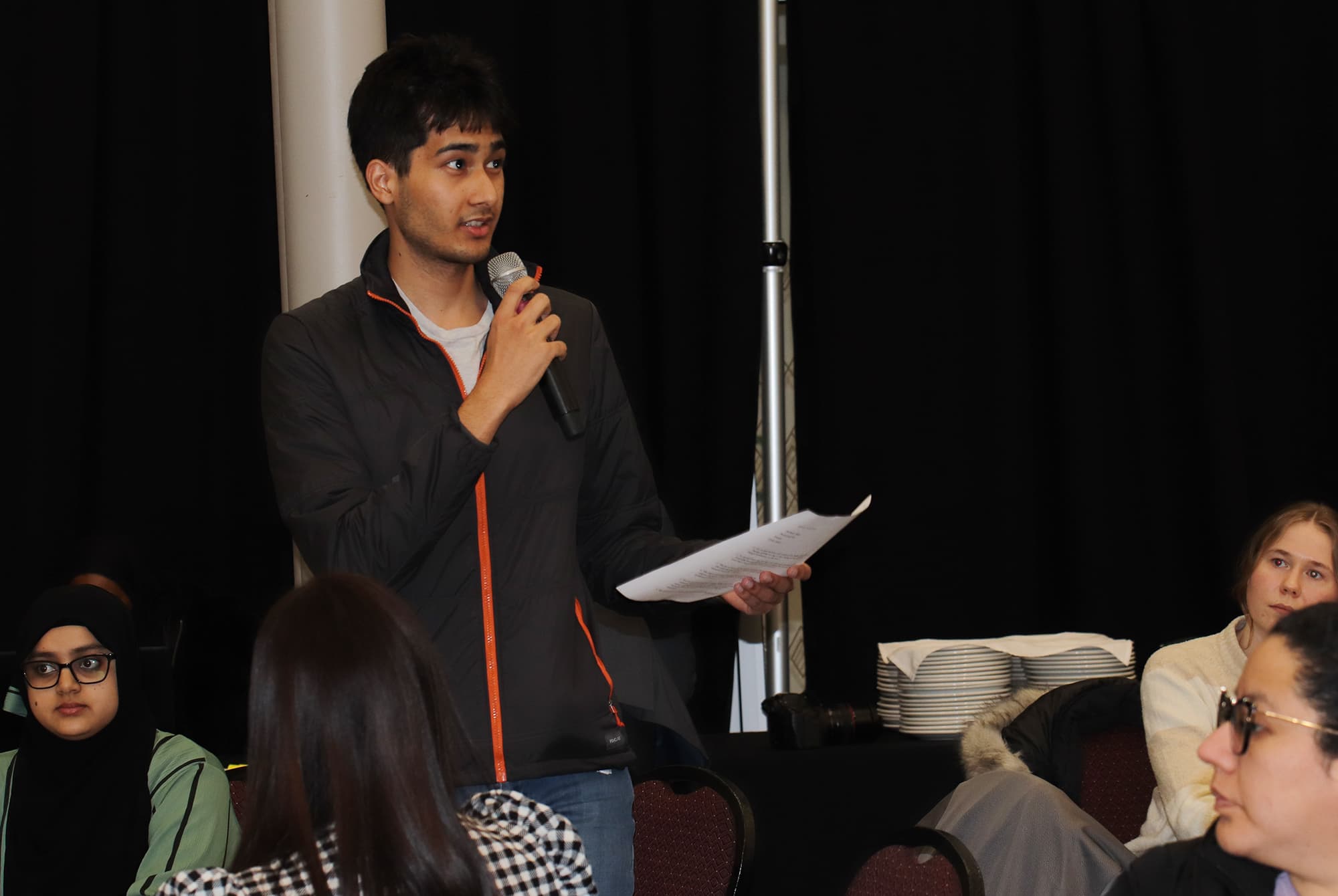
Algonquin students lead the way while building skills and lasting bonds

Aspiring leaders embark on a leadership journey at orientation for Student Leadership Program
Photo: Grinje Randa Bringi
Romaan Joshi, an animation student, shares which leaders inspire him.

The Nawapon gathering space was filled with excitement and anticipation as over 80 aspiring leaders from all three Algonquin College campuses gathered for the Student Leadership Program orientation on Jan. 24.

The Student Leadership Program is a hybrid personal development program aimed to build confidence and practical knowledge applicable to any leadership opportunity. Students can join by nominating themselves or being nominated by college staff members.

The event sparked an unexpected introduction between participants Ayesha Mehveen, a first-year strategic global business management student, and Maya Jyothi, a first-year building information modelling student. Both students are from the same village in South India. They were initially introduced through a social group chat but never met in person.

“I never met her. Only over a group chat, something like WhatsApp,” Jyothi said. “I have never met her in person, it’s a good thing I didn’t leave the orientation early.”

Before her arrival, Mehveen intentionally sought out the Student Leadership Program while searching for extracurricular activities at Algonquin College.

“Before coming to the college, I looked up other activities which I can do apart from my regular studies,” Mahveen said. “I decided I would enter this program.”

Ayesha Mehveen a strategic global business management Student at the Leadership Program Orientation.
Ayesha Mehveen, a strategic global business management student, at the Leadership Program Orientation. Photo credit: Grinje Randa Bringi

Hanan Tkrory, a first-year office administration student, found clarity and excitement in the program.

“I wasn’t so sure before coming here, but the presentation made everything so clear,” Tkrory said. “I’m now excited to be more confident in myself and to express better what is in my head.”

Students expected the program would be more interactive. However, the orientation confirmed a mostly online-focused curriculum.

“Online programs we can do on LinkedIn and get the certificate,” Jyothi said. “I feel that it should be in-person sessions at least once a month. It would be fun. It would be good if we came to meet other people.”

The Student Leadership Program coordinator, Hunter Morris, acknowledged feedback from participants and said adjustments were being implemented with each new cohort.

“For each new cohort, we look at adding new elements to the program,” Morris said. “As more interactive opportunities were a common piece of feedback after the first cohort, we have added additional activities to the program such as a group project, additional guest speakers and more. We will continue to improve and adapt the program to meet students needs in coming cohorts.”

The online leadership program officially starts on Jan. 30 for qualifying participants and is to be completed within one or two semesters. All graduates will receive a certificate of completion and credit toward their co-curricular record. The program ends with a team retreat and a graduation ceremony in partnership with the Mamidosewin Centre.

“I am looking forward to the weekend retreat and the graduation ceremony,” Jyothi said. “It will make us proud that we have completed.”

Applications for the next cohort open in April 2024. For more information about the program check Algonquin College Student Leadership Program website

“You do not need to be a leader now,” Morris said. “We can give you the knowledge and skills to take the first steps on your leadership journey.”

Campus Village showcases college support services to new students

Event happens each semester to increase awareness of the campus programs
Photo: Claire Donnan
Raivyn Halcro, the event organizer, was excited to share all the supports Algonquin has to offer.

Campus Village, an event in the Student Commons showcasing Algonquin College’s student supports, happened on Jan. 30, just in time to welcome January intake students.

The two-hour event, which occurs at the start of every semester to support new students, had booths for every student service or support organization on campus. These booths were operated by staff and volunteers who could answer questions, help students sign up for services like mailing lists and give out merchandise.

“The idea or plan behind this event is to get as many students aware of all the amazing and awesome supports the college offers,” said Raivyn Halcro, an events programmer with the AC Hub and the organizer of the event.

The event raised awareness of student services on campus.

Carol Ann Mahoney, a community outreach officer running a booth for the Volunteer Centre, was excited about sharing volunteer opportunities with students.

“Why should I volunteer, what are the benefits, whether personal, to make friends, build your confidence, learn about your community if you’re new to Ottawa,” said Mahoney on the importance of learning about volunteering.

Trevor NG, a student support volunteer with the Mamidosewin Centre, was also running a booth. NG was most interested in showing students that anyone can benefit from the centre’s services.

“We provide Indigenous supports but we’re open to everybody,” said NG. “So non-Indigenous students, they’re free to come in and learn the culture, come to one of our events, share some food with us.”

The Mamidosewin Centre also had a variety of prizes available at its table, like pens and seed paper cards. Every booth had some form of free Algonquin merchandise and informational pamphlets. Some booths even offered food and drink, including wraps and coffee.

Students at the event enjoyed being able to walk around the different booths and experience the sense of community. They also loved the prizes.

“It looked fun, so I just wanted to check out what’s going on,” said Sana Ahmadzai, an interior decorating student in her final year of the program.

Lara Aegard, a first-year student in the massage therapy program, enjoyed the sense of community at the event.

“Just seeing what’s offered at Algonquin College, I think that’s pretty cool,” said Aegard. “I’m usually in this building so I usually get to see the events, and I think it’s pretty cool how many events we have here. It really creates a sense of community.”

Halcro hopes the event can show students all the support Algonquin College offers them, as well as destigmatize the use of support services on campus.

“Algonquin College has one of the most supportive environments. We were ranked very high on the support offered to students,” said Halcro. “Not only do they have an abundance of support, but there’s also a variety of support.”

Follow Algonquin Times on Instagram
Algonquin Times on Instagram
Algonquin Times podcast
Algonquin Times horoscopes
Follow Algonquin Times on Instagram
Algonquin Times on Instagram
Algonquin Times podcast
Algonquin Times horoscopes

Stay Informed

Sign up for our newsletter

Subscribe

* indicates required