Local CTV News A “wellness and social club” called Altea Active is set to open in Ottawa’s west end later this year. The franchise will be on Carling Ave., in a former Canadian Tire building. It will include fitness studios, a “one-of-a-kind Hot Yoga Studio,” guided exercise classes, indoor pickleball courts, and a three-lane 25-metre […]
A “wellness and social club” called Altea Active is set to open in Ottawa’s west end later this year.
The franchise will be on Carling Ave., in a former Canadian Tire building. It will include fitness studios, a “one-of-a-kind Hot Yoga Studio,” guided exercise classes, indoor pickleball courts, and a three-lane 25-metre lap pool.
“The club will offer youth programming through the aquatic facility, which provides kids swimming lessons, and the Active Kid’s Club, which includes a mini gym, arts and crafts, and interactive game zones for junior members,” said Altea representatives in a statement.
A wildfire has been blazing through the Alberta mountains and finally hit the town of Jasper on Wednesday. The exact extent of the damage is unknown, but assumed to be severe with many buildings destroyed.
“This is simply our community’s worst nightmare,” said Mayor Richard Ireland.
Alberta will be receivingfederal government aid to help fight the wildfires.
The United States Department of Defense released a report warning of “destabilizing” activities in Canada’s far north, including potential Russian jamming of global positioning system (GPS) satellites.
The Pentagon fears that the possible actions of Russia could destabilize the United States, Canada and its allies. The 18-page assessment also notes increased naval cooperation between Russia and China, including a joint bomber flight in international airspace near Alaska yesterday.
The Arctic might have its first practically ice-free summer by 2030, and the loss of sea ice will increase the viability of Arctic maritime routes, which could lead to Russia or other aggressive states attempting to seize control of Canadian waters.
People came together to eat and talk about mental health at the Food for Thought event
Agrani Tiwari
Photos: Agrani Tiwari
July 25, 2024 Revised: July 25, 2024 12:56pm
Photo: Agrani Tiwari
Kathleen Ramsay (left) and Louise Ramsay (right) are served dessert by a student waiter at the Food for Thought event
Algonquin College’s public relations students held a charity dinner on July 20 to raise money for the Royal Ottawa Mental Health Centre.
The event, titled Food for Thought, was the first part of the #ShattertheSilence campaign organized by the program.
The event was a three-course meal, for which the entry fee was $65 per person. It included a silent auction. Forty-six people attended the event, leaving only two seats empty.
The event started with Sophia Wojdak, the co-campaign manager, welcoming people and introduced the guest speaker from the Royal.
Ingrid Gingras was the keynote speaker at Food for Thought and told people about the Royal's work battling mental health issues Photo credit: Agrani Tiwari
Ingrid Gingras, vice-president of communications and donor experience at the Royal, said in her speech: “Today, four in one Canadians are living with a mental illness or substance use disorder. Shockingly less than 20 per cent of those seeking help receive adequate care.” She explained that depression is the most common mental health issue the Royal sees, and how current approaches are not perfect treatment. She further said that the Royal has made “groundbreaking strides in preventing suicides” through community support and innovations. “Community support is key in turning new ideas into research, transforming these discoveries into breakthroughs, integrating them into care. Community support enables us to continually evolve mental health care and significantly improve lives.”
The first course was served at 6:30 p.m., promptly followed by a recipe video, then the entrée and the last course.
Bradley Moseley-Williams, professor and program coordinator in the public relations program, also spoke at the event to express pride for his students, “Every year the students go out in the community and they make it better. They take their education; they take their talent and they take some challenges.”
The silent auction was opened at the end for 20 minutes. People put in bids on many items, including paintings and a ring with the starting price of $195, which sold for $500. All the money from the silent auction also went to the Royal.
The student organizers (left to right) Harjinder Singh, Shristi, Amita Jethi, Dawson Richards, Sophia Wojdak, and Nathan Draaistra with Ingrid Gingras (centre) from the Royal, and Bradley Moseley-Williams, professor of public relations (second from left) Photo credit: Agrani Tiwari
Gingras said: “Tonight was amazing, everyone [here] is so open to hearing about mental health, and supporting mental health and it was really wonderful.” She was impressed with the Algonquin students’ conduct and organization.
“The idea of [this] event was really fantastic and on-point, which is to support mental health by coming together with food and enjoying each other’s company.”
Featured Hero | Featured Story | Home Feature | Home Hero | News
The second event for #ShattertheSilence took place amid the peacefulness of plants and trees
Agrani Tiwari
Photos: Agrani Tiwari
July 25, 2024 Revised: July 25, 2024 12:55pm
Photo: Agrani Tiwari
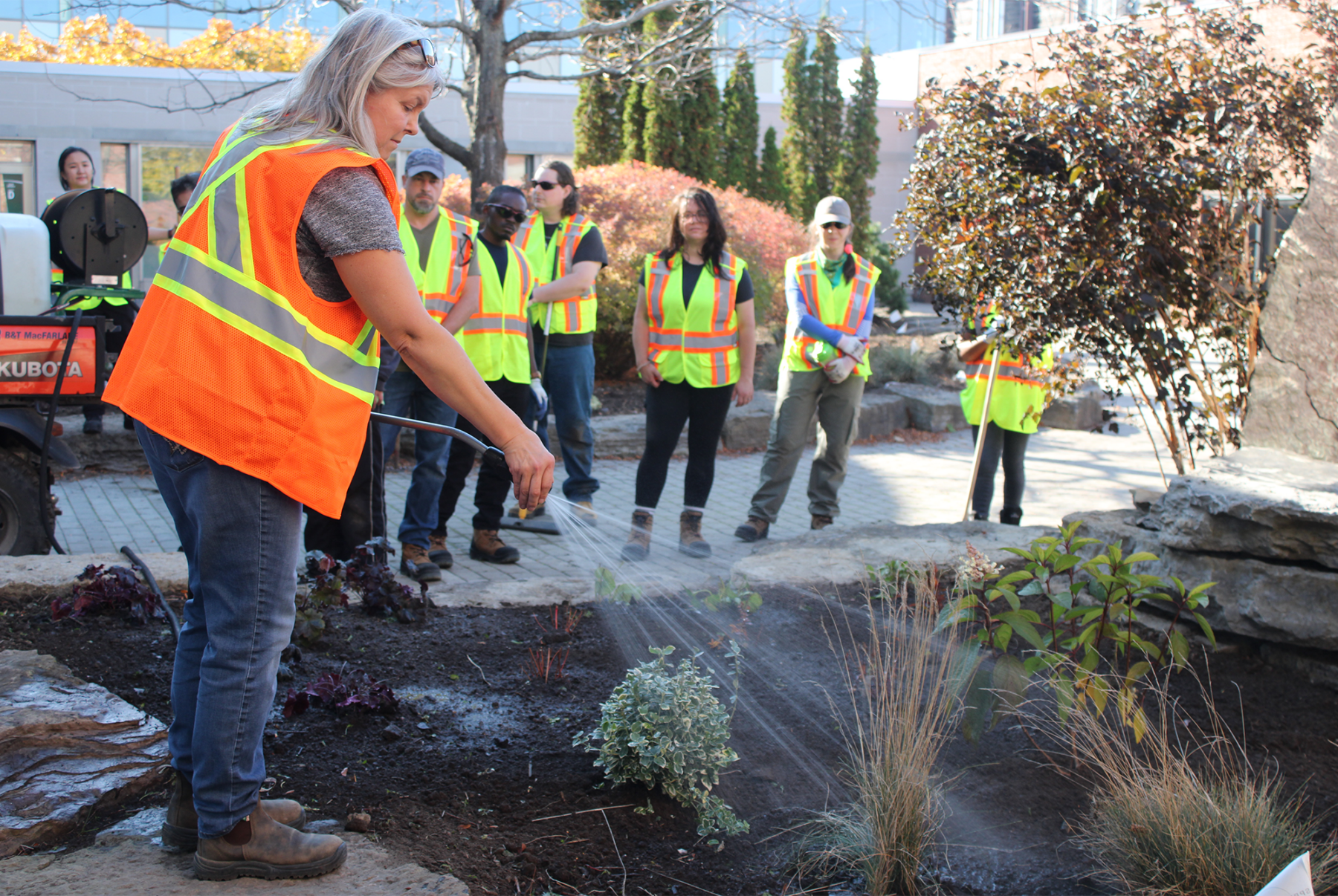
Professor Jason Vodden took attendees on a tour of the horticulture grounds, including a vegetable garden and greenhouse
Garden and Grow, the second event for the #ShattertheSilence campaign of the Algonquin College’s public relations (ACPR) students was held on July 20, 2024 at the horticulture building.
The entry fee was $20 for each adult, and children were given free entry. There was also a silent auction table, with gardening tools for auction. All the proceeds will go to the Royal, Ottawa’s main mental health care centre.
Left to right: Suhkmanpreet Kaur, Abhireet Dandiwal, Julia Bland, Roxanne Kayizaniza and Viergine Fortune from the ACPR were the organizers of the Garden and Growth event. Photo credit: Agrani Tiwari
The event started with a seminar on the physical and mental health benefits of gardening by horticulture professor Jason Vodden. He talked about plants’ evolution, their benefits and how they can help people.
“Living in a city, there’s a lot of noise pollution, a lot of pollution-pollution, and it leads to feelings of isolation, and sometimes, just the busyness can lead to anxiety,” said Prof. Vodden. “I don’t know if any of you have ever gone and sat outside before, in a green space. It doesn’t take long to just feel a little bit more relaxed.”
The seminar was followed by a break so people could mingle and enjoy refreshments like juices and pastries.
Prof. Vodden took everyone on a tour of the horticulture grounds, which are built on four acres of land and have three years of collections of plants. The first stop was the outside garden, which houses many varieties of plants and trees, then the vegetable garden, and last, the greenhouse. “It has 34 species of plants and this place is something I am very proud of,” said Prof. Vodden.
The third and last part of the event was a planting session, where people paired up, mixed soils and planted succulents according to Prof. Vodden’s instructions. People got to take these plants home in a free tote bag.
Ethan Walls (left) and Jonathan Mihigo (right) planting succulents as part of the event Photo credit: Agrani Tiwari
“It was lovely and well done. I love the awareness it is raising,” said attendee Emily Deraiche-Grossberg. “I think learning about plants is good for the environment and a good way of giving back.”
Julia Bland, one of the organizers and an ACPR student said, “I am thankful people came and enjoyed the event, it was amazing. Mental health and plants are co-related, and it was a great way to teach people more about that.”
Featured Hero | Featured Story | Home Feature | News
Students are hosting a number of fundraising events in support of The Royal and mental health awareness
Tyler Reis-Sanford
Photos: This year's fundraisers include Lois Caracas, Manpreet Kaur and Roxanne Kayizaniza. Photo credit
July 23, 2024 Revised: July 23, 2024 12:45pm
Photo: This year's fundraisers include Lois Caracas, Manpreet Kaur and Roxanne Kayizaniza. Photo credit
Public Relations students have raised more than $500,000 for numerous Ottawa area charities since 1986. L-R
Public Relations students at Algonquin College have organized a number of events in support of mental health awareness and The Royal, one of Canada’s foremost mental health care teaching and research hospitals. Their mission is to “help people living with mental illness and addiction recover faster,” according to a press release.
Public Relations students have raised more than $500,000 for numerous Ottawa area charities since 1986. L-R: This year's fundraisers include Lois Caracas, Manpreet Kaur and Roxanne Kayizaniza. Photo credit: James Gray
The students have put together four events to take place through July: Garden and Grow, exploring the benefits of gardening on mental health; Mic Drop the Silence, featuring local artists and headlined by Organ Eyes and Monqiue Messier; Food for Thought, where attendees will have the opportunity to eat and learn at a dinner hosted by the Algonquin College Public Relations (ACPR) students, and guest speakers will discuss the connection between food and mental health, and Sertenitea, a “mental health pitstop” and workshop in the E building of campus.
“We are really excited to raise money for a good cause,” said co-campaign manager Dawson Richards. “In first semester we had a big vote to decide which charity to fundraise for, and The Royal had a lot of momentum behind it.”
The Public Relations program plans to raise thousands of dollars for The Royal over four events Photo credit: Tyler Reis-Sanford
Another co-campaign manager, Sophia Wojdak, thinks these kinds of events can help connect people to everyday ways to help strengthen and support their mental health.
“People rarely address the connection between nutrition and mental health, and this event helped to start that conversation for a lot of people,” said Wojdak.
“This will be a great informative event,” said Kenyon Elechi, a member of the group organizing Serenitea. “I am very grateful and excited to be a part of it.”
The Food for Thought event took place on July 18. Garden and Grow tickets are $20, but free for children. The event will be held at the M building on July 20. The Serenitea mental health workshop will be held on July 23 in the E building and is free to attend. Mic Drop The Silence tickets are $15, and the event will be held on July 24 at The Rainbow Bistro, 76 Murray Street in the ByWard Market.
Featured Hero | Featured Story | Home Feature | News
Pageants today are about "more than pretty dresses," says PR student
Agrani Tiwari
Photos: Agrani Tiwari
July 19, 2024 Revised: July 19, 2024 1:54pm
Photo: Agrani Tiwari
Sophia Wojdak, an AC student, was second runner-up at the Ontario Regional Canada Pageant
Sophia Wojdak, a level 2 public relations student, was the second runner up at the 2024 Miss Ontario Regional Canada Pageant.
“I was the former Miss Teenage Edmonton, because I’m from Alberta, and the former Miss Northern Alberta as well,” said Wojdak. She has been doing pageants for four years now. This was her second time competing in the Miss Ontario Regional Canada Pageant.
Wojdak says that pageants are a lot different than most people think. “I think people have an idea that pageants are all just pretty dresses and baton twirling and it’s really not that,” she explained. “A lot of it is fundraising, public speaking preparation, panel interview preparation, and each delegate has to have a personal charitable platform.”
For this pageant, Northern Ontario Families of Children with Cancer was the primary charity of the organization. “But everybody has to have a personal philanthropic platform,” Wojdak explained, “so mine was Consent on Campus, which was promoting sexual assault survivor resources and consent education on university campuses.” She says that doing research for the platform, fundraising for the organization, preparing for the interview and speeches are the big parts of preparation for the competition.
“Sophia used her pageant platform to raise awareness, understanding and money for issues and causes that are important to her,” said Bradley Moseley-Williams, coordinator of the public relations program. “I also found her interest and concern to be genuine, and she was effective at making presentations about these issues. She spoke in class, at pageants and leveraged the value of various social media channels to get the word out.”
“My favourite part is just meeting all the other women that compete,” said Wojdak. “I’ve made a lot of really good friends through pageants. You make a lot of good connections, not just personally, but also professionally.”
Hailey McDonald, Miss Prince Edward County, met Wojdak in person for the first time at Miss Ontario, Regional Canada 2023 Pageant in May 2023. “Sophia is the sweetest during pageant week,” said McDonald. “She’s extremely bubbly and energetic no matter how busy we are, and she always keeps the mood fun and light-hearted. I’m pretty sure she was the one cheering the loudest for me when I placed in the top six.”
Sophia Wojdak (left) and Hailey McDonald (right) became friends at the Ontario Regional Canada Pageant Photo credit: Ontario Regional Canada Paegant
Jewel Lindemann, Miss Cambridge, said the same thing. “When I won a side award for the competition, Sophia was cheering the loudest and you could tell that she was genuinely so happy for me.”
Wojdak says that she didn’t have to deal with anything negative while competing in the pageants, other than just dealing with the misconceptions and stereotypes on what the paginate actually is.
“When I tell people I do pageants, most people are positive about it and think like, that’s cool or whatever. But some people think that, it’s like objectifying or it doesn’t really have to do with people’s community work or their intelligence,” Wojdak said. “There’s a whole scholastic exam that’s a big part of this pageant, and, like, I won the scholastic award so I was very proud of myself. But it sucks sometimes when you tell people like, oh I do pageants and they think, ‘oh it’s just about being pretty’, ‘it’s just about wearing a dress’, it’s whatever.”
Wojdak wants people to understand that pageants are not just about pretty dresses but also about scholastics, public speaking and philanthropic community work Photo credit: Agrani Tiwari
Wojdak knows that the pageants are a lot of work and is not sure if she will do them in the future.
“I hope to get a job in PR going out of school and I just don’t know if I’ll have time for it.” Wojdak said. “But if I don’t have time to compete again, I would still love to go and watch pageants and volunteer at them and help. I’ve been able to help with some kids pageants in the community and I always really like doing that.”
To women competing in pageants, Wojdak has this advice: “Even if you walk away and you don’t win or you don’t have the experience you want, just remember that you still do take lessons away from that experience and you still get to make great friends and you still, you know, get to have that experience.”
She says that she started pageantry because she wanted to grow.
“I have to kind of ignore what naysayers said about what pageantry was, [who] thought that I was dumb for wanting to do it. Pursue the things you want to do to help your community, and help yourself, and then make you happy. And don’t care too much about what other people have to say about it.”
Picture this: You’re doom scrolling away, happy as a pig in filth, thumb flicking down the screen when suddenly, wedged between a meme about House of The Dragon and a recipe for gluten-free funnel cakes, you see it. Someone is wrong on the internet. Not only are they wrong, but you know you’re right. Struck […]
Tyler Reis-Sanford
Photos: Tyler Reis-Sanford
July 18, 2024 Revised: July 25, 2024 9:14am
Photo: Tyler Reis-Sanford
When we engage in rage online, we're not doing justice to the communication skills humanity has taken centuries to develop, argues Tyler Reis-Sanford
Picture this: You’re doom scrolling away, happy as a pig in filth, thumb flicking down the screen when suddenly, wedged between a meme about House of The Dragon and a recipe for gluten-free funnel cakes, you see it. Someone is wrong on the internet. Not only are they wrong, but you know you’re right.
Struck with divine fury and righteousness, you engage, launching into your well- thought-out argument. You cite sources, send links, attack this online troll with facts and logic. You bombard this petulant know-nothing with a well-articulated, scientifically backed barrage of informational explosives.When we engage in rage online, we're not doing justice to the communication skills humanity has taken centuries to develop, argues Tyler Reis-Sanford Photo credit: Tyler Reis-Sanford
This, of course, goes nowhere. The only reward for your righteous crusade against those nameless, faceless brainless accounts is further aggravation. You roll your eyes, toss your phone down and sigh. “What an idiot,” you say to nobody in particular.
Meanwhile, somewhere in the world, that same person you were arguing with slams their phone down and says the same thing about you.
Social media is here to stay. Whether or not it’s a necessary tool for our survival is irrelevant; whether it’s even useful is irrelevant. Facebook, Instagram, the platform formerly known as Twitter, they’re not going anywhere. They simply make too much money; money they make from you and your engagement. Do you know what kind of engagement makes them the most money? The kind that makes you mad.
Rage-baiting is not a new term, or even a new concept. The idea is simple, people are more inclined to focus on and remember the bad. It’s why you remember the one rude server you had, and not the 100 perfectly kind and lovely ones. It’s why you remember the teacher who was strict and mean. It’s why Facebook’s internal documents show their algorithm prioritized anger and posts that elicit it.
For young people in the age 18-29 demographic, social media is the most popular form of consuming news. Consider first that these billion-dollar private companies have a fiduciary responsibility (meaning they are legally obliged to act in the best interest of) to shareholders.
They are required to take actions that make the most money for the people who invest in them. Nowhere are they obligated, or even encouraged, to design a platform that acts as a conduit for sane, rational, reasonable discussion.
In fact, as you now know, the voices that get amplified are the ones that stir the pot. The squeakiest wheel yelling into the online ether, simply asking to be greased by its loudest, rudest, most obnoxious supporters and detractors. Regular people looking for their dose of thumbs-up fuelled dopamine, and screaming back into the void to get their next hit. Served up and steaming, your daily dose of rage-slop.
Social media is reducing us. It is making us lesser. Fortunately, we don’t have to engage this way online. There are endless things to argue about in this complicated world, ranging from the colour of a dress, what defines genocide and whether or not pineapple belongs on pizza. The good news? We can argue about them in person, too.
Communication theory is the study of the numerous ways humans have explained and interpreted each other over our long history. It also outlines the numerous things that are lost when communicating online.
Many successful ingredients to communication have evolved for humans to signal and perceive. A change in tone might suggest sarcasm. Body language might represent humour. Gestures and volume could indicate levels of anger. We’ve evolved myriad ways to communicate, consciously and unconsciously, the minute details that help the receiver of information decode the full extent of our message.
Most experts agree that 70 to 93 percent of communication is nonverbal. For the most part, what we say isn’t nearly as important as how we say it. When we engage in these serious conversations online we’re trading in our millenia-old ancestral toolkit for emojis and caps lock. I’m no expert, but I’d be willing to argue that’s a bad deal.
This isn’t to say that social media is the devil and we all need to burn our phones. There is plenty of good to be found online, and even in social media. The matter is complicated and intricate; even now I recognize the irony of typing these words onto a keyboard so that someone might one day read them while scrolling on the toilet.
There are, however, some conversations that are worth having in person. Let’s all try our best to remember that the next time we engage online, and let’s also try to remember that the next time we engage in person.
At the risk of sounding like your grumpy grandfather, shaking his fist at the sky, let me give us all (yes, even me) a small piece of advice.
Director of Indigenous initiatives says “very important activities” are coming up
Tyler Reis-Sanford
Photos: Tyler Reis-Sanford
July 18, 2024 Revised: July 18, 2024 1:22pm
Photo: Tyler Reis-Sanford
The intersection of Wajashk Private and Wàbisheshi Private at Algonguin College's Ottawa campus
Algonquin College launched the Kwey video series as part of its commitment to embracing the traditional Anishinàbe language on campus.
The videos feature Algonquin’s director of Indigenous initiatives, Anita Tenasco, teaching words in the language while giving information on Indigenous topics.
In April, the college introduced four city streets with Indigenous names on the Ottawa campus. The new streets are Wajashk Private, Nigig Private, Adjidjàk Private, and Wabisheshì Private. These are named after animals in the Anishinàbe language— muskrat, otter, crane and marten, respectively.
Tenasco, who has been the director of Indigenous initiatives since January, and is herself part of the Kitigan Zibi Anishinabeg community, played an integral role in the project.
“This was a project that I committed to when I started my work back in January,” said Tenasco. “Other First Nations students see that our college’s leadership values our languages, understands the need to revitalize our languages and really honours part of the true history of the territory.”
Algonquin College is located on unceded Algonquin Anishinabek territory, and classes, ceremonies and events often start with a land acknowledgment. The idea of a land acknowledgment is fairly well known, but not every student understands the significance.
”It’s fair to say I don’t know as much as I should,” said level two business analytics student Rajesh Ganji. “I am new to Canada but I know it’s important. I know there is a history, I just don’t know what to look it up.”
The Mamidosewin Centre is Algonquin College’s Indigenous student hub. The Kwey video series says that Mamidosewin is Algonquin and Ojibwe for “meeting place” or “walking together,” and it’s a place where students can learn more about Indigenous cultures and the land that Algonquin College is built on.
Tenasco describes the Mamidosewin Centre as “so important to First Nations students… a safe space to access resources, to access indigenous knowledge keepers”, and “a home away from home” for Indigenous students.
The Mamidosewin Centre also hosts events for non-indigenous students, such as information sessions and film screenings.
”I think at the core we need to acknowledge that we’re still here, that we were here first and we’re still here,” said Sydney LaRoux, an Algonquin College student who is part of the Inuit community. “A lot of people dance around indigeneity, there is a lot of history people get uncomfortable about, but that makes it that much more important to talk about.”
June was National Indigenous History Month, but Algonquin College has more material planned for the future.
”We’re planning a series for the fall [of] 2024. It will be about welcoming people to the territory, back to school… with phrases to talk about accomplishments and studies and success and perhaps even feelings,” said Tenasco. ”Truth, reconciliation, indigenization and most importantly in all of this, building meaningful relationships with the host nation of Ottawa and the host nation of the territory is so crucial.”
The Mamidosewin Centre is located in Algonquin College's E-building. Photo credit: Tyler Reis-Sanford
Tenasco also mentioned other events that Algonquin College was might hold in the future, including but not limited to special guest speakers, important elders teaching student about their communities.
Featured Hero | Featured Story | Home Feature | Home Hero | News
Zachary Smith, a 26-year-old Ottawa man, has been charged with hate-motivated incidents such as mischief/damage of property and verbalizing threats of death or bodily harm to another person, according to police.
The events allegedly took place over the past year in the Rideauview area.
Police encourage all citizens who witness or experience such an incident to report it. “Reporting hate-motivated incidents is an important step in stopping cycles of hatred,” a news release stated.
Anonymous submissions can be made to the Crime Stoppers phone line, toll-free 1-800-222-8477.
Canada plans to reach defence funding targets in support of Ukraine by 2032. Two per cent of national gross domestic product is being offered by NATO’s summit partners.
“We’ll meet the two per cent pledge and I think we even need to go beyond that,” said Defence Minister Bill Blair at today’s NATO summit in Washington, D.C. He hinted at a path forward through partnership with other NATO members. Blair told the audience that Canada had entered into an agreement with Norway and Germany to “work together on issues around production.”
Canada is falling short but provided a plan on how to meet the set benchmark. Canada is expected to see military spending increase to 1.76 per cent of GDP. Twenty-three of 32 NATO members are aligned with the projected two per cent pledge in 2024, while NATO’s Secretary-General has implied that this is the lowest recommended support.
Several people were tragically killed in the Caribbean by the category-3 Hurricane Beryl.
Richard Thompson, acting director general at Jamaica’s disaster agency, said in an interview on local news that 1,000 Jamaicans were in shelters by Wednesday evening. Presently, a death toll of 10 has been mentioned and is expected to rise.
“It’s terrible. Everything’s gone. I’m in my house and scared,” said Amoy Wellington, a 51-year-old cashier who lives in Top Hill, a rural farming community in Jamaica’s southern St. Elizabeth parish. “It’s a disaster.”
The storm reached 200 to 205 km/hr winds in most areas, causing floods, power outage and roofs being ripped off homes.
Several prominent tourist areas such as Cancun, Playa Del Carmen and Barbados have been damaged, which may harm the long-term economy of the regions.
Three people were reported killed in Grenada and Carriacou and another in St. Vincent and the Grenadines, officials said. Three other deaths were reported in northern Venezuela, where four people were missing, officials said.
Local CTV News Ottawa Public Health has recommended that people not swim in Ottawa’s waters after the heavy rainfall recently. They’ve detected a dangerous amount of E.coli bacteria, which can cause infection, vomiting, fever or even Crohn’s disease. Ottawa received 2.7 centimetres of rain over the past few days, due to a weakened remnant of […]
Ottawa Public Health has recommended that people not swim in Ottawa’s waters after the heavy rainfall recently. They’ve detected a dangerous amount of E.coli bacteria, which can cause infection, vomiting, fever or even Crohn’s disease.
Ottawa received 2.7 centimetres of rain over the past few days, due to a weakened remnant of Hurricane Beryl which caused so much devastation in the continent’s south.
Canada’s housing sales remained slow in June despite an interest rate cut from the Bank of Canada at the start of the month.
There was no noticeable change in home-buying activity, which overall has been slow in the spring compared to normally.
Phil Soper, CEO of real estate company Royal LePage, told Global News that he thought rates are still too high for first-time mortgage buyers without a lot of capital, and that “[i]t probably will take an additional couple of rate cuts of that magnitude to start to make a real difference.”
The high interest rates were justified as a counter-inflation measure; Bank of Canada governor Tiff Macklem said that further rate cuts could be expected if inflation remains under control.
But others speculate that shortages of houses will keep prices high regardless of mortgages’ status, and that this could continue to shut first-time buyers out.
A fistfight broke out between Uruguayan soccer players and Colombian spectators at a semifinal of the Copa America tournament yesterday. This occurred after Colombia defeated Uruguay 1-0.
The cause of the fight is unknown, with the involved players claiming that their families were being threatened by drunk people. The fight was broken up by security, and no serious injuries have been reported.
CONMEBOL (Confederación Sudamericana de Fútbol/Confederação Sul-Americana de Futebol), the organization that runs Copa America, stated that they are investigating the situation and condemned “intolerance and violence on and off the field.” CONMEBOL has not announced any punishments related to the fight.
Uruguay’s team will face Canada for the bronze medal on Saturday, while Colombia will play Argentina for gold on Sunday. Both matches start at 8 p.m. EDT.
Students connect, find support and have fun amidst mid-term stress
Aicha Chamor
Photos: Aicha Chamor
July 11, 2024 Revised: July 18, 2024 12:58pm
Photo: Aicha Chamor
Algonquin College international students Ece Kaplan (left), Md Irteza Chowdhury (right) and Leah Grimes ( centre) gathered at Ryan Farm Park to celebrate their cultural diversity and shared college experiences
On Friday, June 21, 2024, the International Peer Mentor (IPM) program held a midday picnic at Ryan Farm Park near Algonquin’s Woodroffe campus. Around 20 international students attended the picnic, enjoying the warm weather and company of their peers.
The event aimed to provide a welcome break from academics, helping international students connect with each other and build relationships and reduce stress.
The IPM program connects international students with each other and provides support during their transition to Canada.
The mentors organized the picnic as part of ongoing efforts to foster a sense of community among IPM participants.The team ran a variety of activities for the picnic, including a footrace, painting, dancing, badminton and Ono cards. A smorgasbord of food, including meat and vegetarian sandwiches, soda, cookies, chips and fruit was served.
“I love being part of this group,” said Ece Kaplan, a fitness and health international student at Algonquin College.
Kaplan, who recently joined the IPM program, had come from Turkey to Canada on her own. While she initially had few friends, she has now made many, thanks to the program’s supportive community.
Ece Kaplan holds a nature scene she painted during the picnic Photo credit: Aicha Chamor
“They’re the reason I never feel foreign or out of place,” Kaplan said.
She shared a traditional Turkish dance called dabke at the picnic. She was surprised to find that some of the Lebanese students shared the same dance with the same name and similar moves.
Yomeng Liu, a Chinese international student studying respiratory therapy, has been in Canada for two months. She likes the IPM program, and enjoyed the picnic’s footrace in particular.
The IPM program gives Liu an opportunity to connect with others from her home country and share her culture with the international student community.
“We had a deep talk about religions and women’s rights,” Liu said.
“Now I feel like I’m home with family.”
Mohamed Taous, an Algerian international student who works as a lead mentor in the IPM program, said that he applied for the role because “I liked the program and I wanted to help new students, the same way my mentor helped me in my first semester.”
Taous chose to host a picnic because he wanted to give students a chance to enjoy the nice weather after being cooped up at indoor college events.
"It was important for me to give back to the community that helped me when I first arrived at Algonquin College," said Mohamed Taous, a leader mentor in the IPM program Photo credit: Aicha Chamor
“I discussed this idea with my coordinator Leah Grimes and other mentors,” Taous said. “They liked it, so we planned the event and informed the other mentees and mentors through our WhatsApp group.”
Despite the important role the IPM program plays in supporting international students, it has faced some logistical challenges this semester. The program has a limited capacity of around 100 participants.
“It’s a lot to manage logistically,” said Grimes, who mentors Taous and others as an intercultural programming and support officer with the international education centre at Algonquin College.
The program is working to reach out to more of Algonquin College’s international student population, which numbers over 3,000.
“We’re actively working to expand the program’s reach and connect with more of the international students,” Grimes said.
Leah Grimes is an intercultural programming support officer at the college's International Education Centre Photo credit: Aicha Chamor