Struggles of young people ignored during pandemic, says NDP leader
Federal NDP leader Jagmeet Singh says he believes in “putting money in people’s pockets when they need help,” and when young people need it especially, is now. “The plight of young people has been ignored during the pandemic,” Singh said during in a press conference over Zoom with Algonquin College journalism students on Nov. 27. […]
Photo: Breanna St-Jean
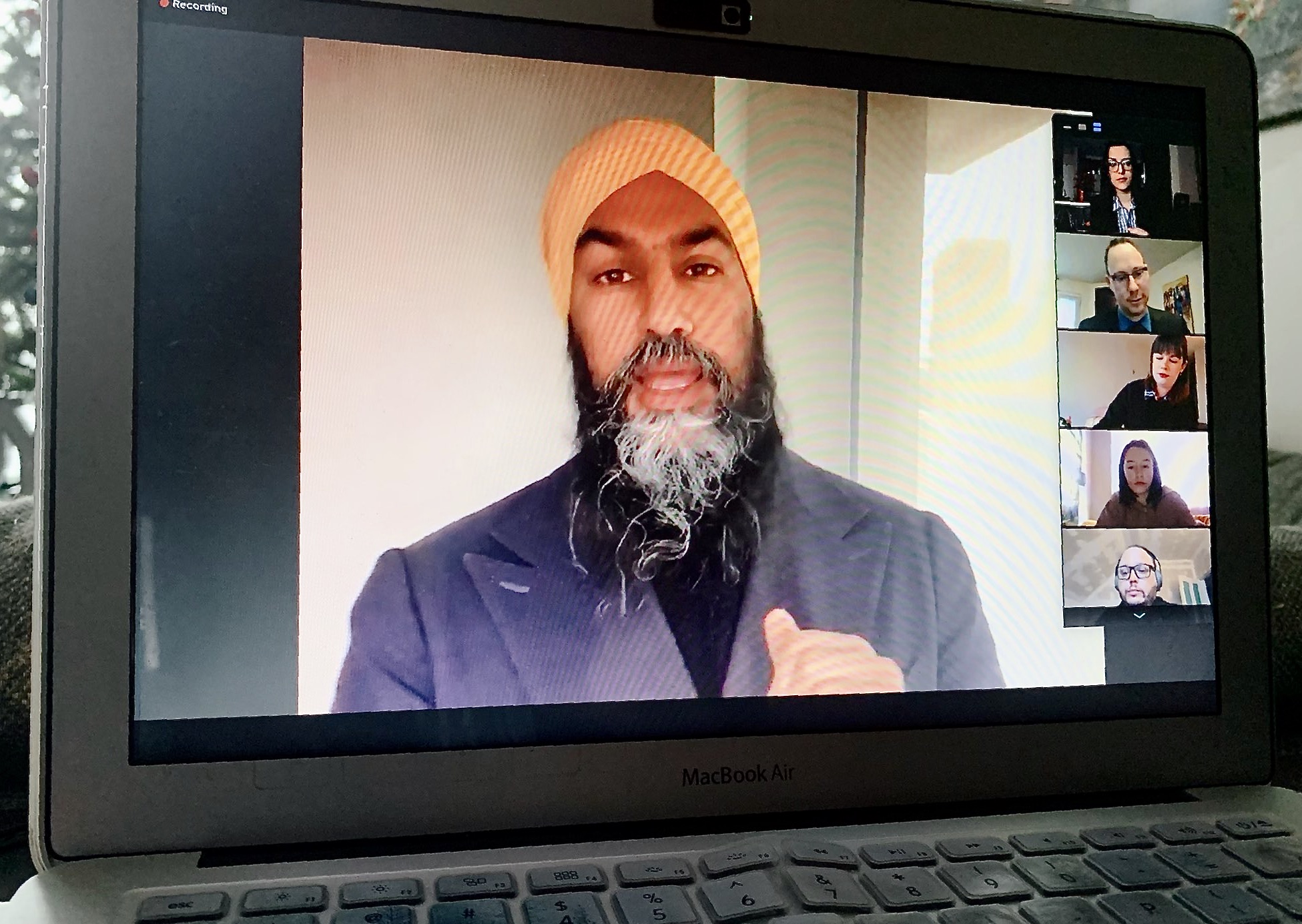
NDP leader Jagmeet Singh joined Algonquin College journalism students for a virtual press conference on Nov. 27.

Federal NDP leader Jagmeet Singh says he believes in “putting money in people’s pockets when they need help,” and when young people need it especially, is now.

“The plight of young people has been ignored during the pandemic,” Singh said during in a press conference over Zoom with Algonquin College journalism students on Nov. 27. “They are one of the hardest hit communities.”

Acknowledging that young people who are starting their careers in a pandemic “will feel the weight of this a lot more than someone who has already established a career,” Singh fielded questions from reporters about how the NDP plans to support young Canadians struggling with issues ranging from student debt to housing inequality.

In particular, Singh addressed how the NDP would support post-secondary students who are feeling the weight of mounting student debt and an uncertain job market during the pandemic.

“The massive debt that people go into [for education] is for me the worst way possible to have someone start their life,” said Singh.

One way he proposes helping students is by bringing back the interest-free moratorium. “We actually believe it should be a permanent end, there should be no interest charged in federal student debt,” he said. “I absolutely believe there should be no barriers to pursuing education. Including post-secondary education into our public education system is our ultimate vision. That’s what I want to achieve.”

Singh also proposed a federal minimum wage of $15 an hour as another quick solution. “Most of the workers that would benefit from this are young workers, or workers starting off in their career,” he said.

Singh criticized the Liberal government for failing to put this into action. “How could the federal government have any moral authority to talk about good wages if we don’t even have a livable or at least working towards a livable minimum wage at the federal level?”

When pressed on why the NDP’s motion called for only a moratorium but did not call for full loan pardons, Singh admitted it was part of the party’s strategy to fight for what it sees as achievable goals.

“One of the strategies that we that we’ve been using in this pandemic is, is where we can win battles that we know there’s enough public pressure and support to kind of get the get the momentum behind getting this done,” he said.

“The moratorium was there before the Liberals took it away, and we thought, this is a clear thing that we can actually get back and clear victory, a concrete thing that we can get done. So that was the reason why we focused on bringing the moratorium back.”

Looking ahead to post-pandemic financial support, Singh was asked specifically if he supports implementing a universal basic income to help Canadians in the long-term. He admitted he believes in the philosophy but hesitated to embrace the terminology.

“I’m not caught up on the label,” he said. “People talk about a livable guaranteed income, about annual guaranteed income. I just want money in people’s pockets directly.”

He instead expressed concerns that Canada’s current tax system allows for too many loopholes to be taken advantage of in a universal basic income scenario and prefers instead to focus on issues of immediacy.

“We were the ones that fought for CERB in the first place, because we believe getting money to people, was important. We wanted CERB, universal because in a pandemic we knew that everyone would need it, and let’s make it as effective and as quick and as easy as possible.”

While he was reluctant to put a label on it, Singh re-iterated that he supports the general idea of a universal basic income. “Moving forward I believe in it. We campaigned on a pilot project nationally, so that we could actually get the data to address some of the stereotypes, that people won’t work, people will be lazy, all these kinds of false myths.”

With sudden job losses and increased financial pressures for Canadians during the pandemic, the push for a federally implemented universal basic income has been gradually gaining public support. A universal basic income is a proposed government program where Canadians receive a set amount of money on a regular basis in order to help alleviate poverty and potentially replace other need-based social programs altogether.

“It actually gives people a support for them to then find better employment, it actually helps people get back to school, helps people start up their own businesses and helps address child poverty, so I really believe in income supports,” said Singh.

A UBI pilot project has been proposed in Newfoundland and the costs and benefits of running the program are currently being weighed. When asked if he supports other UBI pilot projects being implemented across Canada, Singh says he does.

“With a national pilot project, we’ll get the data to actually prove that these [myths] are wrong,” he said.

Singh signed off emphasizing the need for immediate financial supports for Canadians. “That’s something I fully believe in, and I want to find the best way to achieve it.”

Students form online friendships to purge pandemic loneliness

The pandemic has put strain on many aspects of life, not least of all our relationships with family and friends. Public health restrictions have made visiting with those close to us more difficult. Whether or not we’ve been anxious about our own welfare, or concerned about a loved-one with underlying health conditions, COVID-19 has certainly […]
Photo: Meara Belanger
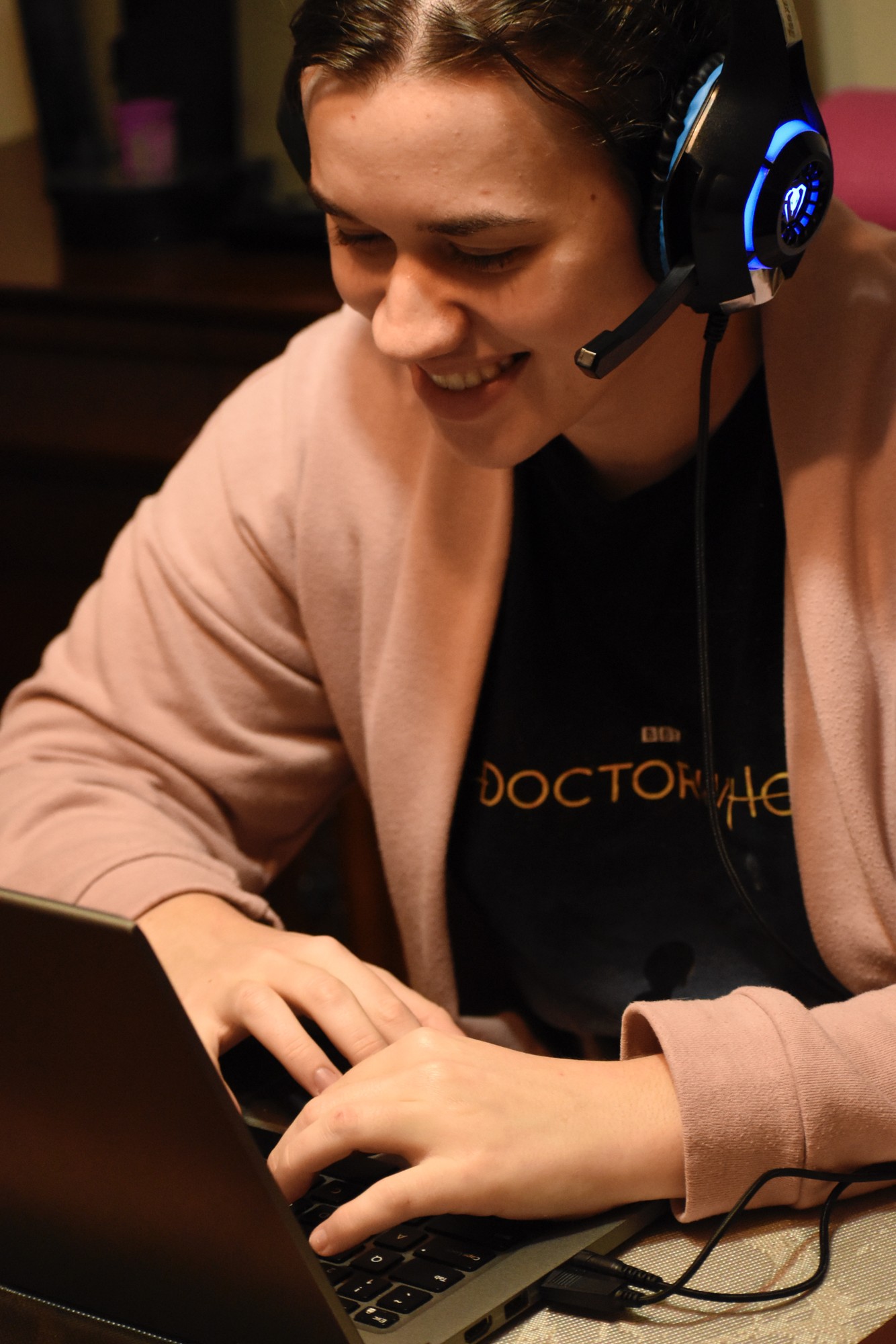
Making new friends online has helped many students with their mental health during the pandemic.

The pandemic has put strain on many aspects of life, not least of all our relationships with family and friends.

Public health restrictions have made visiting with those close to us more difficult. Whether or not we’ve been anxious about our own welfare, or concerned about a loved-one with underlying health conditions, COVID-19 has certainly put a damper on physical closeness.

Although the phenomenon of finding friends – and even a partner – on the internet is as old as floppy disks themselves, the pandemic has been a catalyst for creating a solution to quash quarantine loneliness.

John Muldoon is a counsellor at Algonquin College. He reminds us that although this isn’t a new trend, it’s a rapidly growing one.

“Online friendships have been around for well over a decade,” said Muldoon. “Having an online friend, or having people you talk to online can really bolster your friendships. [You] sort of stay connected, share ideas and thoughts and funny photos […] and memes and all that kind of stuff.”

One student who has forged many friendships online is first year business administration student Mairead Morrison. She uses Bumble Friends to connect with people online – most of whom she describes as “casual acquaintances.”

“For every one in five people I match with, do we actually continue to talk on a regular basis,” said Morrison. “Some are just every now and then others are just that first day you match and then you don’t talk much after that.”

Over the summer, Morrison met with one of her online friends when the case-count in Ottawa was low.

“Since then I haven’t met anyone else, but I do plan to,” said Morrison.

Others have met friends online who they imagine keeping in their lives forever.

Don Seneviratne is a game development student in his second year at Algonquin. He describes an invaluable friendship he made with someone he met through a chat group.

“My cousin introduced me to the group,” said Seneviratne. “Most people were awkward with me but she always kind of related to my ideology […] on certain things. So after a while I contacted her directly and started talking to her. She’s like the yin to my yang.”

Seneviratne says his friend is someone who always has his back, even though he’s never met her in person. He describes their bond as close and emotional.

“I am thinking of meeting her in the future,” said Seneviratne. “In fact, we’re at a point where I want her to be my best-woman at my wedding, ‘cause in such a short time she knows secrets about me that no one knows.”

Although some people might view an online friendship differently than an in-person one, they are one and the same for Chris Pavone, a graduate of Algonquin’s radio broadcasting program.

“Some I talk to a multiple times a week,” said Pavone. “Some a couple times a month. I view them the same as someone I know in person.”

Pavone met most of his online connections through Twitch, Twitter and Facebook. He says he doesn’t have any issues with coordinating real-life plans with his friends after the pandemic has ended.

“I have met a few already,” said Pavone. “Meeting an online friend can be the best thing ever.”

Even with all the social benefits the internet offers as the pandemic confines us to our homes, there can be drawbacks to restricting ourselves to online social connections. Muldoon argues that online communication is a tool that should be used in conjunction with in-person socialization.

“It does show sometimes that if you just have an online friendship, it doesn’t quite meet the full need of physically being with somebody in person,” said Muldoon.

However, since meeting physically is discouraged these days for safety reasons, Muldoon understands the invaluable need to stay connected through other means.

“There’s still lots of value and importance of being physically with people around us,” said Muldoon. “Ideally we still want to have those connections, but under the current circumstances it’s not really permitted.”

Muldoon believes that online socialization has become much more intimate in recent years with the introduction of technologies such as video chat, which have made it easier to pick up on body language and social cues. Although the pandemic will one day end, Muldoon believes the long-term effects from this lengthy period of social isolation will endure.

“Especially when there is a video, you’re in your environment and they’re in their environment,” said Muldoon. “When you’re in person, you have a shared environment, which sometimes influences how people interact, and connect and communicate. Just the warmth you get from being with somebody is not always there with a virtual world. […] Being able to hug somebody or sit on the couch and watch a show together, those are lots of shared experiences that are different.”

Muldoon believes that trading some of those shared experiences for a more isolated, virtual one will perhaps leave a psychological mark on us post-COVID.

For students who are interested in getting involved socially, Muldoon recommends taking advantage of some of the virtual resources offered by the school.

The college is now offering group counselling online to help peers support one another in a therapeutic capacity.

AC launches first Victimology Research Centre in Canada

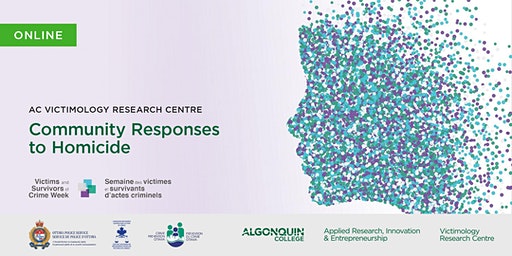
Algonquin College launched a new Victimology Research Centre on Tuesday for National Victims and Survivors Crime Week. The event focused on one of their current studies: community response to homicide. Dr. Benjamin Roebuck is the research chair and professor of victimology at the college and Diana McGlinchey is the research manager of the centre. “This […]
The Victimology Research Centre held its virtual launch event Nov. 24.

Algonquin College launched a new Victimology Research Centre on Tuesday for National Victims and Survivors Crime Week.

The event focused on one of their current studies: community response to homicide.

Dr. Benjamin Roebuck is the research chair and professor of victimology at the college and Diana McGlinchey is the research manager of the centre.

“This is a partnership between the newly formed Victimology Research Centre, the Ottawa Police and the Victim Crisis Unit, the Canadian Resource Centre for Victims of Crime and Crime Prevention Ottawa,” Roebuck explained. “We have such a great group of partners that have helped to put this on.”

The event was opened by Claude Brulé, Algonquin College president, who welcomed all the attendees.

“This centre is unique to Canada,” Brulé said. “The centre’s work produces groundbreaking research in its field in partnership with non-profit organizations and government stakeholders studying victimization and the experience survivors have with the criminal justice system.”

Algonquin College’s learners from the victimology program, police foundations program and community and justice services program have been using the centre as a resource. “These students perform the central role as they work on various research projects,” Brulé said.

The event had Roberta Della-Picca, an elder of the Algonquin Peoples and a recipient of the order of Ottawa for her work in advocacy and preventing violence against women, perform a greeting.

“This is funny because we are all in cyberspace,” she said. “But we are all on unceded Algonquin traditional territory.”

Della-Picca sang a song of welcome. Presenters throughout the event acknowledged the Algonquin Anishinabe Nation’s unceded land.

Dr. Roebuck also released a documentary film titled After Candace: The Art of Healing, which was one of the research centre’s past projects. The film captures the healing journey of Cliff and Wilma Derksen – survivors of their daughter’s homicide.

“Understanding the experiences of victims and survivors is exceptionally important work,” Brulé explained. “It can only lead to greater awareness and positive changes in our institutions and society in general.”

The Research Centre will also be focusing on three other studies: Victim Services and Vicarious Resilience, Male Survivors of Intimate Partner Violence in Canada and COVID-19 and System Responses to Homelessness.

Holiday Baking Contest

Date: November 17th – December 18th Tis’ the season to be baking! Check out @atpromo Instagram account to participate in another fun baking contest for the chance to win a $25 Amazon gift card. Instagram post: https://www.instagram.com/p/CHsvAbRFgju/?utm_source=ig_web_copy_link

Date: November 17th – December 18th

Tis’ the season to be baking! Check out @atpromo Instagram account to participate in another fun baking contest for the chance to win a $25 Amazon gift card.

Instagram post: https://www.instagram.com/p/CHsvAbRFgju/?utm_source=ig_web_copy_link

Halloween Baking Contest

Saturday Night Frights

Even on laundry night, expect the unexpected. Prompt: it’s midnight on a weekend, and you’re doing laundry at your apartment’s laundromat. You hear the door swing open but pay it no mind until the fellow enters your peripherals and you see a very inhuman form. He is a werewolf but is groggily just doing laundry. […]

Even on laundry night, expect the unexpected.

Prompt: it’s midnight on a weekend, and you’re doing laundry at your apartment’s laundromat. You hear the door swing open but pay it no mind until the fellow enters your peripherals and you see a very inhuman form. He is a werewolf but is groggily just doing laundry. He hasn’t realized he’s changed.

The strangest things often happen when we least expect. I was a broke college student doing my laundry late one October night in my building’s laundromat, earbuds in and deaf to the world. The peeling linoleum floors beneath my worn-out slippers made the most peculiar schwick, schwick sound whenever you walked on them, and half the machines looked as though they belonged in the dark recesses of the local city dump. The walls were a dingy greyish colour, though I always imagined that if I focused hard enough, I could see the faintest hue of blue still clinging to its past vibrancy. An old boxed TV perched high up in the corner of the room, never on. One who lived in the building as long I had knew that the TV was a silent sentinel and cutthroat snitch; the landlord, after receiving complaints about people stealing laundry, placed a security camera inside the hollowed out remains of the TV to discourage further theft. I, however, doubt the story is actually true.

It was on this unmemorable night that I encountered the strangest fellow. My earbuds were cheap, and halfway through my second load of thrift-store finds they broke on me. I sighed, crumpled them up in my fist, and stuffed them into my pocket. Without music, the clock in the room and the hum of the two machines I had chosen was like static in my ears. As I folded my last pair of socks, I heard the door open behind me.

Heavy footsteps followed by a clicking noise and heavy breathing filled my ears. I shuddered and tried to mind my own business as the newcomer shambled past me, still breathing heavy and clicking as he went. Confusion fogged my brain as I wondered why he was breathing so heavily… almost like a dog. I snuck a glance at him, only to immediately do a double take.

There, at one of the older looking machines, was a giant furry man. Not a man in a fursuit, either; it appeared to be a giant wolfhound, standing on its back legs. I gawped, as a large clawed hand started to put much smaller articles of clothing into the machine. It was then that I had the ice-cold realization: this man is a werewolf, he’s doing laundry of all things, and I just caught him in his other form. My mind raced as I scrambled about what to do. Do I tell him that he’s changed? No, he might attack me. Do I just mind my business? How does one even do that when they’ve just seen a werewolf for the first time in their too-young-to-die life?

My choice was made up for me when I looked back up only to bite back a scream as he suddenly was right in front of me. I looked into his golden eyes and was surprised to see coherence, along with tiredness. In a very gruff voice, he asked very politely, “may I borrow some of your washing powder? I forgot mine upstairs.”

Jules Licari - Jules is an aspiring horror writer who hopes to one day become a ghostwriter. She loves her cats, her ever-growing makeup collection, and her friends and family.

The Latchkey Kid

My friend and I had very different childhoods… We laid side by side under the covers, close enough so that I could feel her trembling. Sleepovers were a common attribute to our friendship, and continued even through our transition through adolescence. They usually took place at her house. This time it was at mine. There […]

My friend and I had very different childhoods…

We laid side by side under the covers, close enough so that I could feel her trembling.

Sleepovers were a common attribute to our friendship, and continued even through our transition through adolescence. They usually took place at her house. This time it was at mine.

There was a year and a half gap between the two of us, and the older we got, the smaller the bed seemed to get and the bigger that gap seemed to become. Sometimes it felt like I was slowing down my pace so she could keep up. Not with walking, but with everything else.

She was scared, like she always was after scary movies. And I felt guilty. I was just as scared, but was always able to convince myself there wasn’t a monster under the bed, no matter how much it felt like there was.

My best friend’s mom was ever-present. Her mom redecorated the house every few months, and she stopped to talk to people at grocery stores. She had time and spent most of it on her kids.

Her mom preserved my best friend’s innocence with a fervor, skipping over sex scenes in the movies, swatting our heads when we said bad words, and bundling us up like the Michelin Man the moment the thermometer read negative.

Attention was not something I’d commonly receive, at least to the same degree. When I played with my best friend, I was also under the temporary care of a woman with lots of time. I’d drop off my stuff after school and immediately make my way over to their house. I wouldn’t ask for food, but I’d make rather obvious hints that I was hungry.

But, it wasn’t just the food that I was there for, it was the conversation. Sitting on their kitchen island, grabbing handfuls of Goldfish crackers, sipping apple juice from straws, her mom would lean over on the other side and let us in on the neighbourhood gossip.

The bubble-wrapped kid and the latchkey kid. A 21st century friendship.

It sometimes felt as though my best friend’s mom knew me more than my own, but as I grew older I knew this wasn’t the case. My Mom went to work at a stressful job and came home to do her stressful paperwork. Time was a luxury she did not have even for herself, and even if she wanted to give me more.

I looked over at my best friend whose fear made her cry. Sometimes it felt like the responsibility of retaining her innocence was in my hands too. I would get glances from her mother that could only suggest that she was aware I knew more than I was letting on. Thinking of the look I got when I’d let it slip I didn’t believe in Old Man in Red when I was eight years old reminded me to avoid a similar conversation three years later when I stopped believing in the Old Man in the Sky.

It wasn’t as though I was neglected, in fact not at all, but when I came home from school, I didn’t have anyone tall enough to close the blinds, I learned how to get a chair and grab the box of cereal on the top shelf, I watched the war torn news because it was my thumbs pressing the buttons on the remote.

Some part of me wondered if my best friend knew how lucky she was, but as I watched her trembling, I didn’t know if lucky was the right word.

I reached out, grasped her trembling hand in my steady one, and stayed awake until she fell asleep.

Alannah LInk - Alannah is a movie lover and coffee addict, often found browsing the books at the local bookstore. She’s been writing stories ever since her hand could lift a pencil. As a graduate from Carleton University’s Communication and Media studies program, she continued her education to do the one thing she truly loves to do: write.

The Latchkey Kid

My friend and I had very different childhoods… We laid side by side under the covers, close enough so that I could feel her trembling. Sleepovers were a common attribute to our friendship, and continued even through our transition through adolescence. They usually took place at her house. This time it was at mine. There […]

My friend and I had very different childhoods…

We laid side by side under the covers, close enough so that I could feel her trembling.

Sleepovers were a common attribute to our friendship, and continued even through our transition through adolescence. They usually took place at her house. This time it was at mine.

There was a year and a half gap between the two of us, and the older we got, the smaller the bed seemed to get and the bigger that gap seemed to become. Sometimes it felt like I was slowing down my pace so she could keep up. Not with walking, but with everything else.

She was scared, like she always was after scary movies. And I felt guilty. I was just as scared, but was always able to convince myself there wasn’t a monster under the bed, no matter how much it felt like there was.

My best friend’s mom was ever-present. Her mom redecorated the house every few months, and she stopped to talk to people at grocery stores. She had time and spent most of it on her kids.

Her mom preserved my best friend’s innocence with a fervor, skipping over sex scenes in the movies, swatting our heads when we said bad words, and bundling us up like the Michelin Man the moment the thermometer read negative.

Attention was not something I’d commonly receive, at least to the same degree. When I played with my best friend, I was also under the temporary care of a woman with lots of time. I’d drop off my stuff after school and immediately make my way over to their house. I wouldn’t ask for food, but I’d make rather obvious hints that I was hungry.

But, it wasn’t just the food that I was there for, it was the conversation. Sitting on their kitchen island, grabbing handfuls of Goldfish crackers, sipping apple juice from straws, her mom would lean over on the other side and let us in on the neighbourhood gossip.

The bubble-wrapped kid and the latchkey kid. A 21st century friendship.

It sometimes felt as though my best friend’s mom knew me more than my own, but as I grew older I knew this wasn’t the case. My Mom went to work at a stressful job and came home to do her stressful paperwork. Time was a luxury she did not have even for herself, and even if she wanted to give me more.

I looked over at my best friend whose fear made her cry. Sometimes it felt like the responsibility of retaining her innocence was in my hands too. I would get glances from her mother that could only suggest that she was aware I knew more than I was letting on. Thinking of the look I got when I’d let it slip I didn’t believe in Old Man in Red when I was eight years old reminded me to avoid a similar conversation three years later when I stopped believing in the Old Man in the Sky.

It wasn’t as though I was neglected, in fact not at all, but when I came home from school, I didn’t have anyone tall enough to close the blinds, I learned how to get a chair and grab the box of cereal on the top shelf, I watched the war torn news because it was my thumbs pressing the buttons on the remote.

Some part of me wondered if my best friend knew how lucky she was, but as I watched her trembling, I didn’t know if lucky was the right word.

I reached out, grasped her trembling hand in my steady one, and stayed awake until she fell asleep.

Alannah LInk - Alannah is a movie lover and coffee addict, often found browsing the books at the local bookstore. She’s been writing stories ever since her hand could lift a pencil. As a graduate from Carleton University’s Communication and Media studies program, she continued her education to do the one thing she truly loves to do: write.

What Downtown Ottawa looks like during a pandemic

Ottawa’s downtown buzz has hushed due to the pandemic. But the moments captured in photos can still speak volumes. On Nov. 20, Algonquin Times journalists set out to capture the mood of the nation’s capital on a cloudy Friday morning. This is what they saw.
Photo: Baylee Clark
Sparks Street in Downtown Ottawa, Nov. 20.

Ottawa’s downtown buzz has hushed due to the pandemic. But the moments captured in photos can still speak volumes.

On Nov. 20, Algonquin Times journalists set out to capture the mood of the nation’s capital on a cloudy Friday morning.

This is what they saw.

Photo credit: Chanelle Pinard

Photo credit: Katelin Belliveau

Photo credit: Madalyn Howitt

Photo credit: Julien St-Jean

Photo credit: Jorge Maria

Photo credit: Kavya Nair

Photo credit: Zainab Almehdar

Photo credit: Alvin Tsang

Photo credit: Zainab Almehdar

Photo credit: Baylee Clark

Photo credit: Hritika Jimmy

Mood Check: Holiday Season

It’s no secret that the holiday season will look a little different this year. As the pandemic continues, provincial public health guidelines are encouraging people to re-think family gatherings and practice safe celebrations. On Friday Nov. 20, Algonquin Times spoke with community members in downtown Ottawa to find out how they plan to celebrate the […]
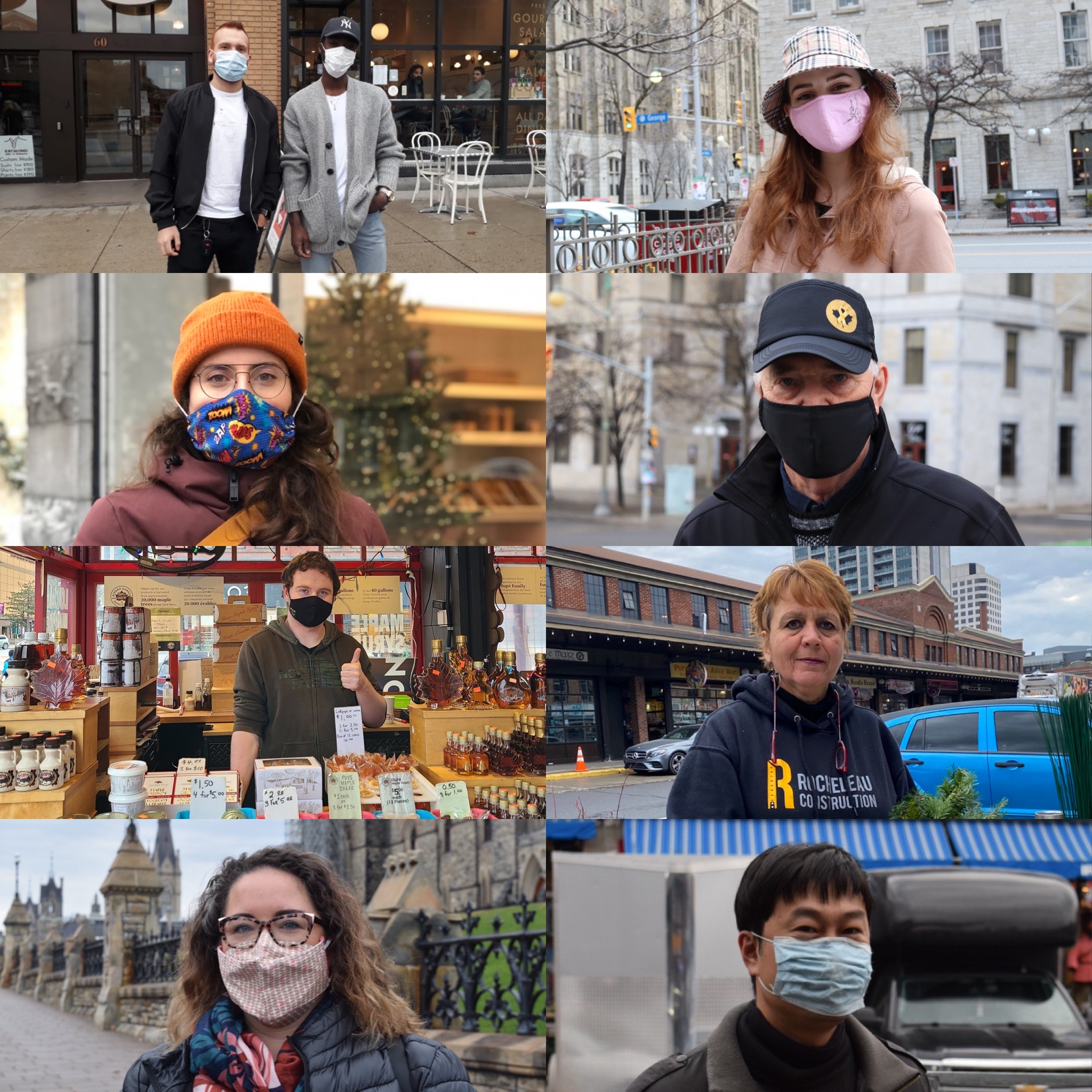
Photo: Algonquin Times reporters
Community members share how they'll be spending the holidays this year.

It’s no secret that the holiday season will look a little different this year. As the pandemic continues, provincial public health guidelines are encouraging people to re-think family gatherings and practice safe celebrations.

On Friday Nov. 20, Algonquin Times spoke with community members in downtown Ottawa to find out how they plan to celebrate the holidays this year. Here’s what they had to say.

Algonquin Times on Instagram
Algonquin Times horoscopes
Algonquin Times podcast
Follow Algonquin Times on Instagram
Algonquin Times horoscopes
Algonquin Times podcast
Follow Algonquin Times on Instagram
Algonquin Times on Instagram

Stay Informed

Sign up for our newsletter

Subscribe

* indicates required