The Sound of Falling in Love

How do you know you’ve fallen out of love? by Madison Costeira As we drove, my eyes were glued to the beautiful view. I hated the cold but nestled in the warmth of a heated car, I couldn’t help but appreciate the soft white glow outside. A thick blanket of snow weighed over the trees, […]

How do you know you’ve fallen out of love?

by Madison Costeira

As we drove, my eyes were glued to the beautiful view. I hated the cold but nestled in the warmth of a heated car, I couldn’t help but appreciate the soft white glow outside. A thick blanket of snow weighed over the trees, glistening as the car purred down the driveway.

I huffed on the window, watching my breath fog up the glass. I pressed a fingertip to it and scribbled a crooked smiley face.

“That’s gonna leave a mark, you know.”

I turned to face Mark, whose eyes were locked on the road ahead of him, his face expressionless. He turned quickly to look at me, his eyes hardly making contact with mine before he turned back to the road. A heavy silence draped over us for the rest of the car ride.

When we finally reached the school, I wasted no time unbuckling my seat belt before shoving myself out of the car. I waited expectantly for him to do the same, but he didn’t move. It was the fifth class of the year and he had been “busy” for the last four. There was no sense arguing, so I made my way alone.

When I reached the classroom, I slid through the half-open door and settled in at my usual table, the seat I saved for Mark still empty.

“Alright, guys! Your prompt for today is to write about what falling in love sounds like. I want to see emotion and style,” Mr. Haybury exclaimed, “and don’t be afraid to stray from the prompt!”

I watched the rest of the class dive for their pencils and start to write, and I tried to force myself to do the same.

With my paper blank, I couldn’t help but wonder. What did love sound like?

Surely it wasn’t the sound of the turn signal blinking in a silent car or the sound of six missed calls? Maybe it was the sound of a pillow being tossed in between your bodies as a barrier or even crying in the kitchen while he sleeps in the guest room.

The passion, love, and excitement that Mark and I felt were short-lived, but the chore of nursing a dying romance seemed never-ending. I couldn’t remember the exact moment I had lost feelings. It wasn’t like I suddenly woke up and realized I wasn’t happy.

“Ally? Are you ready to share?”

My stomach dropped and I tried to stay calm.

I stood, my chair scraping against the tile, making the room fall silent. My hands were shaking but I still clenched my journal until my fingertips turned white. I swallowed hard and looked up at the class. Thirty-some eyes peered up at me, waiting for me to speak. To them, it was no more than a piece of writing. To me, it was a confession.

I cleared my throat, “I decided to write about the sound of falling out of love”.

And with that, I looked down at my journal, the paper still bare.

Madison is a second-year Professional Writing student with a love for unhappy endings. She hopes to one day become an established fiction writer.

Students join forces to bring youth mental health awareness to Algonquin

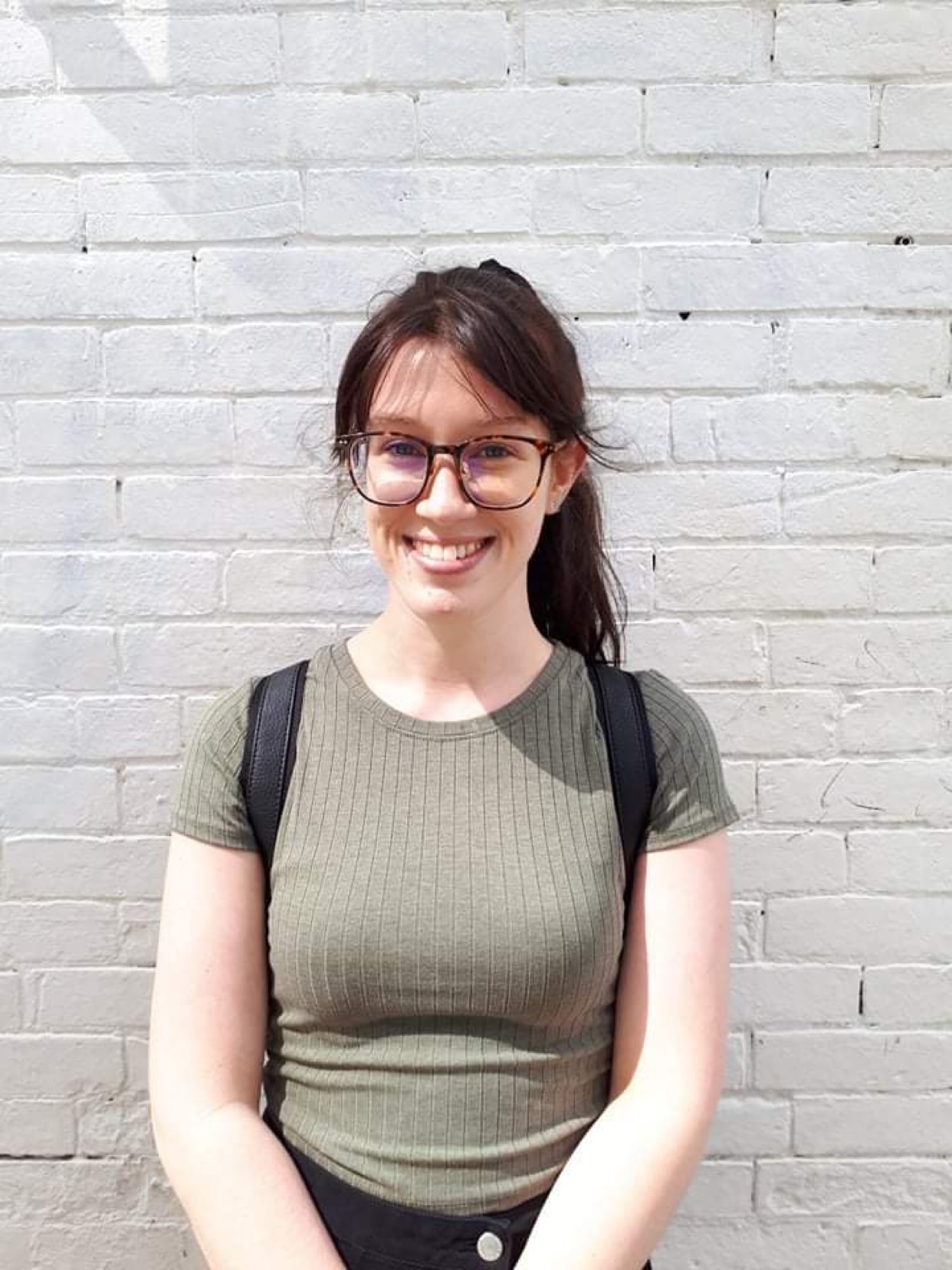
Stephanie Dejardin is set to launch Algonquin College’s first Jack.org chapter through the Students’ Association in January 2022. Dejardin is originally from Ottawa, but recently completed her bachelor of science in animal biology at the University of Guelph where she lived for four years. Currently, she’s in her first semester in the medical radiation technology […]
Photo: Supplied by Stephanie Dejardin
Stephanie Dejardin is helping establish a Jack.org chapter at Algonquin College, a youth led movement to end the stigma against mental health and bring empowerment to Canadian youth.

Stephanie Dejardin is set to launch Algonquin College’s first Jack.org chapter through the Students’ Association in January 2022.

Dejardin is originally from Ottawa, but recently completed her bachelor of science in animal biology at the University of Guelph where she lived for four years. Currently, she’s in her first semester in the medical radiation technology program at Algonquin College.

It was during her second year in university where Dejardin heard of Jack.org, a community started by youth for youth to empower other young adults through their mental health journey.

Dejardin attended a few events held by Jack.org at the University of Guelph and when the chapter announced they were looking for executive team members, Dejardin applied.

“I’ve always been very passionate about mental health,” said Dejardin.

Because it was Dejardin’s first time being away from her family and friends she was trying to branch out and develop a good support network. She believed that being around people who also cared about their mental health would be good for her.

Dejardin was first diagnosed with a panic disorder and generalized anxiety disorder when she was in high school.

“I feel like I’m in a better place now and I want to be able to help other people get connected to help,” said Dejardin. “That’s pretty much what Jack.org’s goal is, to connect people with resources.”

Sabrina Mastroianni, now a fourth-year neuroscience and psychology student at the University of Guelph, first met Dejardin during her second year of university.

Mastroianni has been involved with Jack.org since her high school years, which was when she took the initiative to start looking after her mental health.

As a child, she began displaying symptoms of anxiety and obsessive-compulsive disorder. In her teens, she was professionally diagnosed with both, as well as depression.

“Jack.org has been a huge part of my university experience,” said Mastroianni. “I don’t know where I’d be without the team and I just think it’s so important to have that youth-led conversation about mental health and illness. I think it’s been really amazing that Jack.org has been open to hearing so many different perspectives.”

Yasser Siddiqui, who lives in India, has plans to move to Ottawa before the winter semester begins to study marketing management.

Siddiqui has been working as an engineer for six years, and for the past two years, has been working as a mental health advocate through his own start-up.

Siddiqui had seen Dejardin’s Facebook post looking for members.

“The words ‘mental health’ immediately caught my eye,” said Siddiqui. “I got in touch with her to discuss more about what it was about. I found it similar to the kind of work that I’m doing.”

Because Siddiqui isn’t in Ottawa yet, he has noticed that there tends to be a gap in communication.

Regardless of this obstacle, according to Siddiqui, Dejardin has been an amazing co-lead to interact with and ensure that everything is in place.

Everyone on the team has a strong understanding of how important it is to normalize and de-stigmatize the conversation around mental health, which has created a strong foundation for the club.

“We want to bring change to how people talk about, discuss or care about their mental health,” said Siddiqui.

Dejardin wants students to know that there are options out there if they need mental health support or a safe community to talk with — whether it be the people at Jack.org, her club or the college’s resources.

“We’re still looking for team members, so if anyone wants to join we’d greatly appreciate it and it’s not a great commitment of time,” said Dejardin. “Honestly, the experience for me has been worth it. I’ve made lifelong friends and if you wanted to be part of a community project, it’s pretty low key, but we also are a really great community of people who support each other.”

For more information, contact jack.orgalgonquin@algonquinlive.com or follow on Instagram @jack.org_algonquin_chapter.

Food cupboard supports students in need

The Algonquin Food Cupboard, funded by members of the Algonquin community and the Algonquin Students’ Association, seeks to provide students with access to food and necessities. It is located in the Student Central in the basement of C- Building on the Ottawa Campus and open by appointment on Tuesdays, Wednesdays, and Thursdays from 8 a.m. […]
Photo: Carol Goddard
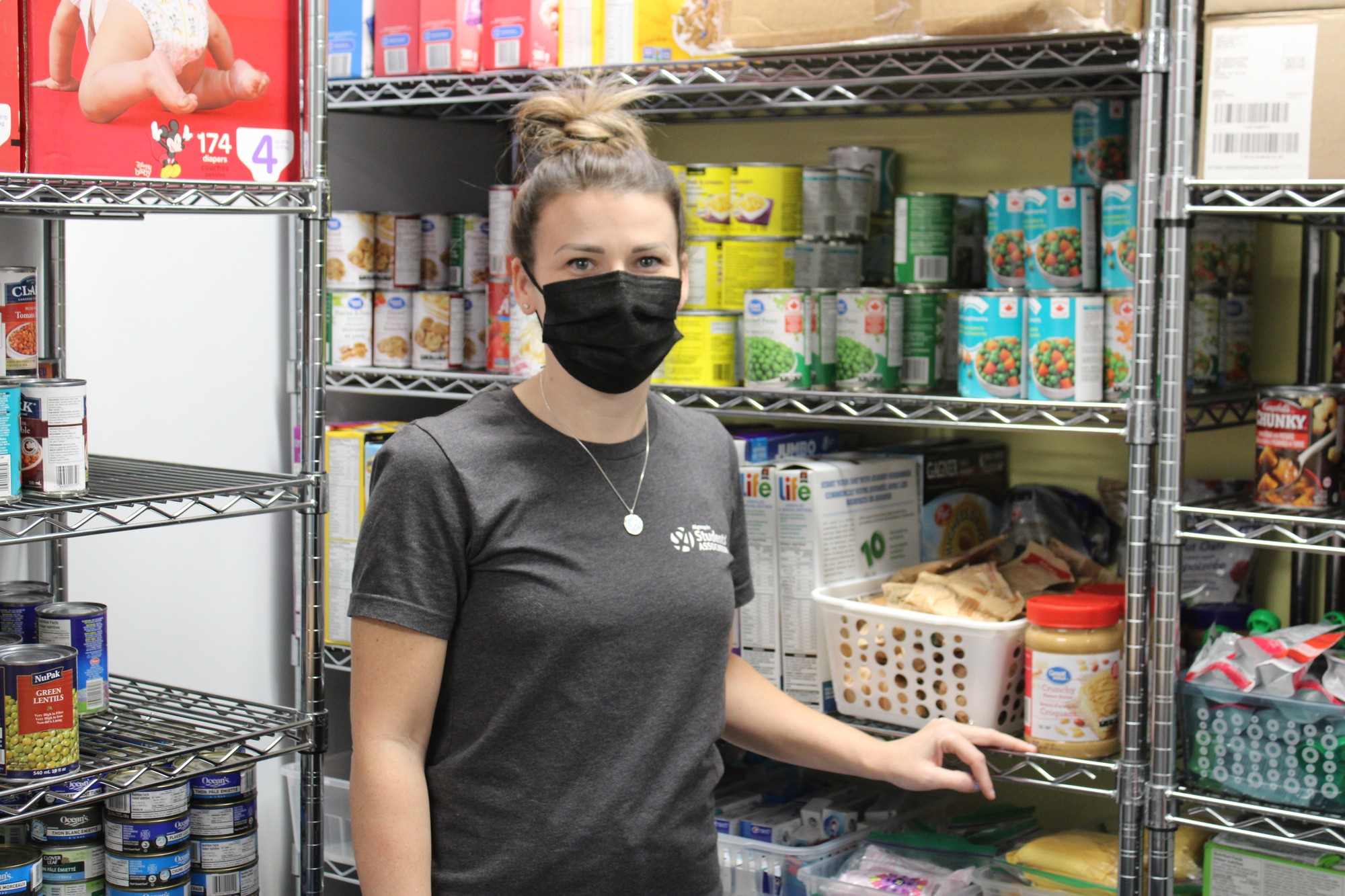
Jessica McCabe, food cupboard coordinator, is shown in the Woodroffe campus of AC.The shelves are full of food and other items for students to access if needed.

The Algonquin Food Cupboard, funded by members of the Algonquin community and the Algonquin Students’ Association, seeks to provide students with access to food and necessities.

It is located in the Student Central in the basement of C- Building on the Ottawa Campus and open by appointment on Tuesdays, Wednesdays, and Thursdays from 8 a.m. to 3 p.m.

The food cupboard opened in December of 2014 as a response to student concerns about food insecurity which can be defined as not having reliable access to food.

This issue arose because of several factors including the cost of tuition, cost of housing and food, coupled with financial concerns. Skipping a meal, running out of money that was budgeted for food, or worrying about not having enough to eat are all ways in which food insecurity is manifested.

Hungry for Knowledge, a study that has investigated food security among post-secondary students, was conducted across five Canadian university classes and found 8.3 per cent of students in the study had encountered severe food security, 30.7 per cent had moderate food security with 61 per cent not facing this issue.

Students as well as other members of society suffer from food insecurity.
Students as well as other members of society suffer from food insecurity. Photo credit: Source: Hungry for Knowledge study
Source: Data from Hungry for Knowledge study
Source: Data from Hungry for Knowledge study Photo credit: Carol Goddard

https://cpcml.ca/publications2016/161027-Hungry_for_Knowledge.pdf

“The Students’ Association board of directors recognized the need for a food bank on campus,” said Jessica McCabe, food cupboard coordinator at AC, when asked why the Food Cupboard began.”The food cupboard has been a recipient of support from the community and members of Algonquin College staff since it began,” she added.

McCabe continued how the need for food cupboard resources vary between accessing its resources on a monthly basis or only once or twice a year such as waiting for Ontario Students Assistance Program funds to arrive or upon returning to college after the holidays.

She mentioned in her email, between September 2020 and August 2021, the food cupboard was accessed 1136 times, before noting during the same time period, 56 spouses were “served through their partner accessing the service” and 85 children “served through their parents accessing the service.”

McCabe commented the food cupboard can provide its clients with access to resources available at their local City of Ottawa Food Banks and works with Period Packs, a local company “who have generously donated packs of menstrual products for students in need.”

As plans for a full return to students to campus, McCabe mentioned there may be an increased opportunity food cupboard fundraising activities, before mentioning a contactless food drive for the Algonquin Food Cupboard is planned for December 15 between the hours of 11 a.m. and 2 p.m. outside C-Building.

More information on the Algonquin Food Cupboard is available at www.algonquinsa.com/services/food-cupboard.

Campus organizations are bringing back the holiday spirit

The COVID-19 pandemic has not only forced students to adapt to virtual learning, but has also prevented them from joining extracurricular activities located at the campus. As more and more people are fully vaccinated, campus organizations are beginning to offer more in-person activities and workshops. One such organization, Project Lighthouse, known for raising awareness about […]
Photo: Sevval Kokten
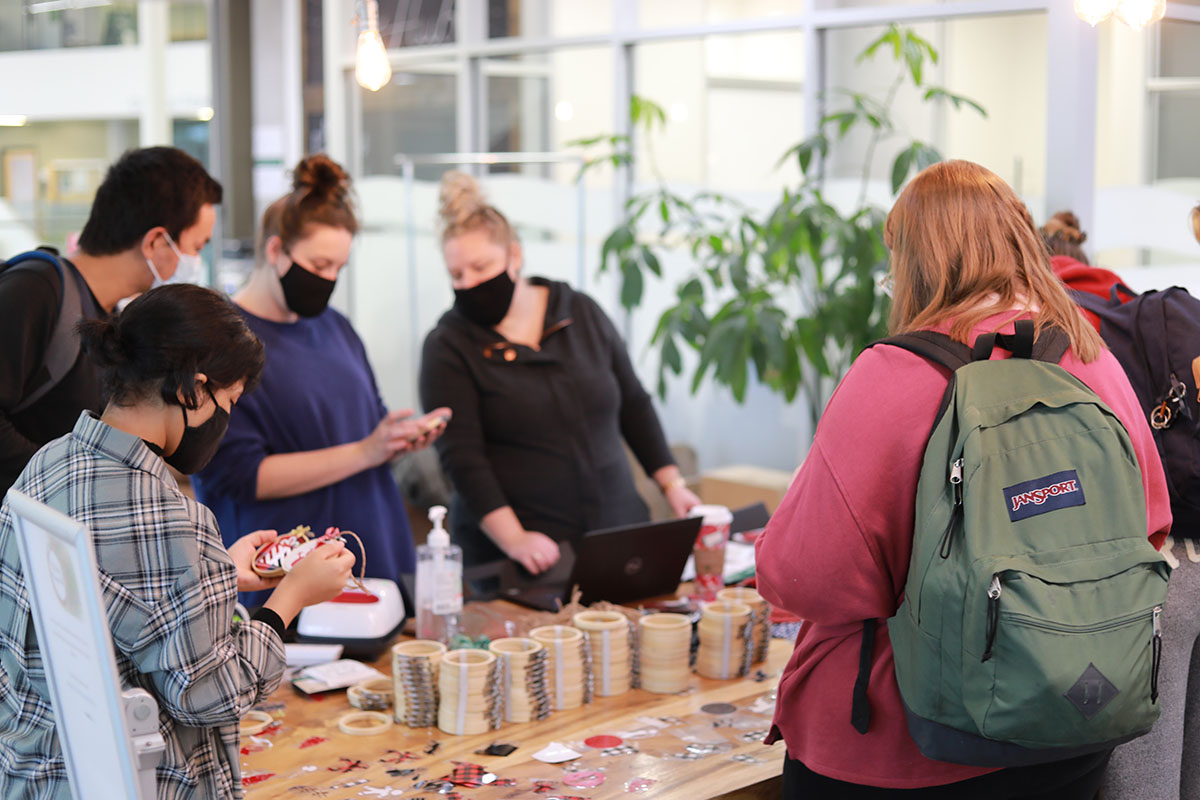
On Nov. 18, 2021, students were gathered around the AC Hub for the holiday ornament workshop to craft their ornaments.

The COVID-19 pandemic has not only forced students to adapt to virtual learning, but has also prevented them from joining extracurricular activities located at the campus.

As more and more people are fully vaccinated, campus organizations are beginning to offer more in-person activities and workshops.

One such organization, Project Lighthouse, known for raising awareness about sexual violence and providing guidance on how to have a healthy sexual relationship recently hosted one of their first free, in-person workshops titled “Holiday Ornament” at the Woodroffe campus on Thursday, Nov. 18, 2021.

The workshop provided materials and tools to craft your own ornament while socializing and meeting new students on campus.

“Now that the restrictions and changes are taking place, we wanted to re-engage our students on campus while we are allowed to do events in real life,” said Sarah Crawford, sexual violence prevention and harm reduction coordinator. “I thought doing holiday ornaments would be fun as we are leading up to the holidays.”

According to Crawford, there is a high volume of students who are interested in joining the holiday ornament event and other upcoming workshops that Project Lighthouse is organizing.

One of the many people who love to join in these types of workshops is Abeer Almonster, a third-year graphic design student. This workshop was an opportunity for her to come to campus and to be around other students.

“Shifting in between virtual and in-person learning could be nerve-racking, you kind of often stumble and forget how to be physically around people,” Almonster said. “When you are alone all that time it could get lonely at home.”

Layla Choi, a student in the cardiovascular technology program, joined a similar virtual workshop last semester, where she made Christmas wreaths during the lockdown.

“It wasn’t as fun as it was in this workshop. Our materials were delivered to our homes, but it was really hard for me to watch the instructor online and make my wreath,” Choi said. “In this workshop, I was able to get a one-on-one from the instructor and talk to other students and see what they came up with. I really felt the change in the atmosphere.”

For more details on upcoming events and how to get involved, students can visit student support services and scroll through the events calendar.

SA launches social media campaign promoting job opportunities

The Algonquin College Students’ Association plans to hire at least 150 students in preparation for the winter semester in 2022, anticipating the increased population at the Woodroffe campus. Over the last three weeks, students following the SA on Instagram have seen a push to promote jobs within many of their facilities. “The jobs are not […]
Photo: Julien Bernier
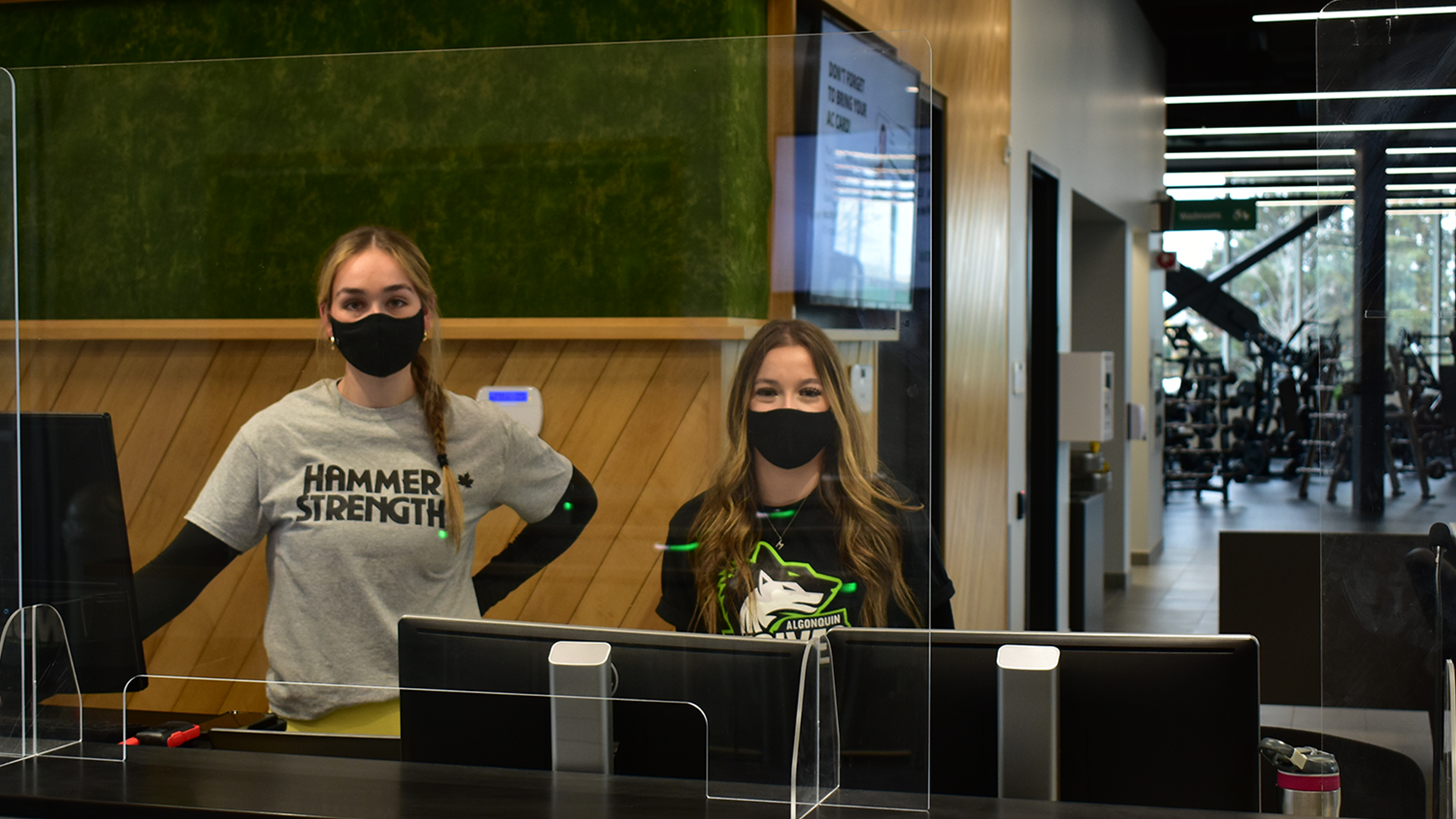
Marysa Voviau (right), a student in the esthetician program at Algonquin, and Madison Tarditth (left), a student in the pre-health sciences program both work at the ARC part-time while continuing their studies.

The Algonquin College Students’ Association plans to hire at least 150 students in preparation for the winter semester in 2022, anticipating the increased population at the Woodroffe campus.

Over the last three weeks, students following the SA on Instagram have seen a push to promote jobs within many of their facilities.

“The jobs are not taking long to fill—we’ve already hired many students this semester,” Matt Regnier, board operations and communications officer, wrote in an email. “The reason they’re still up and have a long application window is that there are multiple positions for each role.”

The SA is not looking for solely one barista or one bartender. Since the employees in those positions are students, it is impossible for just one full-time student to cover all shifts available.

Regnier says there can be as many as six baristas working at the same time and sometimes more than 20 on staff at the SA Starbucks at any time. The same can be said of the bartending position promoted. Bartending positions are available at the Wolves Den and will be available at the Observatory in the future.

As the college prepares for a full return to campus, facilities like the Wolves Den and the Observatory— the latter set to reopen in January of 2022- will require increased staffing which is why the SA continues to promote and post the jobs.

However, there is a distinction to be made. Student jobs tend to be ones with long closing dates for applications. There are more permanent positions for SA jobs and those have shorter application windows and are generally there because there is only one position available for that specific job.

Regnier likened the SA social media campaigns to a ‘we’re hiring’ sign on a business’s door.

The Jack Doyle Athletic and Recreation Centre has a few positions advertised, most with longer closing dates. A posting that has seen many applicants is the fitness representative position according to Timothy Lee, manager, athletic operations – fitness at the ARC.

“The reason we put it on [job posting] is as we continue to change the hours, the demand for staffing has continued to change,” Lee said. “As COVID restrictions relieve, we’re increasing our hours starting next week. There’s more coverage that’s needed.”

Bill Kitchen, senior manager for hospitality services, mentions that hiring people for the advertised positions has presented its unique challenges.

“It’s not the typical environment that it usually is. [It’s] Not unanticipated,” he said. “We’ve been pretty fortunate, or more fortunate it sounds than some in our industry out in the public sphere. We’ve found great candidates for all our positions but yeah, it’s probably moved slower than previously.”

Managers of the various departments do not actively ask the SA social media and marketing coordinator to promote that they are hiring.

They will however let the human resources department know that they need a job posting for a position they deem to be most important to fill at any given time.

Wayne Boucher, senior manager, HR policy and organizational policy for the Students’ Association, is in charge of creating the job postings. He is not in charge of the social media side of things.

“Jobs posts are made internally[to the SA website],” he said. “Then they will go to the Algonquin job board, and externally to sites like Indeed in some cases.”

Many students employed by the SA in part-time positions live in residence according to Boucher.

What happened to the Bio Wall in the ACCE building?

Students have been back on campus for nearly an entire semester, and many have noticed the state of one of Algonquin College Woodroffe campus’s most unique walls – the Bio Wall. The Bio Wall – or living wall – is looking a lot less green than it was prior to the COVID-19 pandemic. Students that […]
Photo: Julien Bernier
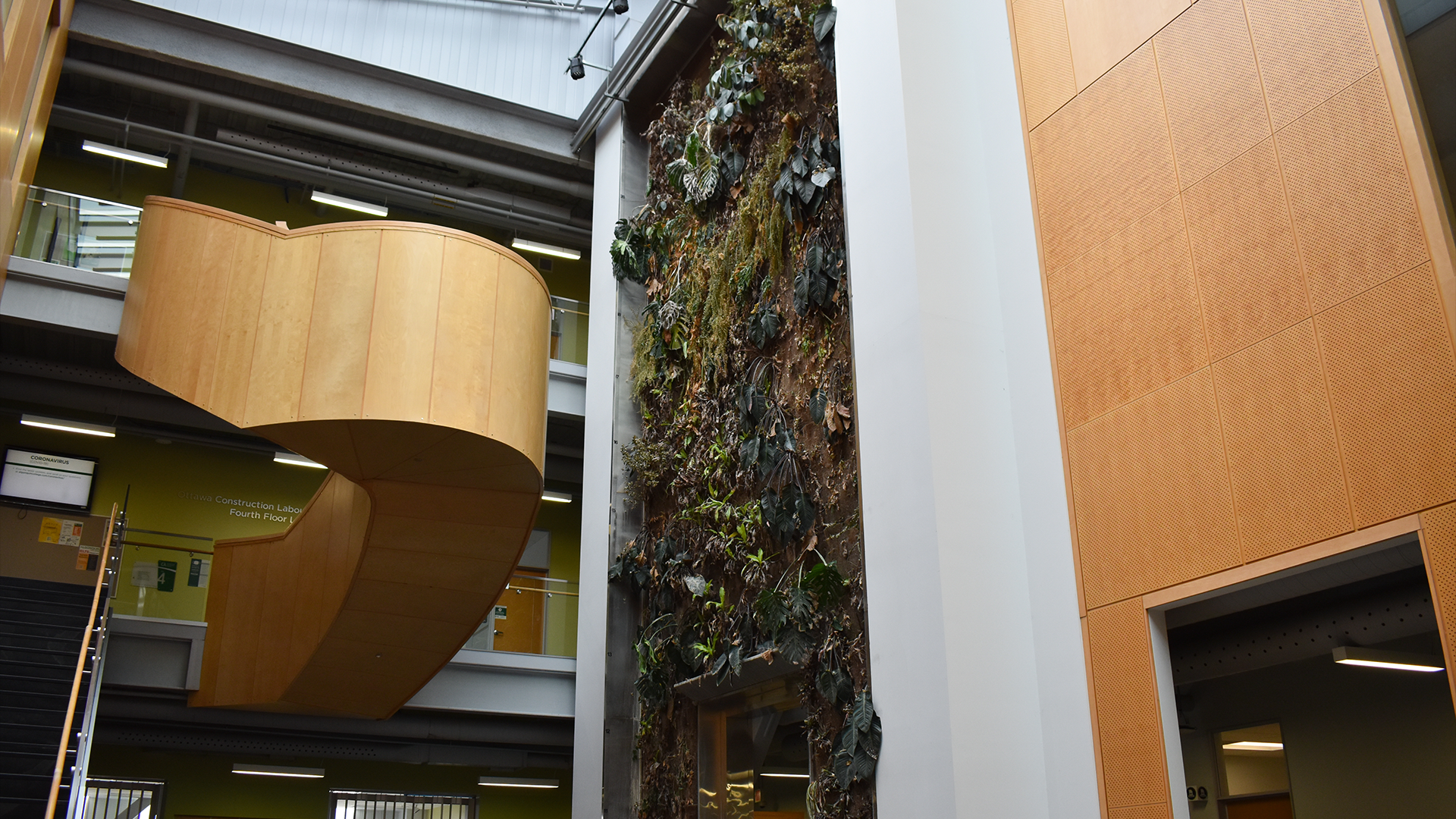
The Bio Wall - known also as the living wall - is one of Algonquin College's most unique displays. It will now have to be restored and may take many months of hard work.

Students have been back on campus for nearly an entire semester, and many have noticed the state of one of Algonquin College Woodroffe campus’s most unique walls – the Bio Wall.

The Bio Wall – or living wall – is looking a lot less green than it was prior to the COVID-19 pandemic.

Students that have passed by this wall and wondered why this was the case were given an answer in the form of signage.

This sign stated: ” The aerial lift used to maintain the living wall has been inoperable due to the travel restrictions imposed on the maintenance personnel as a result of the COVID-19 Pandemic. This is was to the dismay of our horticulturalists, the plants on the wall are dead and dying. They have not been able to receive the level of care necessary for them to thrive or survive.”

Signage has been left as students only source for answers to what was once something beautiful to look at and is now an eye sore.
Signage has been left as students only source for answers to what was once something beautiful to look at and is now an eye sore. Photo credit: Julien Bernier

This was not the only reason the living wall is dead.

Ryan Southwood, the executive director of facilities management at Algonquin College, explained that the aerial lift also needed maintenance but finding a technician to maintain it was difficult.

“We searched all through Canada for a technician that was qualified to deal with that [maintenance] and meet the safety requirements,” he said. ” But there was nobody available in Canada, the only place you could get it serviced was from technicians in the U.S.”

Southwood said that flying a technician over from the United States and having them quarantined for two weeks was not viable and so the company they contacted did not want to do that.

The decision was made to ship the lift to the United States to be serviced by the company they had contacted prior.

Importing and exporting equipment is not something the college does much of according to Southwood.

“Figuring out that process took – honestly, quite a few months,” he said. ” We finally found an exporter willing to work with us, but the paperwork was quite exhaustive and was another time sink.”

The aerial lift returned on Oct. 1, 2021, after maintenance was completed. A timeline for assessment was not given by Southwood who said the work would begin in a few weeks.

The living wall is in such a bad state that there may be a need to contract out the work to determine if the living matter on the wall is still viable or not.

Another reason the living wall is in the state it is in is due to the irrigation system not working due to blockages in it. This system is usually serviced by the facilities operations and engineering team. Due to the lift being inoperable they were not able to tend to the maintenance of the irrigation system.

The horticulturalists are in charge of maintaining the plants on this wall and as a result of the lift being out of commission, they were unable to tend to the living wall.

Rachel Rhoades, one of the horticulturalists at Algonquin College, said that the plants on the living wall are standard tropical plants that can be found in any home or retail store.

“They [the plants] require monthly or bi-monthly cleaning of the leaves to remove dust and insects,” she said in an email. ” Beneficial insects are released monthly in order to control the population of pest insects.”

Rhoades said the insect released is known in its common name as the mealybug ladybird is used to control the mealybug, which is the biggest pest second to the two-spotted spider mites.

The plants on the living wall are grown in water supplied by nutrients instead of being grown in soil.

“The water reserved is changed every three weeks and fertilizer added, “Rhoades said in an email. “The filters for the reverse osmosis system which delivers the water to the reservoir are changed roughly every six months.”

Rhoades does not think any of the plants on the wall will be salvageable as the water for the system has been off for months.

Work on restoring the living wall is set to begin in December.

“We have engaged a contractor to prune and clean up the wall in December,” Southwood wrote in an email. “And then replant in January if the growing medium is still in good condition.”

Away

“Will you answer the call to war?” Answered the call to war The men now march away To fight on foreign shores Blood has stained our souls Delusions now fall away Drowning in foxholes State of mind untenable Life now slips away Death has become plentiful We lie in silent tombs Body now rots away […]

“Will you answer the call to war?”

Answered the call to war

The men now march away

To fight on foreign shores

Blood has stained our souls

Delusions now fall away

Drowning in foxholes

State of mind untenable

Life now slips away

Death has become plentiful

We lie in silent tombs

Body now rots away

By war we’ve been consumed


Kyle is a second-year Professional Writing student at Algonquin College. He enjoys writing, music, video games, and cool stuff.

Stranger Still

Will You Deny a Stranger’s Hand? by Delina Murray I sit up desperately, dreams fading with each breath. I check the corners; one, two, three, four. Dresser, desk, basket, picture. Clear and empty. In the living room, my buzzing phone. Cold breeze through the window, warm blanket over tired limbs. My head sags back, and […]

Will You Deny a Stranger’s Hand?

by Delina Murray

I sit up desperately, dreams fading with each breath. I check the corners; one, two, three,

four. Dresser, desk, basket, picture. Clear and empty. In the living room, my buzzing phone.

Cold breeze through the window, warm blanket over tired limbs. My head sags back, and I’m

sinking.

The Stranger shuffles their cards leisurely, leaning back into a cushioned chair. The table

is illuminated in the dark of the throne room, the endless halls echo as the cards are spread.

“Kings,” they say, black teeth clacking. My fist closes around a chess piece, the statues in

the room cackle.

“QUIET!” The Stranger bellows, hushing them. I startle, the edges of the white knight

digging into my palm.

“You haven’t yet gone, are you afraid to show your hand?” The Stranger laughs

breathily, sending shivers down to my bones.

“It’s hurting me, I can’t play,” I beg. The Stranger’s cards glow, royal figures coming

alive under candlelight. Diamonds, clubs, hearts, spades.

“Yes, it’ll hurt. It always does.” The Stranger’s head lifts, their eyes nothing but holes of

pale flesh. “And it always will.”

“Not if I can help it,” I whisper into the quiet of my room. I’m on my side now, body

frozen. Was I talking to someone? Corners, the corners. One, two, three—there! He’s here. Long

and static, head up to the ceiling, arms spread; fingers contorted. The black mass, still and

watching. I clench my eyes shut.

“What, you don’t like me in the daylight?” The Stranger mocks at the edge of a cliff.

Ravens peck at my head, a crown of blood dribbles down and my eyes disappear. Big breaths,

one, two, three—

I’m on my back. My eyes won’t open. Keep at it, it starts with the fingers. Claw, grasp,

twitch. I hear a door creaking—my door? —and footsteps. They stop beside my bed. Please, I

don’t want it. The bed dips, my heart jackhammers and my breath quickens. A weight settles beside me. Something pulls my blanket. My mind screams and thrashes while my limbs stay still. The pulling stops. Somewhere far away, shrieking laughter.

I leave my body, floating through the wall, over the city, into the stars. Through the dirt,

down towards the earth’s core. The magma warms like the summer sun. Twirling now, through

oceans, over neon jellyfish fields. Spinning faster, to the crushing depths of the seabed and

up through the swaying pines. Up further, to the bathroom tile of my childhood home, a short

rest on the ceramic. Knocking on the door—one, two, three—OPEN YOUR EYES!

I’m here again, my fingers are moving. One twitch is all it takes to throw my arm over—

I’m free. I sit up, exhausted. The light from outside has barely changed, I can afford a little more

sleep. I check the corners, one, two, three, four. Dresser, desk, basket, picture. Clear and empty.

Cold breeze through the window, warm blanket over tired limbs. My head sags back, and I’m

sinking.

Delina spent the majority of her childhood and teenage years either face-deep in a book or eyeball-to-pixels with a television. Now, she dissociates on the regular and has rebranded her maladaptive daydreams as “creative skills”. She’d like to publish a novel someday. If that fails, she’ll move into the mountains with a horde of canines and wait out the apocalypse.

Logo Quiz

Can you spot the two incorrect logos?

Can you spot the two incorrect logos?

Students surpass fundraising goal while raising awareness for DIFD

A group of Algonquin College recreation and leisure services students have raised nearly $3,000 in funds, and an immeasurable amount of awareness towards Do It For Daron (DIFD) youth mental health. Students Tia Taft, Cathy Dowsett, Julianna Alibrando and Dakota Ostrowski have long surpassed their assignment goal of $500 for their second-year community development class. […]
Photo: Tia Taft
Students Julianna Alibrando, Tia Taft, Cathy Dowsett and Dakota Ostrowski have long surpassed their assignment goal of $500 for their second-year community development class.

A group of Algonquin College recreation and leisure services students have raised nearly $3,000 in funds, and an immeasurable amount of awareness towards Do It For Daron (DIFD) youth mental health.

Students Tia Taft, Cathy Dowsett, Julianna Alibrando and Dakota Ostrowski have long surpassed their assignment goal of $500 for their second-year community development class.

However, this has become much more than just a class project according to the entire group.

“The most important thing about this project is raising awareness and trying to decrease the stigma of depression and mental illness,” said Dowsett. “There’s no shame in not being okay, it’s okay to not be okay.”

The team will be hosting a fundraiser trivia night on Saturday, Nov. 13 at Buster’s Bar & Grill in Kanata from 2 p.m. to 5 p.m. Teams of three to five, individuals and families are all welcome. Trivia teams can contact Dowsett at dows0001@algonquinlive.com to register. A silent auction featuring prizes donated by local businesses will also take place.

On Sunday, Nov. 14, the team will be drawing a 50/50 raffle. The winner will receive half of the amount raised, with the other going towards DIFD. Tickets can be purchased for $2 by contacting Ostrowski at ostr0042@algonquinlive.com.

Aside from the events, Taft has been taking orders for her own English rock buns, made from ingredients donated by Brandon & Megan’s No Frills in Stittsville. The rock buns have become very popular according to Taft, especially after adding a fall-themed tweak.

“I thought, you know cinnamon, that’s quite a nice feel-good warm for this time of year,” said Taft. “Maybe I’ll do a cinnamon rock bun, so I did. I changed the theme, so it complemented, and all of the sudden the injection of orders came in.”

Taft has raised over $1,000 in the sale of her rock buns alone.
Taft has raised over $1,000 in the sale of her rock buns alone. Photo credit: Tia Taft

Taft, an international student from England, has been amazed by Canadian hospitality. Multiple small businesses are running themed programs like tea parties and bazaars featuring her rock buns.

Individuals have also come forward, volunteering their time to help fundraise.

“It just proves that when it’s for something that’s a good cause, people are willing to help,” said Taft. “You’ve just got to show that passion and that support just comes rolling in abundance.”

Dealing with mental illness can be a struggle for many, especially with the added layer of stress during the pandemic.

The chosen good cause, DIFD, supports education, awareness and research initiatives at The Royal in Ottawa, which encourage youth to talk openly about mental illness and to ask for help when needed.

“Care enough to act is the community development motto,” said community development professor Kevin Lee. “These guys certainly have cared so much, I’m certainly proud of the work that they’ve done and will continue to do. I think it’ll be something that they will hold in their hearts as they move forward.”

Follow Algonquin Times on Instagram
Algonquin Times podcast
Algonquin Times on Instagram
Algonquin Times horoscopes
Algonquin Times podcast
Follow Algonquin Times on Instagram
Algonquin Times horoscopes
Algonquin Times on Instagram

Stay Informed

Sign up for our newsletter

Subscribe

* indicates required