‘It just makes you happy.’ Performing Arts program hosts Sri Warisan dance workshop

The performing arts program hosted Sri Warisan Wayang Kulit (shadow puppet) on Sept. 29 at one of the classroom theaters. The performing arts group from Singapore executed traditional dances and […]
Photo: Elio Elia
Sri Warisan performing a traditional dance.

The performing arts program hosted Sri Warisan Wayang Kulit (shadow puppet) on Sept. 29 at one of the classroom theaters.

The performing arts group from Singapore executed traditional dances and explained the cultural and historical background behind the instruments and costumes.

The group then hosted a workshop involving the audience, teaching the students to perform the dances.

To cap off the event, group members gave the audience a chance to ask them any questions about the show. The group left to a standing ovation.

“I really liked the first dance, but the workshop was really interesting too,” said Rory Woodland, a performing arts student.

Fellow performing arts student Rebecca Macheri concurred. “It was fun,” she said. “The noises in the middle, the smiling, it just makes you happy.”

Sri Warisan won an award from the National Heritage Board for being “The Steward of Intangible Cultural Heritage” in 2020 for the same dances the group showed off in front of the Algonquin College students.

For performer Farrah Lindros Ewell, being able to display her culture in front the students gave her great pride.

“I think it was a lovely experience,” she said. “It’s not often that all of us are able to share our culture and our traditions.“

“Having an audience like the one here today is so amazing because they’re actually curious about us, and having a lot of passion for what we do. It makes us very proud to be a part of this culture.”

For performing arts coordinator Teri Loretto-Valentik, giving the performers a chance to show their artistic passion was more than just an educational lesson for her students.

“It is absolutely important to host events that display diverse cultures,” Loretto-Valentik said.

“If you look around the room, our students at Algonquin College, and in this program in particular, are incredibly diverse, and we want to be as inclusive as possible.

“As entertainers and as artists, I think it’s our job to learn about the world that we live in,” Loretto-Valentik said.

“So we’re going to do more workshops like this and hopefully bring in more cultural diversity for students.”

Algonquin College’s food cupboard adapting to increased demand

With a new school year starting, Algonquin College’s food cupboard has seen a growing demand for services. Through funding from the Students’ Association and support from local community members, the […]
Photo: Connor Lalande
Food cupboard coordinator Julia McCann standing alongside the program's inventory.

With a new school year starting, Algonquin College’s food cupboard has seen a growing demand for services.

Through funding from the Students’ Association and support from local community members, the food cupboard provides food and other basic household items to students facing financial constraints.

Julia McCann, the coordinator of the food cupboard, said the increase in demand is not a new development. The program first launched in 2014 and demand for its services has only grown, McCann said.

“It’s just really difficult with the cost of living increasing,” McCann said. “It makes it even more difficult for students to afford basic necessities like food.”

According to Canada’s Food Price Report 2022, overall food costs are set to increase by between five per cent and seven per cent throughout the year. The report, researched and released collaboratively by several Canadian universities, said it’s “the highest predicted increase in food prices since the inception of the report twelve years ago.”

The rising food costs are adding financial strains on students, resulting in greater numbers of them seeking the support of the food cupboard. McCann said the program has expanded the amount of food provided to students.

“We were giving out roughly three days’ supply of food to students,” said McCann, “and we’ve recently increased that to about five days because, seeing the increased demand, we are realizing that students need more.”

With price increases not being exclusive to food items, the food cupboard has also started offering nonedible household and personal items. Products like hand soap and laundry detergent are among the most popular as their high costs make them an added financial burden, McCann said.

When filling out the program’s intake form, students can request different food and nonedible household items based on their personal needs. The items are numerous and include refrigerated items like eggs and milk, frozen meats, canned goods and baby supplies. Provided the desired items are in stock, the food cupboard will then fill the order and contact the student with a pickup date and time.

The majority of the food cupboard’s donations are funded through the Students’ Association and, according to the program, the food cupboard has spent approximately $35,000 on donated items in the last 12 months.

Students also contribute a sizable portion of the donated food and household items. Those interested in donating can drop off food items at one of the three red and white Campbell’s Soup-themed bins located at the ARC, Students’ Association office and food cupboard office.

The food cupboard collects nonperishable food items throughout the school year. The donations go a long way in ensuring Algonquin College students are properly fed.

A message from your SA president

My name is Bolu Olutunda, Iโ€™m a second-year public relations student, and I am honoured to serve as the Algonquin Studentsโ€™ Association President. Five other students join me on the […]
The SA board connects with students on Algonquin's three campuses to understand what is important to them and the factors impacting their success.

My name is Bolu Olutunda, Iโ€™m a second-year public relations student, and I am honoured to serve as the Algonquin Studentsโ€™ Association President.

Five other students join me on the Board of Directors. Together, we work for our membership โ€“ full-time Algonquin College students. We connect with students in Ottawa, Pembroke, and Perth to understand what is important to them and the factors impacting their success.

We take those concerns to our committees within the college and regularly communicate them to the college executive team. Each year, the Board collects feedback from students. This feedback forms goals for our term in office.

This year, we are working to increase support for international students, increase quality housing options in Pembroke and Perth, enhance the knowledge of mental health services to students, improve the academic calendar from the studentsโ€™ perspective, reinvigorate student life, expand the mandate of the class representative system, and extend the benefits of the U-Pass. You can find out more about each priority at Alqonuinsa.com/BOD.

Iโ€™m happy to share why increased support for international students is at the top of our list.

The SA is committed to diversity and inclusion on our campuses. We know that international students enrich our community and the student experience in many ways. We also know that there are needs specific to international students demanding our attention and action.

How we support and care for international students is crucial to the success of students and Algonquin College. I look forward to many conversations with students and the leadership at Algonquin College โ€“ and to the changes that come when we listen to students.

Algonquin College club fostering community through rock climbing

Algonquin College’s rock climbing club is working to foster a community among students through the club’s namesake sport. Seeking to establish and support a community for student rock climbers at […]
Photo: Connor Lalande
Club leader, Kyle Van Schaik, demonstrating his skills.

Algonquin College’s rock climbing club is working to foster a community among students through the club’s namesake sport.

Seeking to establish and support a community for student rock climbers at the college, the club hosts climbing-related events throughout Ottawa and the surrounding area.

Welcome to all, club members range in ability levels from beginner to experienced. During events, members climb in an encouraging environment where they can learn tips and challenge themselves to improve alongside others.

For many who join, attending one of the club’s events will be the first time they have ever tried rock climbing.

Kyle Van Schaik, a second-year computer engineering student and one of the club’s leaders, said joining was a great way to learn the sport and improve his skills.

“It’s just fun to hang out with people and get physical activity at the same time,” said Van Schaik.

Events are held multiple times within a given month and range from climbing gym meet-ups, movie nights, outside climbing sessions and pub gatherings.

Aside from the rock climbing itself, the club also serves an important social role for its members.

“It gives you a chance to meet people that aren’t just in your program,” said Alicia Parker, a first-year photography student, “because otherwise, your main social group is just people you are taking classes with.”

Robert Odin Cassan, a first-year mechanical engineering student, agreed that the club is a fun and fulfilling way to get more involved in the college’s student community.

“This is the first club event that I’ve done, and this is totally awesome,” said Cassan.

While some may be intimidated by joining one of the college’s clubs, students like Parker say there is no need.

“Most clubs are really excited to have new people and to share the stuff their passionate with,” said Parker. “That’s why they made a club in the first place.”

People interested in joining the rock climbing club can find more information and the club’s registration sheet on the Algonquin College Students’ Association website.

‘I think if I had run, I still would’ve won.’ Rick Chiarelli addresses allegations and decision to not run

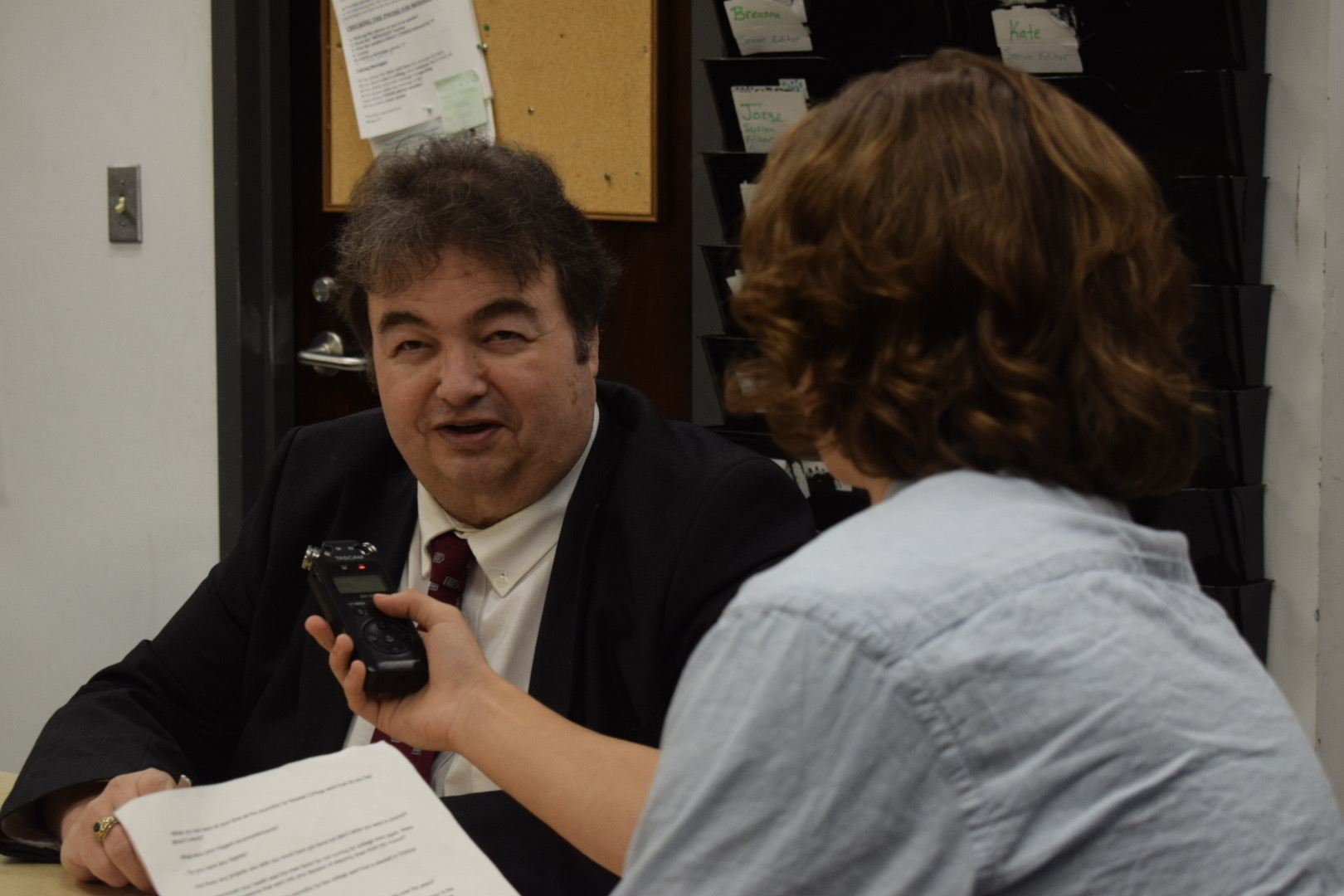
Long-time College ward Coun. Rick Chiarelli mused about running for office in the future during an interview with the Algonquin Times, despite the conduct violations revealed by an integrity investigation […]
Photo: Aadil Naik
Coun. Rick Chiarelli will not seek reelection in the upcoming municipal election. He spoke with an Algonquin Times reporter about his decision.

Long-time College ward Coun. Rick Chiarelli mused about running for office in the future during an interview with the Algonquin Times, despite the conduct violations revealed by an integrity investigation into inappropriate and sexually charged behaviour in the workplace.

“If I were to get elected again, which I may, it would be to meet residents, see what’s important to them and make sure those things are done,” said Chiarelli.

Chiarelli is not seeking reelection in the upcoming municipal election.

A former Chiarelli staffer said she would be worried about a possible return to politics for Chiarelli.

Nancy O’Brien, who’s advocating for stronger penalties for conduct violations by municipal politicians, said she was experiencing severe anxiety and sleep loss in the lead-up to the election registration deadline because she feared Chiarelli campaigning in College ward, where she lives.

“I wouldn’t be surprised. He has the audacity and clearly has no remorse for his abusive behaviour,” said O’Brien on Chiarelli contemplating a return to politics in the future.

O’Brien feels there needs to be more accountability for elected officials, suggesting a neutral third-party body passing judgement and penalties on council instead of the current system of fellow councillors assessing each other.

“Rick Chiarelli is the byproduct of a system where individuals are given power and influence with no accountability for their behaviour,” said O’Brien.

Chiarelli partly blames accusations against him on the culture surrounding the #MeToo movement and political motivations.

“The overcorrection caused by the #MeToo movement has turned this kind of accusation into a weaponization of politics because you can bring down any male member of council just by having three or four people make an accusation,” he said.

Chiarelli said he does not think the conduct allegations affected his legacy as a city councillor and feels he would still win if he chose to run for office again.

“I think if I had run, I still would’ve won,” he said. “In the end, people look at what they have around them, and most people like where they live. They think we’ve done a good job with it.”

Chiarelli attributes his decision to not run for another term in council to health and family matters. Chiarelli underwent open-heart surgery In December 2019 and a bacterial chest infection in January 2020, according to a tweet attributed to his wife, Lida, posted on Jan. 10, 2020.

Chiarelli said his mother died months ago. He also said his family is tired of dealing with the fallout from the conduct allegations he faced.

The allegations surfaced in 2019 when five women filed formal complaints against the longest-serving Ottawa city councillor. The city’s integrity commissioner found Chiarelli committed “incomprehensible incidents of harassment” against his female staff members and job candidates. Chiarelli has denied the allegations.

Chiarelli is set to receive a $55,000 transitional allowance as he leaves city council. “I’ll probably put it into, at least some of it, into RSP (retirement savings plan),” he said.

O’Brien had her own suggestion for what Chiarelli should do with the money.

Chiarelli “should donate this money to a charity dedicated to stopping violence against women,” said O’Brien.

As for his plans when a new councillor is appointed to College ward, Chiarelli does not fully know what is in store for him, but he expects to be involved in some capacity in film production for a Christmas movie.

College unveils sculpture on National Day for Truth and Reconciliation

An Indigenous storyteller led an emotional ceremony at Algonquin College on Sept. 30 in honour of National Truth and Reconciliation Day. The college also unveiled a commemorative sculpture. On a […]
Photo: Sophia Adams
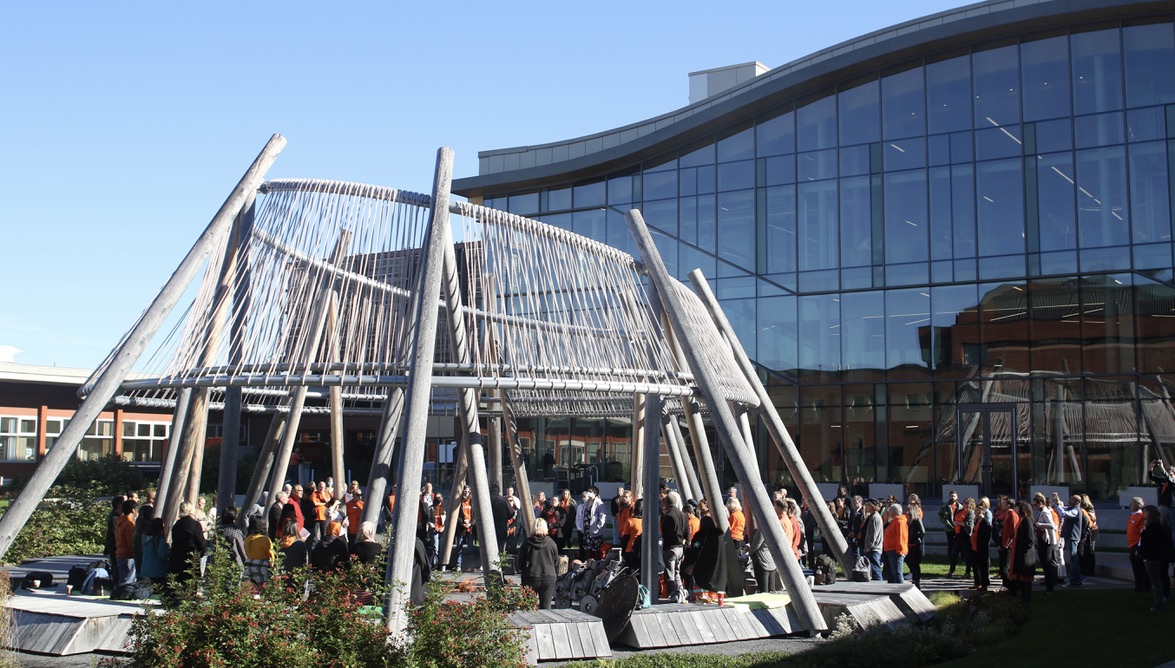
People gathered in the Ishkodewan Courtyard on the National Day for Truth and Reconciliation.

An Indigenous storyteller led an emotional ceremony at Algonquin College on Sept. 30 in honour of National Truth and Reconciliation Day. The college also unveiled a commemorative sculpture.

On a day intended to honour the families and children who are affected by the residential school system, guest speakers, faculty members, families and young children, most of whom were wearing orange shirts or an orange shirt pin, met in the Ishkodewan Courtyard and took comfort under the Gathering Structure.

The event began just after 10 a.m. as people shared hugs and settled into their seats.

Setting the tone with honesty and personal impact stories, community knowledge keeper and Indigenous rights advisor Michael Desautels led a storytime.

Beginning his speech by emphasizing the beauty of being Indigenous and how he became knowledgeable about history, Desautels shared parts of his life, the lives of his family and community members, and the significance the day holds for them.

Urging his listeners to reflect on their families and who they love, Desautels asked them to imagine having that same loved one being taken away without any say. While he himself did not experience the first-person effects of residential schools, he said he is familiar with the pain it caused.

Desautels talked openly and truthfully what being Indigenous means for him.

Discussing what community members can do to help reconciliation on Sept. 30 and on other days, he said, “What we ask of our settler allies is to not let the government get away with it anymore.”

“Lend your voice to what is happening. Lend your voice to the fact that there are still 53 communities in Canada that do not have access to clean drinking water and lend your voice to the fact that the students who attend provincially funded schools will receive $3,000 per student per year more than Indigenous kids,” he added.

It was a sunny day with a breeze. Children, as young as three or four years old, were bundled warmly and had smiles on their faces. They were seated in a circle with blankets close to the fire. The adults, participants, and contributors gathered closely behind.

Near the end of the event, participants were welcomed to the sculpture unveiling.

To commemorate those who suffered from or never returned home from residential schools, Barry Rager, a local artist, created a monument that helped tie the morning together.

The sculpture is made of metal and depicts flowers surrounding numerous pairs of shoes from young children. The front of the sculpture reads, “Remembering the Children.”

Thanking everyone who showed up, Algonquin College president Claude Brulé emphasized that Sept. 30 is a day for change.

“We value the contributions that First Nations, Inuit, Métis and other Indigenous Peoples have made, both in shaping and strengthening this community, province and country,” Brulé said.

Students’ OC Transpo frustrations increase

With many students returning to campus for in-person courses this semester, OC Transpo has welcomed back riders to the transit system. A total of 9,014 U-Passes had been issued to […]
Photo: Myriam Landreville
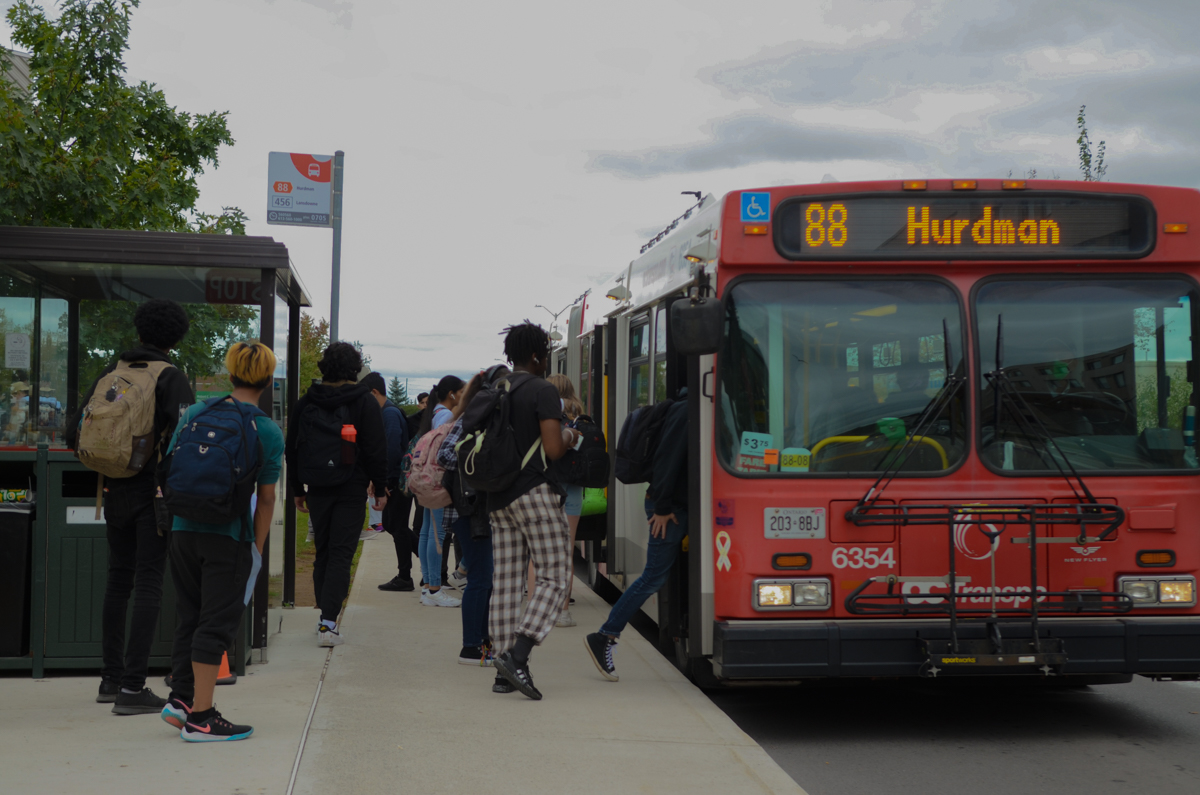
Students entering on the Route 88 Hurdman bus.

With many students returning to campus for in-person courses this semester, OC Transpo has welcomed back riders to the transit system.

A total of 9,014 U-Passes had been issued to Algonquin College students for this semester as of Sept. 22 according to Card Services. Citywide, approximately 80,800 U-Passes were issued to full-time students at participating institutions, according to the City of Ottawa.

For many students, however, there is dissatisfaction with OC Transpo.

“It feels like a waste of time,” said Étienne Paré, a computer engineering technology student.

Paré said it typically takes him 90 minutes or more to get to school from Orléans “and I can’t practically do homework during that time.”

This commuting time is not uncommon for Ottawa. According to the Moovit, an online and mobile application that helps riders map out their routes, an average Ottawa commuter spends 84 minutes a day on the bus and 86 per cent of riders spend over two hours riding. In Toronto, the average is 52 minutes, and in Montreal it’s 47 minutes.

OC Transpo says that the commute from Orléans to Algonquin College should take approximately an hour.

Other students are pointing out how packed buses can be.

“The 88 specifically is always packed like sardines,” said Nadia Desormeaux a business-marketing student.

“It’s draining when I’ve had a long day at school and I have to stand next to everyone squished together. And more often than not there is always someone sick who chooses not to wear a mask.”

OC Transpo has launched a new ad campaign with a budget of $625,000 approved by city council.

One of the advertisements has received particularly harsh criticism online. The advertisement, which says “A pass costs less than gas,” has made some customers angry.

A thread on Reddit Ottawa has many commenters calling for better service, not more ads. “A pass costs less than gas…BUT I can fill up my tank and know that I won’t get fired for not making it to work on time,” one commenter wrote.

“The campaign is not being received well. People are feeling that the ads and by extension OC Transpo are gaslighting them in their experiences. It is a bit tone deaf,” said Sarah Wright-Gilbert, a member of the transit commission, during the commission’s most recent meeting.

Commuters are pointing out that the monthly OC Transpo pass for adults is $125.50, which is one of the highest prices in the country.

However, students are able to get a U-Pass at a rate of $223.48 per semester with an administrative fee of $5.65 per academic year, which is cheaper than the adult pass.

The price of the U-Pass has jumped by $15.96 and the administrative fee has jumped by $2.23 since the 2018/2019 academic year.

“I am not worried about prices yet, but if it keeps increasing I will be” said Paré.

Mayor Watson reflects on political career and life after city hall

Outgoing Mayor Jim Watson says he hopes politicians of today make sure they underpromise and over-deliver. “I think they all have to realize nothing is free in life. You can’t […]
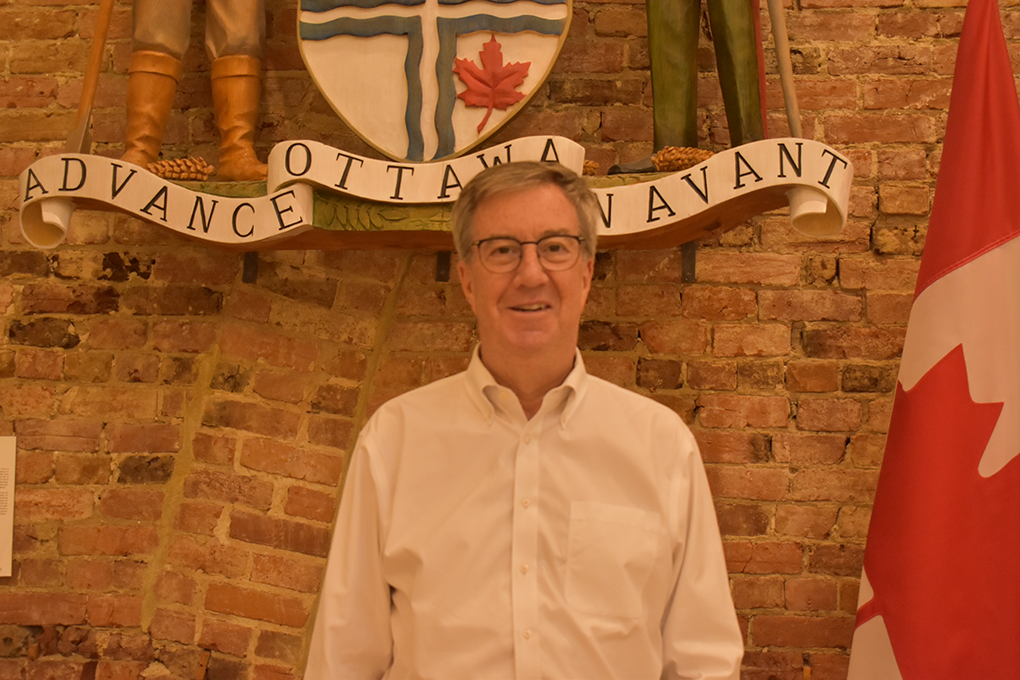
Ottawa Mayor Jim Watson, who isn't seeking re-election in October, talked with the Algonquin Times about his exit from city hall.

Outgoing Mayor Jim Watson says he hopes politicians of today make sure they underpromise and over-deliver.

“I think they all have to realize nothing is free in life. You can’t promise free transit because you got to pay it somehow,” said Watson.

Watson, who isn’t seeking re-election in the Oct. 24 municipal vote, talked to the Algonquin Times about his exit from Ottawa City Hall.

Watson said he first ran for municipal politics in 1991 as a city councillor because he was displeased with a councillor’s decisions and the direction the city was going.

“They were investing a lot in almost monuments to themselves. You know, a new city hall, a new regional headquarters,” said Watson. “The tax rate was well above the rate of inflation. And there were a lot of people upset at the lack of action on Lansdowne Park, which was a big issue.”

He said that during the 1990s, Lansdowne Park was a big issue because the previous council — the one he got elected to — voted to tear down the Aberdeen Pavilion. So, instead of sitting on the sidelines and grumbling about it, he organized a campaign with some friends.

“I thought I had a realistic chance of winning because people seem to like the message that I brought to the election of living within our means and preserving our heritage,” said Watson.

In 1994 he was elected mayor in the pre-amalgamated city of Ottawa. Then, in 1997, he left municipal politics and worked as the Canadian Tourism Commission president. After that, he was elected as an MPP for two terms and served in provincial cabinet. He returned to municipal politics and was reelected in 2010, 2014 and 2018 as mayor in the amalgamated city of Ottawa.

LRT expansion

Watson said that with phase two of the LRT under construction, it will serve Algonquin College very well because it will connect the four post-secondary institutions with rail.

“Obviously, notwithstanding the challenges of the first year, the light rail system will serve as well in the future,” he said.

The City of Ottawa is counting on the provincial and federal governments support to split the entire cost of Phase 3 extensions that would serve Barrhaven, Kanata and Stittsville.

The Innovation Centre

“The centre is run by Invest Ottawa, one of my creations, and we have four post-secondary presidents. Claude Brulé, the president of Algonquin, sits on the board of directors,” Watson said.

Arts Court

“For years, we talked about building a proper art gallery and nothing ever happened, and I was fortunate enough to play a small role in bringing everything together, and it’s now open seven days a week behind the Rideau Centre,” Watson said.

A new Ottawa central library

“A new library is under construction and will kickstart the LeBreton Flats for redevelopment that will hopefully have an arena for the Senators,” Watson said.

New Civic Hospital

Another project that will have a massive impact on the city is the new Civic Hospital.

“How can a city help make that $2-billion dream become a reality to better serve our residents in western Quebec, eastern Ontario and the far north of Nunavut that use the Civic as our trauma unit for the region?” said Watson.

Watson said COVID-19 has affected every person in some way.

“Over 800 people died and that number continues to go up,” said Watson. “I think it was a good team model, or response. We got the best results for vaccination of adults and the best in Canada and the best in children’s vaccination in all of Ontario.”

Watson said test centres opened quickly, mobile units opened in economically challenged neighbourhoods and vaccination centres opened in collaboration with hospitals.

“Our Ottawa Public Health and branches did an excellent job,” he said. “I’m proud of the work that our paramedic service did and our social services where open respite centres for the homeless to go and self isolate.”

Watson also talked about the downtown truck convoy earlier this year.

“The truck protest was another challenging opportunity. But I think, you know, notwithstanding, it went on too long, in my opinion,” said Watson. “The one thing that people forget to realize is that not one person was seriously injured or killed during that protest. And that could have turned on a dime, the severity of the situation.”

Watson’s last day in office is Nov. 14 and he said he’d like to take a train ride across the country on VIA Rail.

“At some point, I’ll probably do that sometime in the fall after the term is over,” he said. “I’ll sleep in for a couple of weeks and then I want to do some more voluntary work and charity work. And we’ll see what comes to that.”

Online Editor

The Algonquin Times is a newspaper produced by journalism and advertising students for the Algonquin College community. Follow us on social media! Algonquin Times Twitter Twitter (Events & Promos) Facebook Facebook (Events & Promos) Instagram Snapchat

Algonquin College cricket club dominates summer tournaments

The Algonquin College Cricket Club displayed its dominance at the 2022 Capital Cup and men’s nationals, winning both tournaments. At the Captial Cup, Algonquin College defeated Concordia University by five […]
Photo: Manveer Singh Chopra
The Algonquin College Cricket Club celebrates its victory in the men's nationals

The Algonquin College Cricket Club displayed its dominance at the 2022 Capital Cup and men’s nationals, winning both tournaments.

At the Captial Cup, Algonquin College defeated Concordia University by five wickets and Carleton University by five wickets on Aug. 11. The next day, Algonquin trounced University of Ottawa by 69 runs before defeating Carleton University again, this time in the final, by three wickets.

In the men’s nationals, Algonquin College battered St. Clair College and Nova Scotia XI by 91 runs and 79 runs, respectively, on Sept. 7. University of Toronto St. George was beaten by six wickets before McGill University lost by 25 runs.

In the semifinal, Algonquin College annihilated Brock University by 134 runs, before defeating Toronto Metropolitan University by eight wickets to win its second title of the summer.

Manveer Singh Chopra, an opening batsman for Algonquin College, credited the team’s performance to its collective talent.

“It was all a team performance,” he said. “From the Capital Cup to the nationals in Toronto, we had some very good senior players who were guiding the youngsters and the whole team through tough situations.”

“We weren’t dependent on one player to perform well every match because the whole team excelled. It was a tough win in the finals, we lost a lot of wickets, but our confidence and team spirit were high. What our guys did was exceptional,” Chopra said.

His sentiments were shared by his teammate Jasleen Singh Saini, an all-rounder.

“The most important thing was there was no pressure on any particular person to perform,” Saini said. “All 11 players were brilliant. In every match a different person performed and took the responsibility to score runs or take wickets. That’s good for our team. That’s how we won.”

Both men thought the team performed strongly from the very first day and overcame any challenge.

Chopra recalled one match when the team needed a special performance for the victory.

“The match against McGill University, our batsmen were struggling to perform,” he said. “But one of our players, Arun Anthony, singlehandedly won the game for us.”

Anthony scored 69 out of 128 runs and took five wickets, including a hat-trick, as Algonquin College won the game and secured itsplace in the semifinals.

“Everyone knew their own role,” said Saini. “We had good bowlers, good batters and everyone was disciplined.”

The final of the men’s nationals saw Algonquin College bring its nine-match winning streak into the last match of the season. They were set a total of 156 runs for victory by Toronto Metropolitan.

“In finals, chasing 150 or 160 is a tough target because you have a pressure,” said Chopra. “They [Toronto Metropolitan] have a very decent bowling line up. Throughout the season they would win matches by taking early wickets.”

Manveer Singh Chopra was man of the match in the final after scoring 100 not out.
Manveer Singh Chopra was man of the match in the final after scoring 100 not out. Photo credit: Manveer Singh Chopra

Chopra, who made back-to-back unbeaten centuries in the semifinal and final, said the strategy in the final was patience.

“We decided not to throw our wickets at least for six or seven overs. Even if the score is around 30 or 40, it doesn’t matter. If we have the wickets at the end we can easily chase the target,” he said.

Algonquin College claimed an emphatic tenth consecutive win as it clinched the title, losing only two wickets and chasing down Toronto Metropolitan’s score of 155 with 18 balls to spare.

The team’s dominance is even more impressive considering there is no single voice at the top.

“We don’t have a coach,” said Chopra. “We have some senior players who have been playing for quite a long time with Algonquin College and have been guiding us.”

According to the website Cric Clubs, Algonquin College has played five tournaments since 2019. The college has won four of them: the Capital Cup in 2019, 2021 and 2022, and the nationals in 2022. In those five tournaments, the college has played 22 matches. The team has had one no result, two losses and 19 wins.

‘They just want us to get the basics right.’ Mark Sutcliffe is running to restore trust in Ottawa

Mark Sutcliffe is hoping his centrist campaign for mayor will lead him to victory in Ottawa. “I heard more and more from people that they thought there was a need […]
Photo: Cameron Ryan
Mark Sutcliffe is running a centrist campaign for mayor.

Mark Sutcliffe is hoping his centrist campaign for mayor will lead him to victory in Ottawa.

“I heard more and more from people that they thought there was a need for a strong centrist, sensible, non-partisan candidate to kind of come in and get everyone working together,” Sutcliffe said during an interview.

Sutcliffe, a lifelong resident of Ottawa, is an entrepreneur and businessman. He is in what many consider to be a three-way race with Coun. Catherine McKenney and former mayor Bob Chiarelli.

Sutcliffe has spent his career in media. He founded the Ottawa Business Journal, has hosted a radio show on CFRA and written columns for the Ottawa Citizen. He also served on the board of Algonquin College from 2012 until 2017.

With no prior political experience, Sutcliffe is running on his record as a successful businessman, community leader and volunteer.

“I want to bring a fresh outside perspective to city hall. I’m not a career politician, I have nothing against people who choose to spend their lives in politics, but I think there is more than one way to serve your community and I’ve spent the last 30 years serving my community as a volunteer and by starting small businesses and working in the media,” said Sutcliffe.

“Jim Watson and Bob Chiarelli and Catherine McKenney have been in politics for more than 25 years or longer, all of them.”

Watson, the current mayor of Ottawa, is not seeking re-election.

Sutcliffe is not affiliated with any political party and the non-partisan nature of municipal politics is what attracted him to this mayoral race, as opposed to running provincially or federally.

“I’m not trying to win some partisan battle, I’m trying to bring everybody together from across the political spectrum and from throughout the community, bring everyone together and get them working together,” said Sutcliffe.

Sutcliffe said he is focused on bringing competent leadership to Ottawa and restoring trust in the city’s systems, such as public transit, road quality and emergency services.

“There are obviously lots of big ideas we can tackle as well but ultimately people, they just want us to get the basics right, they want us to deliver city services that work for them and work for them no matter where they live in the city,” said Sutcliffe.

Sutcliffe bills himself as the candidate that can bring everyone together to solve the city’s toughest problems without letting partisanship get in the way. He lamented the infighting and toxicity in the last term of council.

“I don’t have all the answers and I’m not an expert in many of those areas but what I am is a leader and I can bring the right people together and put aside the partisan ideological differences and get people working together towards a shared objective,” said Sutcliffe.

Sutcliffe has an uphill battle to climb with the latest polling from Mainstreet giving McKenney a 14-point lead over him.

Sutcliffe’s name will appear alongside 13 others vying for the job of mayor when voters go to the polls on Oct. 24.

Algonquin Times podcast

Stay Informed

Sign up for our newsletter

Subscribe

* indicates required