Fire causes evacuation of college residence

Algonquin College students were treated to an early wake-up call Saturday after a fire alarm at 3:18 a.m., causing the entire residence to be evacuated. No injuries were reported. “Just […]
Photo: Guillaume Laflamme
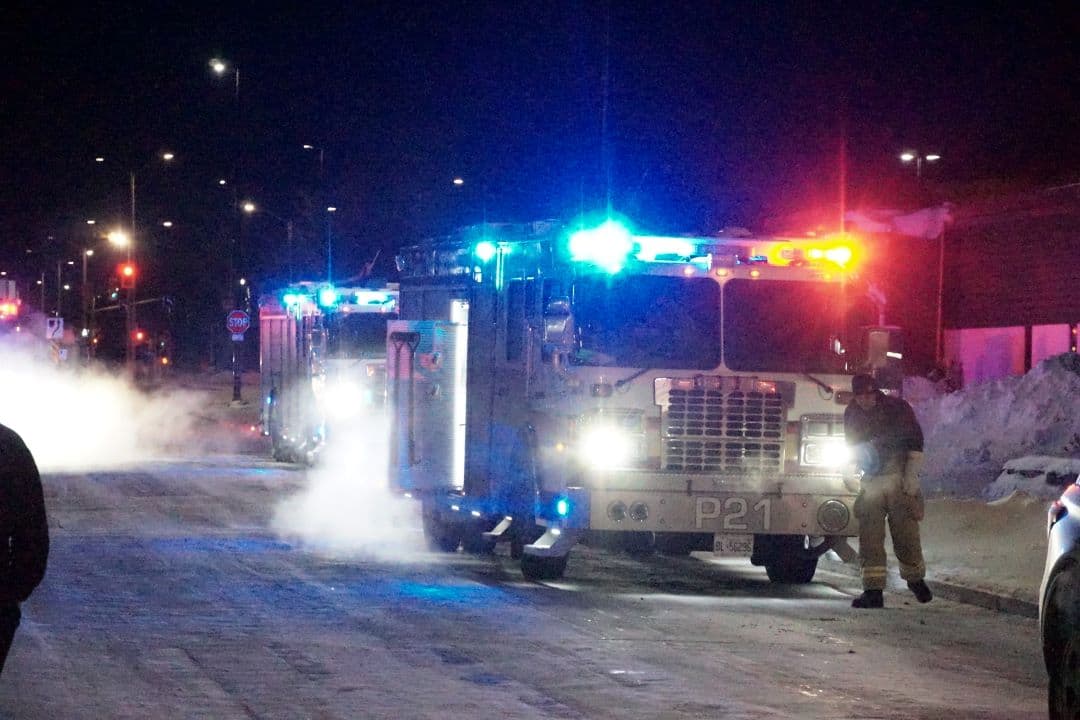
Firefighters were quick to show up to a fire at the college residence Saturday, arriving just four minutes after getting the call.

Algonquin College students were treated to an early wake-up call Saturday after a fire alarm at 3:18 a.m., causing the entire residence to be evacuated. No injuries were reported.

“Just a good old alarm at 3:30 a.m.,” said Owen Uchacz, an architectural technician student at the college.

Hundreds of Algonquin College students were evacuated from the residence building after a fire broke out in a dormitory room on the first floor of the building. The cause of the fire was unknown.

“There was black smoke coming out of the cracks of the doors, like black smoke,” said Amelie Leger, a public safety student at Algonquin College.

Ottawa Fire Services were quick to respond to the emergency, arriving within four minutes of getting the call. Firefighters were able to contain the situation quickly after arriving, putting the fire out at approximately 3:30 a.m.

Algonquin Students were instructed to evacuate from the residence to the Student Commons during the fire.
Algonquin Students were instructed to evacuate from the residence to the Student Commons during the fire. Photo credit: Guillaume Laflamme

Temperatures dropped to a record low of -32 C during the evening, making it the coldest Feb. 4 in 100 years, according to Environment Canada, which issued a frostbite warning due to the freezing temperatures.

Students took shelter in the Student Commons while firefighters dealt with the situation.

“At first there was just a little bit of smoke, we got everyone out of my room and left,” said Tavish Blakely, a motorpower technician student at the college. “You couldn’t see down the hallway to the other end.”

Firefighters also conducted a ventilation operation to make sure the building was clear of any smoke before the students re-entered the building, according to Ottawa Fire Services’ Twitter page.

The fire services dispatched an investigator to the residence to determine the cause of the fire.

Students were able to return to their rooms at approximately 4:50 a.m., more than an hour after the alarm initially sounded.

Australia removes images of British monarchs from their bills

Local CTV Ottawa: Environment Canada has issued an extreme cold warning for regions spanning from Eastern Ontario to Western Quebec. Ottawa could see its coldest weather in years as the […]

Local

CTV Ottawa: Environment Canada has issued an extreme cold warning for regions spanning from Eastern Ontario to Western Quebec. Ottawa could see its coldest weather in years as the temperature is set to drop below -40 C over Thursday night.

The warning is expected to last until Saturday. During extremely cold weather, the risk of hypothermia and frostbite increases.

With Friday’s high being -26 C, and low being -42 C with the wind chill, Environment Canada advises that everyone dress appropriately before going outside.

National

Global News: Thursday marked annual Groundhog Day. This day groundhogs across the country make their predictions, an early spring, or six more weeks of winter.

Ontario’s groundhog, named Wiarton Willie, called for an early spring. Alberta’s groundhog, Balzac Billy, also predicted an early spring. All other groundhogs predicted six more weeks of winter, as did Nova Scotia’s Lucy the Lobster.

Though groundhogs aren’t so reliable in predicting the weather, the tradition remains popular among Canadians as many gather today to watch the groundhogs make their call.

International

Global News: Australia’s central bank announced on Thursday that it will not replace Queen Elizabeth II’s image on its $5 bill with an image of King Charles III.

The new bill will feature an Indigenous design honouring the land’s Indigenous people.

While King Charles III will still be featured on the Australian coin, Queen Elizabeth II’s image is the last of the monarch’s images on any Australian bills. After the $5 bill is changed, all Australian bills will feature Indigenous designs.

Residence fees to increase for 2023-2024 academic year

Students who are coming back to Algonquin College in the 2023-2024 academic year and planning to stay in residence will find their bank accounts lighter than they were this year […]
Photo: William Bailey
Austin Ristau, an electrical engineering student, is empathetic towards those who may be affected by the increasing fees. "The college could do a lot better," he said.

Students who are coming back to Algonquin College in the 2023-2024 academic year and planning to stay in residence will find their bank accounts lighter than they were this year as their fees are going up.

This spike in fees will range from $250 to $370 more than what students were charged for the 2022-2023 academic year, according to the residence section of the Algonquin College website.

Each resident has two options on how they want to pay their fees. The first is the full payment option, where the resident can pay the entire fee for the academic year. The second is the split payment option, where the resident can pay the fee in smaller portions.

Those who choose the latter must pay a portion within the first two weeks of each semester.

Students returning for a two-term academic year will have to pay $8,520 if they select the full payment option and $8,670 if they choose the split payment option. For those who decide to live in residence for a three-term academic year, including the spring 2024 semester, they would have to pay $11,520 or $11,670 respectively.

These fees do not include the residence meal plan, which is mandatory for all first-year students. Those fees are also to increase between $50 and $181, depending on whether residents pay for the light, regular or premium meal plan.

“Historically, our residence rates have increased year to year to address annual increases in operating costs,” says Brent Brownlee, director of Campus Services. “For 2023-24, our residence room rates are set to increase by about 3 per cent. The revenue from these increases is allocated to address facility requirements and to continuously improve the value we deliver to the residence community. Specifically, we allocate funds to programming, staffing, maintenance, supplies, and services to ensure the greatest impact on the residence experience.”

Some residents don’t view the increase in fees to be that big of a deal.

“I’m not too bothered by it,” said Austin Ristau, an electrical engineering student. “I get supported financially by the college, so it doesn’t affect me much. Having said that, I definitely understand how that may affect other residents. I think the fees as it is are somewhat reasonable, but the college could do better, especially when these fees don’t include food.”

Despite his praise of Algonquin College having a good residence, Ristau believes that there’s more to be desired when it comes to the quality of living that residents are paying for.

“The rooms could be of better quality,” he said. “The college should focus on the lighting in our rooms. They can also do something about the parking lots, which they don’t plow.”

Thomas Armstrong in study lounge at residence
Thomas Armstrong, an electrical engineering student, does not feel the fees are worth what residents are receiving. "It's ridiculous," he said. Photo credit: William Bailey

Thomas Armstrong, another electrical engineering student, feels that living in residence is already pricey and doesn’t approve of the rising fees.

“The fact that they are going up is ridiculous,” he said. “I find what we pay currently for what we get is a bit too much, to be honest.”

Ryan Yasawy in his room at residence
Ryan Yasawy, a computer programming student, does not like the sound of increasing fees. "It's kind of unfair," he said. Photo credit: William Bailey

Upon hearing the news of the increasing fees, Ryan Yasawy, a computer programming student, is left with more questions than answers.

“It’s kind of unfair,” he said. “Every year, residents are getting charged more and more. For what exactly? What is being solved by charging us more? Is the extra money going into upgrading our living conditions? More reliable services from maintenance? What’s changing?”

Students who apply to live in residence between Feb. 1 and May 1 will have an opportunity to win their room for the 2023-2024 academic year.

Murray Sinclair recognizes the role of education in reconciliation

Murray Sinclair says education for Indigenous students is at a “critical point”. “That critical point is emphasized by the fact that Indigenous students make up the highest dropout rate, and […]
Photo: Kerry Slack
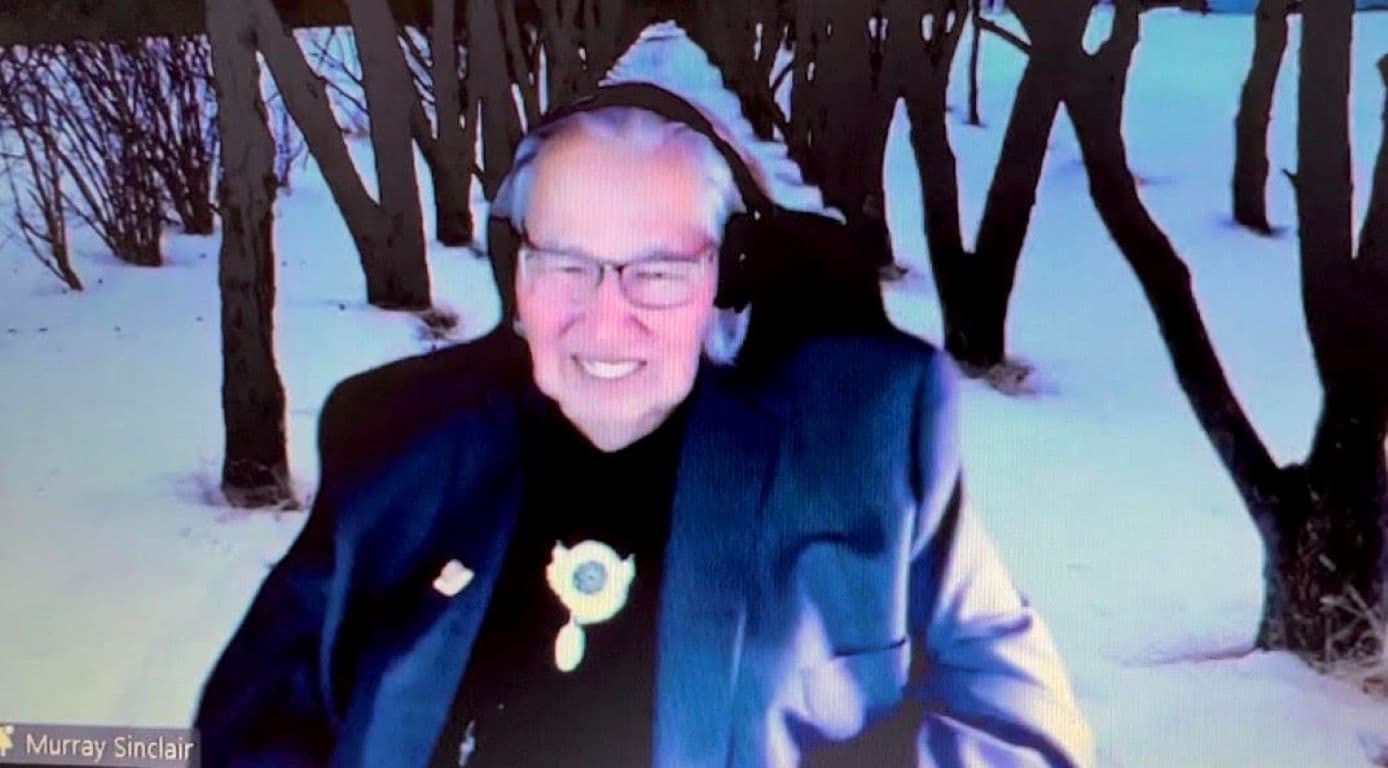
Murray Sinclair answers questions and shares stories with Algonquin College staff and students in an online discussion on Jan. 30.

Murray Sinclair says education for Indigenous students is at a “critical point”.

“That critical point is emphasized by the fact that Indigenous students make up the highest dropout rate, and the failure rates are unacceptably high,” Sinclair said in a retrospective Zoom event with Algonquin College staff and students on Jan. 30.

“It has nothing to do with intelligence or capacity. It has everything to do with the programs for education that are in place, for the most part.”

Added Sinclair: “You took away our sense of self and gave us nothing in return. We can change that.”

Sinclair was born just north of Selkirk, Man. He has spent his life creating a new image of justice for Indigenous people. He is the former chair of Canada’s Truth and Reconciliation Commission. Elected as Manitoba’s first Indigenous judge in 1988, he also served as legal counsel for the Manitoba Human Rights Commission. He served as a senator from 2016-2021 and is a recipient of the Order of Canada and Meritorious Service Cross.

The online event hosted 101 attendees who were able to submit one question each.

Sinclair remained over his allotted time, answering additional questions.

Algonquin College president and CEO Claude Brulé welcomed Sinclair to the event. Jamie Bramburger, manager of community and student affairs, delivered a land acknowledgment.

Chief Wendy Jocko of the Algonquins of Pikwakanagan welcomed Sinclair with a prayer in Anishinaabemowin and English.

Questions touched on education, support, language, relationships and responding to the Calls to Action.

“One of the disadvantages of Zoom is you don’t get to see your audience,” Sinclair said.

“I like to think of it this way, too: it makes it easier to talk to more groups, more presentations. I can do a presentation one day in Halifax, and the next day in B.C. It is convenient in that respect.”

Answering a question about the education system, he said, “The history of our people gives us our sense of identity and validity. Indigenous students don’t get that from the public school system. The public school system in Canada is largely a white supremacist system, based on the concept of colonization.”

Not everything he had to say about school was critical.

“I would not have become what I’ve become without the help of some great teachers who pushed me, pushed me past those who were resistant to me,” Sinclair said.

On finding purpose, Sinclair said, “Part of that is through the education system. It is also through your experience, who your heroes were, and what your parents did, and what your parents were.”

“In my teachings, our purpose is reflected in our spirit name,” Sinclair said.

His Ojibwe name is Mizanay Gheezhik, which means “the One Who Speaks of Pictures in the Sky.”

“It’s about a young man who goes to a high place to seek out answers for his people who are struggling,” Sinclair said.

While Sinclair criticized the education system, he also recognized the significant role the system plays in reconciliation.

“Education got us into this mess. Education will get us out,” he said. “I said that on the final day of the Truth and Reconciliation Commission. Education is not about being in school. Education is about learning what it means to be a human being,”

For more information about the Truth and Reconciliation Committee’s Calls to Action, visit the Government of Canada’s website.

For up-to-date happenings with the Calls to Action, visit www.indigenouswatchdog.org.

Valentines Day Event

February 14th Share the love this Valentine’s Day with the Atpromo team! Tuesday February 14th, the Atpromo team will be hosting a hot take on a “candy gram’ event in […]

February 14th

Share the love this Valentine’s Day with the Atpromo team!

Tuesday February 14th, the Atpromo team will be hosting a hot take on a “candy gram’ event in the “N+J” foyer.

Come by and spread some kindness and leave with a treat.

We look forward to seeing you!

Mental health experts raise awareness about resources to support wellness

Communicating with others about our mental health struggles can be essential for our long-term wellness. This is just one of the messages participants learned when mental health experts from The […]
Photo: Stefan Keyes, Dr. Gail Beck, Mike Souilliere and Dr. Zach Kaminsky join the mental health conversation in the Algonquin Commons Theatre on Jan. 25 Photo credit
From left to right

Communicating with others about our mental health struggles can be essential for our long-term wellness.

This is just one of the messages participants learned when mental health experts from The Royal Ottawa Mental Health Centre and Do It For Daron came together on Jan. 25, in the Student Commons to present Let’s Keep Talking About Your Mental Health.

“Seventy-five per cent of people who are suicidal indicate so prior to killing themselves,” said Dr. Zachary Kaminsky from The Royal, during a panel discussion. “Talking about it can open up the conversations that lead to healing, reduce anxiety and get people on the path to help.”

As part of Bell Let’s Talk day, students had the opportunity to watch a panel hosted by CTV Morning Live’s Stefan Keyes, which featured local mental health experts Kaminsky, Mike Souilliere and Dr. Gail Beck.

The in-person and virtual panel discussion was part of the program set up by the Students’ Association for Mental Health Awareness Week at Algonquin College, which took place from Jan. 23 to 27.

Social interaction flooded the Student Commons with life as students engaged with volunteers and exchanged mental health stories before the event. Outside the Commons Theatre, tables were set up for student volunteers from The Royal and Algonquin College to distribute items like hats, brochures, wristbands and fridge magnets.

(Left to right) Nicola Ostrom, Alynn Casgrain, Shaundra Mitchener and Regina Silva at the Do It For Daron table outside Commons Theatre on Jan. 25
From left to right: Nicola Ostrom, Alynn Casgrain, Shaundra Mitchener and Regina Silva at the Do It For Daron table outside Commons Theatre on Jan. 25 Photo credit: Alex Lambert

Next door to the Do It For Daron table and Bell Let’s Talk student health and wellness zone was The Beacon Peer Support Place. The peer team was hosting a colouring table alongside the AC Purple Couch.

Historically, only about eight to 10 per cent of students have one appointment with a counsellor over the course of a school year, according to Bruce Hickey, manager of communication for the college, on behalf of Student Support Services.

Students were encouraged to join the conversation by writing down what mental health means to them on fliers. The Students’ Association posted these fliers and students’ names around the Student Commons and the ACT.

Students' Association vice-president, Gwyn Jones (Left) and Students' Association director, Marwa Alibakhiet (Right) in front of student mental health posters on Jan. 25
Students' Association vice-president Gwyn Jones (Left) and Students' Association director Marwa Alibakhiet (Right) outside the Commons Theatre on Jan. 25 Photo credit: Alex Lambert

During an interview before the panels, Dr. Gail Beck, the interim psychiatrist-in-chief and chief of staff at The Royal shared some practical tips to help someone identify when a family member or friend may be having a mental health crisis.

“Family members will notice when a person isn’t sleeping well or is irritable and seems to be worried more,” Beck said. “We know that about 25 per cent of the population of people between the ages of 14 to 25 have some form of anxiety or depression disorder that would merit treatment.”

After answering audience-submitted questions and offering mental health resources, the presentation ended with a closing address from the Students’ Association’s director Marwa Alibakhiet.

“We’ll continue the conversation after this event with resources on campus, online and from our community partners. Thank you for joining us for such an important discussion,” she said.

Algonquin College offers extensive services for coping with mental health, including counselling, online group therapy, AC Purple couch, Umbrella Project (for substance use support) and The Beacon Health & Wellness Peer Support Drop-In.

Observatory eyes a hopeful reopening next Month

After shutting its doors in late September, the Observatory, once a fixture of campus life, is eyeing a reopening on March 6. While the popular campus hangout was open for […]
Photo: Morgan Farrell
Bill Kitchen, the Senior Manager of Hospitality Services, is hopeful for a reopening of March 6th after staffing shortages have kept the Observatory closed since late September.

After shutting its doors in late September, the Observatory, once a fixture of campus life, is eyeing a reopening on March 6.

While the popular campus hangout was open for events in the fall, the only bar on campus that is open right now is the Wolves Den, located in the Jack Doyle Athletics and Recreation Center. While many students and faculty have been enjoying the Wolves Den, some have expressed their hopes of being able to return to the Observatory.

“Students need a place where they can just chill and hang out with their friends,” said Angela Arthur, a second-year early childhood education student. “If you look at the Wolves’ Den and compare it with the Ob when it is open, there is an extreme difference.”

Some first-year students have yet to have the chance to use the Observatory, leaving them curious about it.

“I will definitely check it out, I want to see what it’s like,” said Alessandro Vivolo, a first-year fitness and health promotion student.

It’s not just students who are looking forward to returning to the Observatory. The staff of the bar are excited to be returning to work there.

“I’m so looking forward to it,” said Ali Aldaawadh, a second-year game development student and bartender. “It’s so nice, the food menu is a lot better. I like being behind the wooden bar and just the whole look of the place.”

“The buffalo chicken poutine, everybody misses that,” said Arthur.

The Observatory has been closed since September due to staffing shortages. Bill Kitchen, the senior manager for Hospitality Services, hopes he has found the necessary staff to reopen at full capacity.

“I don’t think we are isolated from this,” said Kitchen about the challenges of finding staff. “It’s been a really competitive job market for anybody in the hospitality sector.”

Tom Brady announces retirement ‘for good’ after 23-year NFL career

Local news Ottawa Citizen: Ottawa Mayor Mark Sutcliffe is announcing that transit fares will be frozen. Additionally, $30 million a year will be invested into road maintenance once the budget […]

Local news

Ottawa Citizen: Ottawa Mayor Mark Sutcliffe is announcing that transit fares will be frozen. Additionally, $30 million a year will be invested into road maintenance once the budget is granted.

Sutcliffe says that the budget is “a much more realistic and much more responsible assumption about ridership than last year’s budget.”

An expected $706 million will be spent on OC Transpo and Para Transpo operations.

National

CTV News: Health Canada is warning citizens to stop wearing Helly Hansen sweaters and hoodies, claiming that the products “either do not or may not comply with the textile flammability regulations.”

It has been reported that 128,680 of the affected Helly Hansen products have been sold across Canada between August 2019 and 2022.

International

National Post: At the age of 45, Tom Brady has officially announced his retirement.

Brady posted a short announcement on social media Wednesday morning, stating that he’s retiring “for good.”

This is the second time in as many years that Brady has made this announcement, where he opted to play another season just six weeks after announcing his retirement in 2022.

February Horoscopes

City’s draft 2023 budget freezes transit fares, including U-Pass

In positive news for students, OC Transpo didn’t propose fare increases in the city’s draft 2023 budget tabled on Wednesday. If the budget is approved by city council, the U-Pass […]
Photo: Cameron Ryan
Students can't opt out of the U-Pass if they reside in Ottawa, making any changes to its price a direct financial concern for them.

In positive news for students, OC Transpo didn’t propose fare increases in the city’s draft 2023 budget tabled on Wednesday.

If the budget is approved by city council, the U-Pass will continue to cost $223.48 per semester, adult monthly passes would remain $125.50 and an adult single-ride fare would be still $3.70.

Housing and groceries have become more expensive over the last year, increasing the financial strain on students.

“If we are not paying more then it’s good for us,” said Praveetha Prakash, a first-year accounting and financial practice student. “All the other prices are gonna go up so (transit fares) staying the same is nice.”

Meanwhile, some motorists could pay more to park in 2023. The annual parking permit is proposed to increase to $733 (up 2.5 per cent) and a winter parking permit is proposed to increase to $159 (up 2.6 per cent).

The draft budget was tabled during a city council meeting.

“People often think of a budget as a bunch of numbers, but a city budget is not really about data. It’s about people and neighbourhoods. It’s about programs and services. And it’s about intentions and priorities,” Mayor Mark Sutcliffe said during the meeting.

Sutcliffe’s first budget promises a 2.5 per cent property tax increase, which comes out to around $104 more per household over last year for a home in the urban area with an assessed value of $415,000. This is in line with his election promise, although he warned that money is tight without help from other levels of government.

“Make no mistake,” Sutcliffe said. “This is a tight budget. If the provincial and federal governments don’t support the gaps we have in transit and other areas, we will face significant budget pressures in 2024.”

The Ottawa Police Services draft budget proposes just over $401 million in spending, some of which would be spent on 25 new positions.

The spending accounts for roughly nine per cent of the city’s budget and would equate to a $17 tax increase for the average household in Ottawa. Policing in 2023 would cost $680 for an average Ottawa household.

Ottawa police have stated that their main priorities they hope to address in 2023 include violence against women and guns and gangs, while promoting equality and diversity. They also hope to take a new more focused approach when handling public events and demonstrations.

Police have also promised to answer community feedback, taking hate crimes and mental health calls more seriously, making sure to handle them justly and appropriately.

Despite this, it seems the community still feels as though too much of the budget has gone to police services. University of Ottawa student Aya Sassi said the city should defund the police.

“Every day you hear a story of brutal police violence and it’s very unsettling,” said Sassi, 22. “If they don’t make us feel safe nor do they actually protect us, then they’re a waste of our taxpayer money. I’d rather it goes to services that need it more, like mental health.”

The Ottawa Fire Services are not planning to add more firefighters. The fire services responded to over 28,000 incidents involving fire, hazardous materials, rescue, medical and mutual aid agreements in 2022.

The City of Ottawa has allocated over $100 million to replace or rehabilitate parks and city cultural and recreation facilities in its 2023 budget plan.

The city has also pledged to build more than 25 new parks in residential communities through partnerships with developers as well as work with community groups to develop, expand, improve and renovate city parks and recreation facilities.

User fees for recreational memberships, admissions, or rentals are proposed to increase by 1.8 to 2.6 per cent from 2022. Included in the increased user fees is a proposed two per cent annual hike to fitness, swimming and skating membership fees. The increased fees would be in effect as of April 1.

The budget allocates over $3.2 million for the enhancement or upgrading of accessibility in parks and facilities across the capital. The draft budget includes $235,000 to enhance accessibility at Centrepointe Park, with plans that include an accessible swing.

How councillors reacted

Somerset Ward Coun. Ariel Troster tweeted that her focus is to improve services for downtown Ottawa residents and try to improve the poverty, homelessness and addiction issues.

Capital Ward councillor and the chair of the environment and climate committee Shawn Menard tweeted that although he hasn’t read through the 2023 city budget, he hopes to see funding for climate action.

College Ward Coun. Laine Johnson shared a video explaining how residents can participate in committee meetings to discuss issues in the ward.

Councillors also promoted budget consultations in their communities.

On Feb. 7, River Ward Coun. Riley Brockington will be hosting a consultation with councillors Jessica Bradley, Marty Carr and Menard.

Bradley, the councillor for Gloucester-Southgate ward, tweeted that she’s encouraged to see $5 million of sustainable base funding for Ottawa’s climate change master plan and additional funding for infrastructure maintenance.

West Carleton-March Ward Coun. Clarke Kelly is hosting a consultation on Feb. 7.

Barrhaven-West Ward Coun. David Hill and Barrhaven-East Ward Coun. Wilson Lo are hosting a consultation on Feb. 7.

Story contributors: Sophia Adams, Tyler Beauchesne, Magan Carty, Kolbe Devaux, Nathan Drescher, Elio Elia, Alyx Ewing, Liam Fox, Rory Friend, Tyler Major McNicol, Aadil Naik, David Rotel, Cameron Ryan and Griffin Waller

Online Editor

The Algonquin Times is a newspaper produced by journalism and advertising students for the Algonquin College community. Follow us on social media! Algonquin Times Twitter Twitter (Events & Promos) Facebook Facebook (Events & Promos) Instagram Snapchat

Algonquin Times podcast

Stay Informed

Sign up for our newsletter

Subscribe

* indicates required