
main

Selection committee approves team of hopeful directors, includes SA president

Students’ Association president Deijanelle Simon will be seeking re-election for president for the upcoming academic year, but not before her and the other recommended directors receive confirmation of appointment from […]
Photo: Stephen Riccio
The Students' Association holds their annual general meeting on March 13 at noon. The results of proxy voting on next year's directors will be announced then.

Students’ Association president Deijanelle Simon will be seeking re-election for president for the upcoming academic year, but not before her and the other recommended directors receive confirmation of appointment from voting results.

Simon made her way around campus on March 7 to make students aware of her intent to stay on with the SA, as well as to promote the six other board hopefuls who have been recommended through a selection process facilitated by the director of the SA, Paige Nicks.

The recommended students for the board have somewhat of an advantage, as running as a group appears more organized to student voters who are approached.

The proxy voting took place from March 7 until March 8 at noon, with the results set to be announced at the annual general meeting on Wednesday, March 13. Any other students who were hoping to get through the proxy voting would have been required to make the rounds of campus in hope of gaining more votes than any of the members on the recommended list.

The recommended students are; May Ghadban, business administration-marketing; Shanti Cosentino, public relations; Chelsea Moses-Blackned, business administration; Katrina Medina, bachelor of science; Greg Jeffreys, heritage carpentry; Deijanelle Simon, advertising and marketing communications management and Michael Wolff, bachelor of early learning and community development.

“We’re running as a group, that’s why we ask for all the votes; to be unanimously chosen. So then there is no chance that one person could have less votes than another,” said Ghadban, second-year student representative for business marketing.

The current SA president was quick to calm any worries about the nature of the selection committee, assuring students that she feels it is a legitimate process.

“Honestly, how the selection committee works, it’s a lot stronger than I thought it was going to be,” Simon told the Times. “Our platform hasn’t necessarily been set yet; we were all chosen because we’re passionate about student experience and student life and success. And that relates directly to the Students’ Association mission.”

Students interested in being recommended for an SA board position were required to submit a package with their CV detailing their relevant accomplishments to the committee. The committee performed interviews to ensure that the group of candidates selected would work well as a team.

One of the recommended students for director is a second-timer along with Simon. Michael Wolff served as director last year after narrowly losing the presidential race to the current president.

Although this preliminary round of voting does not impact who will be running for officer positions in the next round of elections, Simon looks to continue what she has viewed to be a very positive tenure as SA president.

“The accomplishment I am most proud of is the fact that we have progressed so much more in our priorities. I know there are seven, but still I would have to pick class representative number one. When we first came into the system there were three people on our board that were class reps, and we didn’t even know it was related to the Students’ Association. I’ve been lucky enough to see the value that comes out of speaking with the class reps, and a lot of our relationships have been built that way.”

The first priority details the 2017-2018 Students’ Association’s intent to facilitate, “the operation of an effective and thriving class rep system,” according to the Students’ Association website.

The officer positions are president and vice-president, and campaigning for these positions begins on March 14. The campaign will be open until after midnight on April 1, after which students will be allowed to vote until April 5.

Faculty union grieving information breach

The college’s faculty union has filed a grievance against the college over the latest phishing controversy. With the number of phishing attacks becoming more public surrounding the college, Pat Kennedy, […]
Photo: Jessica Alberga
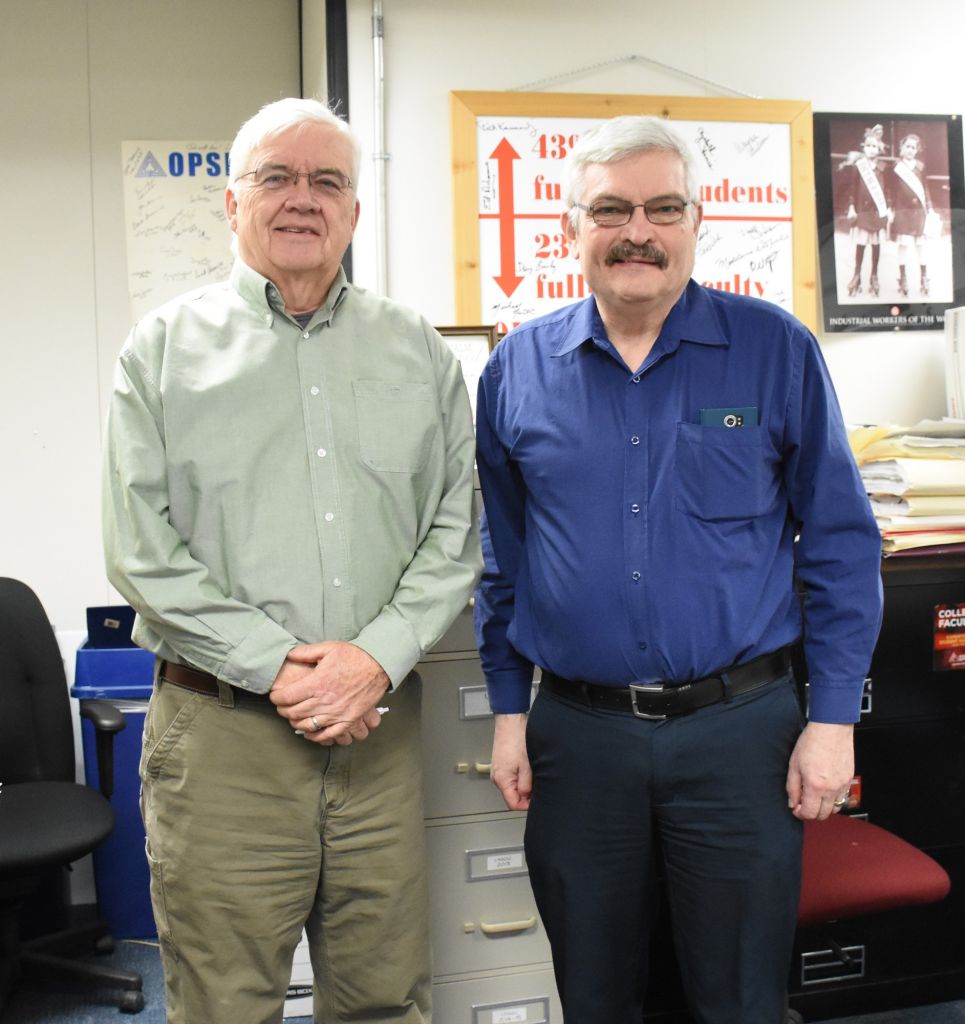
Pat Kennedy, left, and David Haley. They are the president and vice president of Union Local 415.

The college’s faculty union has filed a grievance against the college over the latest phishing controversy.

With the number of phishing attacks becoming more public surrounding the college, Pat Kennedy, president of Union Local 415 stressed that waiting to take action would do their members a disservice.

“Under the collective agreement, we want to protect our members now and in the future related to this. I’m not confident that two years down the road, someone’s SIN number won’t be used for some other reason.

“We’re obligated, once we become aware of what we would say are practices contrary to the collective agreement, that we have to take action and that’s what we’re doing,” said Kennedy.

The collective agreement has been in effect from Oct. 1, 2017 to Sept. 30, 2021. A policy grievance is a formal process stating the violation of the agreement between the union, its members and the college.

The policy grievance covers not only the violation in the agreement, but it also details the violation of the Freedom of Information and Protected Privacy Act.

“Under that act, which is part of our collective agreement, employers have a responsibility to provide a reasonable amount of security for personal information.

“With the types of information the college needs from us to put on Workday, such as: banking information, addresses, and most importantly SIN information, we have little confidence when they say this one has been accessed, but this [information] ‘no way’, we’re not entirely convinced,” said chief steward J.P Lamarche.

Ontario Public Service Employees Union, (OPSEU) now formally controls the policy grievance. The college has 15 days from first receiving the grievance to arrange a meeting with employees, a union steward and an additional representative designated by the union local, if requested.

“We file but it’s in the control of OPSEU; they now have it. We want to be clear we’re not alarming anybody because this is after the fact. We don’t have a lot of information, but we’re not confident with oral assurances,” Kennedy stated.

“Rest assured we’re after protection of the faculty going forward, and we’re after full disclosure.”

The current level of communications surrounding this issue could be potentially be building more barriers rather than trust between Algonquin and its faculty, the union feels.

“The most frustrating thing we’re hearing from faculty is the lack of communication with the college. Not only the college in general, but there’s been very little communication about what’s going on and when we can expect things to be up and running. Some of us still can’t access email,” Lamarche said.

During a media availability visit with journalism students on March 7, president Cheryl Jensen admitted to having no knowledge of the union filing a policy grievance.

However, when it came to the computers affected by the phishing scam, she was sure those devices were thoroughly cleaned.

“Oh yeah, I know for certain we’re wiping it. Our IT folks are cleaning those computers completely. And if they can’t do it, we’re sending them out to be cleaned.”

Doug Wotherspoon, vice president of innovation and strategy, also had no previous knowledge of the union local’s policy grievance filing during an interview on March 8.

“We’ve said it all at the town hall. Everybody that has been impacted has been informed. If they haven’t reported it and used a personal computer then I can’t know.

“So if for anyone that hasn’t told us that they clicked on the link and has a personal computer, I don’t know about it yet. But everyone else, yes,” said Wotherspoon.

If there is not a satisfactory agreement from all involved parties, the grievance moves to a third party arbitrator.

“Depending on what we find out we may have to take further action, and maybe we won’t,” said Kennedy.

“It’s not to say that you never get breached. We’re talking; okay it’s taken place, so now how do we protect our members? It’s pretty basic stuff that we’re asking for; as an employee it’s not a high expectation from our employer.”

Wolfie: The unmoving protector of the Mamidosewin Centre

It stands on legs that don’t move in the corner of the room. It watches students come and go with eyes that don’t see. And yet, the grey wolf stands […]
Photo: Emily Hsueh
Raven Brightmoon smiles as she pets the stuffed wolf that stands in the Mamidosewin Centre. Brightmoon was the owner of the wolf for 20 years, and described it as her protector in times of hardship.

It stands on legs that don’t move in the corner of the room. It watches students come and go with eyes that don’t see.

And yet, the grey wolf stands in the Mamidosewin Centre in the collegeโ€™s E-building, has been dead for at least 20 years, which is how long Hรฉlรจne Choiniere, 56, who goes by Raven Brightmoon, has had it.

But it has served a mighty purpose for Raven long after its death.

In 1995, she attended a spiritual gathering in Maniwaki, a small town to the northwest of Montreal. She stopped by a store — whose name has since faded from memory — and laid eyes upon an animal she had never met before, but played a large part in her life.

โ€œThe first time that I saw [the stuffed wolf], it was like the wolf in my dreams that came to help me when I was having nightmares as a kid. That wolf would come and protect me,โ€ said Raven. โ€œIt was mainly me being in the woods, and I had been abandoned and I was scared. The wolf would come and just comfort me.โ€

It took her three years to get the stuffed wolf, which she called โ€œWolfie.โ€ She was finally able to purchase it in 1997. The taxidermy wolf initially had a trap stuck to its paw, and the first thing Raven did was remove the trap as to offer Wolfie freedom again.

Having the wolf in her home elicited many reactions from visitors.

โ€œI had all kinds of comments,โ€ Raven recalled. โ€œIโ€™ve had people running out of the house when they saw it, Iโ€™ve seen people people attracted to it. I had a friend that I had to cover the wolf when she was at the home because she couldnโ€™t stand a stuffed animal.โ€

The wolf stood guard in Ravenโ€™s house for the next 20 years, giving her protection and companionship. Eventually, she decided to move to a smaller home with her husky, meaning Wolfie would no longer fit. Raven decided it was best to give her longtime protector away, but space was not her only motivator.

โ€œThe main reason is because I wanted more people to share the wolf than just me. I wanted to have other people enjoy Wolfie. The wolf is protection, itโ€™s family, itโ€™s the teacher.โ€

Wolfie moved into the Mamidosewin Centre at the beginning of the 2018 – 2019 academic year. It was brought to the college by Audrey-Claire Lawrence, a member of the college’s Board of Governors.

Jackie Tenute, the Aboriginal counsellor at the centre, confirmed that Raven’s wish for Wolfie had come true.

“It has been good having it here, people seem to love it,” Tenute said, adding that visitors always treat it with respect. The counsellor has affectionately called the wolf “Nimkii Mhiingan,” which means Thunder Wolf; a nod to Algonquin’s mascot, the Thunder, represented by a wolf.

โ€œIt was hard because I was losing some of my protection,” Raven said of donating Wolfie. But she has not lost all connection to her guardian.

โ€œFor me it was alive. Because it was alive in my dream, I feel that its spirit is always there with me.” ๐Ÿ™‚

Brighter future for business students with help of L-SPARK

Algonquin’s business students can look to a brighter future with the new partnership between the college and Canada’s leading software as a service accelerator, L-SPARK. The two institutions will join […]
Photo: Joshua Ambar
Sarah Al-Ahmadi is a business administration student at the college. She is looking forward to the L-Spark partnership as it will help students express thoughts and ideas for business.

Algonquin’s business students can look to a brighter future with the new partnership between the college and Canada’s leading software as a service accelerator, L-SPARK.

The two institutions will join forces to help college students in the school of business with their startups and will be located in the DARE District, according to a college press release from March 5,

“We are working hard and focusing on getting entrepreneurs to build their companies and become more successful,” said Leo Lax, executive managing director of L-SPARK. “We believe Algonquin is a great source for entrepreneurship and students who are looking to start their own businesses or considering joining a startup.”

L-SPARK wants to share knowledge and exchange capabilities, to be able to give a view of what the future will potentially look like for the next generation, explained Lax. Students can expect focus on key areas such as software, cyber security and IOT (internet of things) as the mentors at L-SPARK specialize in these fields.

“It’s an exciting situation; we are building our ecosystem, we are creating an environment and becoming a destination of choice,” said Lax. “We encourage that, and we hope to be able to build with that with Algonquin in the future.”

This is L-SPARKs first time partnering with a post-secondary institution, however Algonquin has a history of partnerships with external industry organizations. Katherine Root, chair of marketing, entrepreneurship and office studies, said that the approach is to enhance academic progress and bring entrepreneurs into our environment.

“It can bring them into industry or bring industry into the classroom,” said Root. “I think giving our students many pathways to opportunities is a good thing.”

For many students, networking is key to success and having help for the future can be very beneficial.

Sarah Al-Ahmadi, 27, a business administration student, believes It will be beneficial for students because it will give them an opportunity to express their thoughts and ideas through business. This is especially true for young startups because younger people need advice and network to get more ideas about how to run their businesses.

“Yes, if I am thinking to start my own business I think it will be beneficial,” said Al-Ahmadi. “I would get to have an opportunity to have more knowledge from more experienced people in the field.”

L-SPARK is based in DARE because the area allows it to be centralized for some of the services to make it successful. This area is where ideas collide and “space matters” according to President Cheryl Jensen. There is opportunity through the DARE District for companies to come in and hire students and stay there until they are big enough, then move out.

Jensen explained that this partnership is a “knowledge exchange” and will open opportunities to students if they want to start a business and use the space as an incubator before venturing off themselves.

L-SPARK is business-oriented, but all students can seek their services. However; this is only the beginning for partnerships with the college like this one.

“Once that pilot gets going there’s no reason we can’t expand into other disciplines,” said Jensen. “Just getting started.”

An overdose of heroism to the rescue

Hunched over and down on his knees, the man clenches his jaw — his eyes fixed on the subject. With one hand wrapped behind the other, he falls into a […]
Photo: Darius Shahheydari
Marianne Black teaches first-aid to her student, Warren Vibert-Adams, on a mannequin. This practice could be necessary in an overdose situation.

Hunched over and down on his knees, the man clenches his jaw — his eyes fixed on the subject.

With one hand wrapped behind the other, he falls into a steady rhythm thrusting the chest. Every so often he stops, plugs the nose, tilts back the head and exhales deeply into the mouth. The goal is to bring the victim back to life.

Except there was never any life to begin with.

This is not a victim, just a mannequin. The human is Warren Vibert-Adams, a massage therapy student who is engaging in more vigorous therapy than the ones he practices in his course.

He is mirroring the actions of Marianne Black, his mentor. She is a first aid instructor for the Red Cross and is currently working for National Capital First Aid, who have partnered with the college in an extensive program of teaching participants the vital practices of resuscitation.

The program is split into two levels. Standard first aid is covered in level one, and emergency first aid in level two.

By the end of the course, students will know how to properly provide CPR as well as other life-saving methods.

For young adults like Vibert-Adams, the recent opioid crisis in Canada suggests he is more likely to be faced with this ask now more than ever — an ask which he is prepared to tackle.

“I know now how to recognize an emergency and be prepared to act accordingly,” he said.

According to data released by the Government of Canada between 2016 and 2017, the rate of emergency department visits due to opioid overdoses increased by 73 per cent in Ontario. In just the first half of 2018, there were 638 deaths due to overdoses on the substance: roughly nine out of every 100 000.

Last year, 26 per cent of victims were between the ages of 30 to 39 — the highest demographic — and 75 per cent of all victims were male. No data has yet been released for 2019.

In the case of an overdose encounter, Black teaches students to be prepared in several ways.

Breathing protection masks and gloves could be purchased at pharmacies, and should be worn when performing CPR. Everyone is encouraged to carry these with them at all times; they could be stuffed into some key chains.

During resuscitation, an automated external defibrillator must also be sought.

“Survival rate increases exponentially when you have an AED,” Black.

These devices send an electrical shock to someone in cardiac arrest in an attempt to bring back a steady heartbeat; they are designed to be easy to use for anyone. There are more of them per capita in Ottawa than anywhere else in the world.

they must also call 911. The call should be put on speaker, so they could provide help in the meantime. Cellphones should always be charged. If there is someone nearby, they could go look for the AED.

“Be prepared to help when you notice something is not normal,” Black.

Narcan, an emergency nasal spray used to treat opioid overdoses, is also to be given to the victim. Pharmacies could provide anyone with the spray free of charge, so long as they complete a quick tutorial on how to use it.

For a person who is suffering an opioid overdose, their respiratory system is compromised. Black “In plain language, they cannot breathe properly.” The nasal spray is there to remedy that; however, it might have its side effects.

The spray can trigger a reaction in the brain that causes combative behaviour; the victim could get violent. In that case, Black says the resuscitator should back away. They are there to save lives, but if their own is being compromised, then the less victims the better.

Out with the old and in with the new food

Food Services is giving students more options during the winter semester with the continuation of the monthly food features. This month the food features included a salmon burger, chicken quesadilla, […]
Cafeteria staff prepare a sandwich for a student. This is one of the options the eatery offers.

Food Services is giving students more options during the winter semester with the continuation of the monthly food features.

This month the food features included a salmon burger, chicken quesadilla, ramen burrito and a grilled cheese sandwich.

Each location has a feature for breakfast and a feature for lunch which allows the student to try a new item that they wouldn’t usually get on campus.

Food Services has been offering new food features for the last three to four years.

“If items are popular we look at them and tend to bring them back and make them part of our regular menu,” said Andre Villeneuve, operation manager food services.

“I’m always happy to see different offerings when I go to buy food,” said Lara Kareem, a human resource management student.

According to Villeneuve, students and staff have reacted positively to the food features but some students aren’t happy with the features they offer.

“I tried the ramen soup, and it was horrible; the pork tasted like fried pork grease,” said Candy Wasser Mann, second-year advertising student.

To end the school year Food Services will be rolling out their last feature for the school year in April.

“For April, we are looking to offer more healthy bowl options and a vegan feature,” said Villeneuve.

Women’s empowerment celebrated by the college

Women need to amplify each other, reevaluate what they’re apologizing for and to keep working through the career path they choose. Those were the words of guest speaker, president and […]
Photo: Mae Estravo
President and CEO of Global LK, Laraine Kaminsky speaks to a crowd of men and women in support of empowerment. The event was to mark International Women's Day on March 8.

Women need to amplify each other, reevaluate what they’re apologizing for and to keep working through the career path they choose.

Those were the words of guest speaker, president and CEO of Global LK, Laraine Kaminsky, whose speech highlighted he International Women’s Day event at the college on March 8.

Approximately 125 Algonquin faculty, students and visitors of the college walked into the event eager to hear what she had to say.

Kaminsky entered the room filled with people of all ages with one question to ask: “Why are we still talking about this?”

Every year, this day has a different campaign. However, change is still not happening fast enough, she told the crowd.

Kaminsky pointed out that women always tend to minimize their accomplishments on a daily basis. In order to speak up, start where you want to be in terms of your goal in the industry. Use your power to make your points and get the credit you deserve.

She also emphasized the need to celebrate women’s achievements, to challenge stereotypes and bias within our society.

Kaminsky recently worked at a law firm, where a senior lawyer explained to a mixed group his understanding of paternity leave. He said, “You know why we call it paternity leave? You take paternity and you leave.” In other words, only a wimp takes paternity leave.

There are cultural restrictions which to women are held to higher standards. Many jobs a woman would go for are often seen as a “man’s job”. Examples include lawyers, police officers and anything that would do with technology.

According to a Yale University study that was shown at the presentation, women were perceived as more aggressive, therefore less likely to get the job they want. In the video, both the man and woman had the same resume and answer to the question, concluding that men are more likely to get the job instead of women.

“A little bias goes a long way,” Kaminsky said.

Before the event, attendees expressed why International Women’s Day is significant for them.

“As a woman, I feel it’s important to uphold our independence and the fight for our equality because it’s definitely getting there,” said Isabelle Teeuwen, a personal support worker. “It’s not totally there so I feel that International Women’s Day is a really good reminder for everyone who maybe forgot that we’re not quite there yet.”

Not only women attended the event, but several men made an appearance to come as allies to support women in leadership.

“Supporting them in each and every work of their life — and it’s not just about the professional or their family life — it’s that they have to have support in both the lives,” said Preet Savsani, a director for Students’ Association.

Kyla Mouré, a design studies student, said that her mother is her biggest motivation as she is a woman of power at her workplace.

“[Women empowerment] is something a part of my daily conversation and I think I just want to put an amplifier on it,” she said to the Times. “As I’m doing these things on my own now, I’m becoming more and more passionate about it.”

Adding onto Mouré’s answer, Harinderjeet Kaur, a computer engineering technology student, said her mother is someone she looks up to every day.

“My mom, she is a housewife and a working woman so she motivates me every time, each and every day. She works so hard, so I’m like ‘Oh, I have to do this,'” said Kaur.

Why it’s time to visit the orchestra

I’m what my dad likes to call an “Orch dork,” and, honestly, I can’t deny it. I’ve been playing bass in orchestras for five years, I get excited when a […]
Photo: Emily Hsueh

I’m what my dad likes to call an “Orch dork,” and, honestly, I can’t deny it. I’ve been playing bass in orchestras for five years, I get excited when a symphonic piece I know plays on the radio and I have a classical music playlist on Spotify. I am a dork.

You probably think orchestras and their concerts are boring and stuffy, but I beg to differ. Orchestral concerts are just as amazing as any other concert, and let this dork tell you why.

Sure, you have to stay quiet while they play, but the point of a concert is to listen to the music. What’s great about listening to an orchestra is that the musicians don’t need to play at blaring levels for everyone to hear (but they totally can if they need to).

“Part of the fun is watching the show, and there’s nothing to watch at the orchestra,” you might argue. Of course, that isn’t true. Not only are there dozens of skilled artists playing their hearts out, but the conductor is almost always a pleasure to watch. They jump, dance and spin; you can practically see the passion exploding out of them.

Orchestras now are also including more popular music in their repertoire, which is the kind of music I love playing with the Ottawa Pops Orchestra. We’ve played music from movies, video games and anime, and the concerts are accompanied by light shows or screen projections.

Even world-class orchestras are doing this: on Jan. 25-26, the NAC Orchestra played the music of Harry Potter and the Philosopher’s Stone along with the movie to a packed Canadian Tire Centre. I was thrilled to know that my peers – who would not usually go to see an orchestra – went to a concert which they all thought was great.

This also proves that orchestras aren’t just for older audiences. The orchestral scene embraces all ages. In December 2018, the OPO played Star Wars and we learned that several kids wanted to pick up an instrument or baton after coming to the show.

And if you must know: yes, you can get beer during intermission, depending on the place.

So yeah, I’m an orch dork, and I’ll probably be one for a long time. If you still think orchestras are boring, I urge you to see one in action. You’ll see that entertaining concerts can be their forte too.

NCC back at it again with a new plan for the redevelopment of LeBreton Flats

LOCAL According to the Ottawa Citizen the National Capital Commission is continuing with the development of LeBreton Flats in stages. After the breakdown of the $4.1 billion plan to move […]

LOCAL

According to the Ottawa Citizen the National Capital Commission is continuing with the development of LeBreton Flats in stages. After the breakdown of the $4.1 billion plan to move the Ottawa Senators downtown, the NCC has chosen to inch forward by redeveloping LeBreton Flats in sections instead of the entire 56 acres at once. The NCC will be inviting proposals for the newly-named “library district,” a three-acre piece of land on the southeast corner of LeBreton Flats near the new site of the main branch of the Ottawa Public Library and will be close to the Pimisi LRT station.

NATIONAL

According to Global News 55,900 full-time jobs were created in Canada in February. The job market produced a second straight month of job gains. The unemployment rate still sits at 5.8 per cent, as more Canadians continue to look for work.

INTERNATIONAL

According to The Globe and Mail President Donald Trump’s former campaign chair Paul Manafort has been sentenced to 47-months in prison for laundering millions of dollars in payments from former Ukrainian President Viktor Yanukovych, evading paying American taxes and defrauding several banks. Manafort,69, will face another sentencing next week in Washington, on charges related to illegal lobbying and witness tampering. Manafort faces up to 10-years in prison in that case.

Board of Governors discuss impact of tuition cuts, approve budget

International students may have a tuition increase of up to 16 per cent as the college looks to respond to Doug Ford’s domestic tuition cuts, the Board of Governors heard […]
Cheryl Jensen, President and CEO, speaks to the board of governors on Monday, Feb. 25.

International students may have a tuition increase of up to 16 per cent as the college looks to respond to Doug Ford’s domestic tuition cuts, the Board of Governors heard at a meeting on Feb. 25.

While domestic students can look forward to receiving a 10 per cent tuition break going into next fall, international students can expect their tuition costs to increase significantly.

College administration had planned on increasing tuition fees by three per cent going into the 2019-2020 school year, but given provincial government actions, the school will be experiencing a 13 per cent loss in expected revenue.

President Cheryl Jensen brought attention to the proposal at the Board of Governors meeting. In order to offset revenue loss, the college is having to increase international fees by six to 16 per cent, depending on the program of study.

To put this increase into a clearer context, the fees for the business accounting program costed international students $7,339.62 in total for the fall 2018 semester. To take this range of between six and 16 per cent and apply it to this program specifically, the increase for 2019-2020 fees could be as low as $440.37 and as high as $1174.33.

“The advantages that we have right now are in international tuition and international enrolment,” Jensen said. “At the bureaucratic level, they are well aware of the challenges that this may place on students. As we speak now we are looking at plans at how we can provide assistance to our students.”

Jensen also said that she is working to make things fair for those students who have benefited from the net-free tuition program in the past. She hopes that steps can be made so these students can be grandfathered through the rest of their education with the former offer in place.

Krista Pearson, school registrar, spoke about how the college has already experienced an increase in OSAP applications for 2019-2020.

“We have tools available to support students,” Pearson told the board. “And we’ve already made a commitment internally to be very pro-active in articulating for students’ level of affordability as well as available resources.”

2019-2020 budget approved despite last-minute adjustments

While the recent changes to tuition laws were of great significance to the board meeting, the main scheduled topic for Feb. 25 was the proposed budget for 2019-2020 academic year.

Grant Perry, acting manager for financial services, announced to the board during a presentation that the forecast for next years’ net contribution would be $1.2 million after expenditures, from a projected total revenue of $412 million.

Peter Nadeau, chair of the board, thanked Perry for his ability to work on the budget flexibly given the government changes, saying “It’s been a bit of a moving target.”

Perry also announced that the college will need to dig into its internally restricted funds next year, with roughly $1.5 million of these funds to go into the proposed Athletic and Recreation Complex.

The board unanimously approved the budget for next year, while Perry also drew attention to the $35 million estimate for the new student information system that is set to be established some time from 2020-2022.

During the course of the presentation to the board, Perry also announced the revenue figures from the third quarter of 2018-2019. The college experienced a net contribution of $4.8 million, mainly due to an increase in international enrolment.

Workday update suggests system is fully back on track

In other business, an update was presented to the board about the encouraging results from the school’s new employee pay-system, Workday.

Despite concerns about a phishing attack to the system in January, Cheryl Jensen assured board members that security is not in any doubt.

“We have been communicating with the individuals who have clicked on the survey and given their name and password. We’ve been working very diligently with them to have their computers cleaned.”

Doug Wotherspoon, vice president of innovation and strategy, announced to the board that the system has been accessed by over 1,800 employees for online training purposes with a customer satisfaction rating of 4/5.

“Workday has worked exactly as advertised, (and) as configured,” Wotherspoon said.

2019-2021 business plan unveiled, solar photovoltaic project update

The main highlights of the multi-faceted 2019-2021 business plan are the increase in co-op student spots from 2,000 to 2,600, as well as the college adopting a 14-week model with a week off in each term.

The board also discussed the college’s funding options with the ongoing solar photo-voltaic project, as the previous budget for its completion still requires $1.2 million.

The project was started in 2018 to receive provincial government funding, but the deadline for the project is March 31, 2019. By changing the heating solution on campus, the goal is to achieve a targeted reduction in greenhouse gas emissions.

Algonquin Times podcast

Stay Informed

Sign up for our newsletter

Subscribe

* indicates required





