main

October Activities

Print and enjoy!

Print and enjoy!

What you need to know about the new COVID-19 recovery benefits

Early in the pandemic, the federal government launched benefits such as the Canadian Emergency Response Benefit and the Canadian Emergency Student Benefit to support Canadians as the economy shut down. […]

Photo: Julien St-Jean
โ€œDuring the pandemic, the need for financial support continues to be true,โ€ said Krista Pearson, the Collegeโ€™s registrar. โ€œFor some students, the need for financial support could be greater with unexpected impacts that could include family, health, or employment."

Early in the pandemic, the federal government launched benefits such as the Canadian Emergency Response Benefit and the Canadian Emergency Student Benefit to support Canadians as the economy shut down.

For students struggling to find work, these benefits offered relief from the financial stress of tuition, rent and other expenses.

“CERB was helpful for me because it was the only way I was able to pay for school this fall semester,” said Avery Batchelar, 19, a bachelor of public safety student at Algonquin.

“When I lost my job, I really struggled to find another one because my experience was limited to restaurants and most of them were closing down. It helped me pay for school but I would also say that it took off a huge amount of stress off my shoulders.”

Despite the end of the CERB and CESB, there are still those who need financial support.

According to the federal government’s website, the number of working post-secondary students aged 15 to 29, decreased by 28 per cent in March from February.

“During the pandemic, the need for financial support continues to be true,” said Krista Pearson, the College’s registrar. “For some students, the need for financial support could be greater with unexpected impacts that could include family, health, or employment.”

In an effort to help those with reduced income, the federal government recently launched three new benefits to provide financial support for those who need it.

These new benefits include the Canadian Recovery Benefit, the Canadian Recovery Caregiver Benefit and the Canadian Recovery Sickness Benefit. EI has also been modified to be more easily accessible.

Here’s what you need to know about the new benefits.

Canadian Recovery Benefit

The CRB is for self-employed workers, those who have lost work because of COVID-19 and those who do not meet requirements for EI. The benefit pays out $1,000 ($900 after taxes) every two weeks.

The CRB operates in biweekly periods which began Sept. 27. Residents must apply through the CRA for each period and can apply for up to 26 weeks.

It is available to workers ages 15 and over who have seen at least a 50 per cent reduction in average weekly income compared to the previous year. They must have earned at least $5,000 in 2019, 2020 or in the 12 months before their first application.

You can work and earn income while receiving the CRB, but will be required to reimburse 50 cents for every dollar earned over $38,000.

To receive the benefit, you must currently reside in Canada, but do not need to be a citizen. You must “have not quit your job or reduced your hours voluntarily on or after Sept. 27, 2020, unless it was reasonable to do so,” states the CRA’s requirements for the benefits.

Employment Insurance

EI offers a minimum weekly payment of $500. It provides temporary income support to unemployed workers while they look for employment, develop skills or take time off work due to special life events.

Because of COVID-19, the government has made temporary changes to EI for a year starting Sept. 27. Workers now need to have worked only 120 insured hours in the last 52 weeks, but this can be extended if they received the CERB.

Canadian Recovery Sickness Benefit

The CRSB is available to workers who miss at least 50 per cent of their scheduled work week because they are sick with COVID-19, have been advised to self-isolate or have an underlying health condition that puts them at risk of getting COVID-19.

This benefit helps prevent the spread of the virus by allowing those who can not afford to miss work to self-isolate but maintain an income. You are not eligible for the benefit if you receive paid leave from your employer during the same period.

It offers a weekly payment of $500 and must be applied for weekly. The benefit is available for two periods of eligibility.

Canadian Recovery Caregiver Benefit

The CRCB is for people who must care for a child under 12 or another family member and can not work as a result. “This applies if their school, regular program or facility is closed or unavailable to them due to COVID-19, or because they are sick, self-isolating, or at risk of serious health complications due to COVID-19,” state the government’s outline for the benefit.

The benefit pays $500 a month and must be applied for weekly. “You may apply up to a total of 26 weeks between Sept. 27, 2020, and Sept. 25, 2021,” state the government’s outline for the benefit.

For more information on the benefits, see the government’s economic response plan.

Your SA President’s Mid-Term Break Message

Emily Ferguson, President of your Algonquin Students’ Association, shares a reminder that the mid-term break is not for assignments – it is a time to recharge and refocus.
Emily Ferguson, SA President.

Emily Ferguson, President of your Algonquin Students’ Association, shares a reminder that the mid-term break is not for assignments – it is a time to recharge and refocus.

What it’s like to adopt a pandemic puppy

When it comes to parenting, it is often said that the teenage years are the worst. If you ask Ella Duchaine, she would agree. “He does not like to listen, […]
Photo: Image provided by source
Ella Duchaine said the biggest challenge that comes with raising her 6-month-old husky, Wilbert, is how energetic he is. Duchaine said he needs to be taken outside for at least an hour a day.

When it comes to parenting, it is often said that the teenage years are the worst.

If you ask Ella Duchaine, she would agree.

“He does not like to listen, he kind of ignores you,” said the business administration student. “He complains every time we ask him to sit. He talks back at us.”

Duchaine said her teenager started complaining when asked to sit and has picked fights with others at the park over his stick.

If you have not guessed by now, Duchaine is a dog mom.

Wilbert, her husky, has brought a few challenges since she and her boyfriend adopted him in June.

Like many dogs, Wilbert was adopted during the pandemic and is part of the phenomenon known as pandemic puppies. Since COVID-19 has resulted in people staying home, puppy sales have spiked.

According to Google Trends, in late April of 2019 in Ontario, the research rate ‘Dog for sale’ had a score of 27 out of a possible 100. In late April this year, the rate spiked at a perfect 100, nearly quadrupling 2019’s search rate.

Duchaine and her boyfriend adopted Wilbert from a private breeder through Kijiji. Since late August, there have been 250 ads placed on Kijiji for dogs in the Ottawa area alone and they are selling fast.

They talked about adopting for months before going forward. Then, before school began, it seemed like a good opportunity to adopt. “I thought it would be a great time to get a dog I guess because we’re all home and I was off work.”

Andrew Tannahill, a Trent University alumnus, and his wife Pascalle Carpini, an Algonquin alumnus, adopted their miniature American shepherd, June, from a breeder in August. Since they are both working from home, Tannahill said they can now afford to give June the time and energy she needs as a puppy.

"They&squot;ve got so much love to give if you give them the basics that they need," Andrew Tannahill said about his recently-adopted puppy, June.
"They've got so much love to give if you give them the basics that they need," Andrew Tannahill said about his recently-adopted puppy, June. Photo credit: Image provided by source

Mike Gatta, a foster for the Ottawa Dog Rescue, said this is the reason that many people are choosing to adopt during the pandemic. He said they have seen a significant jump in adoption applications. “For every dog we post, I’d say we’re getting anywhere from fifteen to one hundred applications per dog.”

Gatta said the rescue has not seen a single return since the pandemic. He credits this to the organization’s thorough adoption screening process. Dogs are matched with an owner that can best meet the needs of the specific dog breed.

Duchaine has realized that handling Wilbert’s specific needs as a husky means finding ways to tackle his high energy. “He always needs to be outside at the dog park,” she explained. “He needs to be outside for at least an hour, if not more, a day.”

Tannahill said he and his wife have needed to create a routine for June. “She goes to bed at 9:30 [p.m.] every night and then she’s up at 6,” he explained. They also had to learn to tuck away things that June likes to chew like curtains and wires in order to protect her.

For some, the need to adjust their lifestyle is not always top of mind especially when it comes to adopting for the first time. This is why Gatta advises that adopters research the breed they are interested in.

“Pretty much every puppy is super cute,” he said. “But they all grow up into whatever their breed is. And you have to be able to handle that breed.”

As for students looking to adopt, Duchaine suggested they, “wait a couple of months and see if you want the dog, still, or if it’s just kind of an irrational thought in your head.”

Tannahill added that if adopters decide it is the right choice, it is well worth it.

“She’s a little person and she needs her needs taken care of and she deserves that,” he said. “They’ve got so much love to give; if you give them the basics that they need.”

SNL comedian gets creative with Algonquin students

From her celebrated impressions of Owen Wilson and Lady Gaga to her whimsical musical talents, Saturday Night Live comedian Melissa Villaseñor is a creative force to be reckoned with. Yet […]
Photo: Madalyn Howitt
Comedian and artist Melissa Villaseรฑor shows the progress of her wolf drawing at the Oct. 19 virtual drawing event hosted by the SA.

From her celebrated impressions of Owen Wilson and Lady Gaga to her whimsical musical talents, Saturday Night Live comedian Melissa Villaseñor is a creative force to be reckoned with.

Yet even she admits that finding inspiration to make art was difficult for her in the early months of the pandemic.

“When the lockdown hit it felt like, what’s the point?” she said.

Admitting that she struggled with feelings of loneliness during quarantine, Villaseñor spoke with Algonquin students at a virtual drawing event on Oct. 19 about how she eventually found the motivation to create art in the pandemic.

“Ultimately, I like healing people,” she said. “I’m always thinking of ways I can heal myself and others.”

In addition to the comedic and musical talents she is most known for, Villaseñor is also a talented visual artist, sharing many of her sketches on her art Instagram account.

The interactive event hosted by the Students’ Association allowed students to ask Villaseñor questions about her experiences on SNL, her favourite projects and what inspires her, while participants drew images of wolves along with the comedian.

“Drawing helps me calm down, which is really helpful these days,” she said.

In-between discussing her favourite celebrity encounters (“Meeting Tom Hanks was crazy”) and sharing the musical impressions she’s working on (currently singers Halsey and Brandon Flowers of The Killers), Villaseñor guided participants through a laid-back drawing session while sharing advice on being kind to oneself.

“The word I’ve been saying a lot is ‘gentle,'” she said. Be gentle to yourself and to others.”

A student draws along with comedian and artist Melissa Villaseñor in a virtual drawing event hosted by the SA on Oct. 19.
A student draws along with comedian and artist Melissa Villaseñor in a virtual drawing event hosted by the SA on Oct. 19. Photo credit: Madalyn Howitt

Throughout the evening, Villaseñor shared her progress on screen and encouraged attendees to do the same. Students got creative with their illustrations, with one person drawing a monkey instead of a wolf and others using different tools to add colour to their creations.

“Doing things in little bits is more than enough,” said Villaseñor. “You have to make yourself smile.”

One way that Shantel Bell, a graduate of Algonquin’s illustration and concept arts program, makes herself smile these days is by drawing snapshots of her daily life.

“The first few weeks of the pandemic were a rollercoaster, but my creativity went up when I started drawing comics,” she said. “Illustration is a great way to find yourself.”

Her comics are inspired by the little moments that make her laugh. Through doing so, Bell said she is “learning not to be too hard on myself.”

Sarah Woronchak, another graduate of illustration and concepts arts, also channeled her creativity into illustrating comics during lockdown. She is currently participating in Inktober, a challenge to draw something everyday in October.

“Funny stories inspire me,” she said. “The pandemic has given me time for self-reflecting on personal experiences, which I appreciate.”

Finding the funny in everyday life has been a source of comfort for artists like Bell and Woronchak. For funny-lady Villaseñor, it’s also her advice for stretching creatively.

“Stick to the true you and embrace your weird side,” she said. It’s advice that has certainly worked well for Villaseñor.

A community left in the dark is making its own light

Algonquin Commons Theatre joined over 600 venues, on Sept. 22, to shine red lights outside the venue to represent how the live performance industry is still in the dark. At […]
Photo: Madalyn Howitt
The box office outside of the Algonquin Commons Theatre remains closed until further notice.

Algonquin Commons Theatre joined over 600 venues, on Sept. 22, to shine red lights outside the venue to represent how the live performance industry is still in the dark.

At the beginning of the pandemic, live performance venues in Ottawa were among the first businesses closed because of large audiences, performers and staff it unsafe for all involved.

Light Up Live was then started by Morgan Myler, Harrison Bye and Rob Duncan to raise awareness for the live events industry that has been hit hard during the COVID-19 pandemic.

Statistics Canada reported 44.6 per cent of staff in the arts, entertainment and recreation business were laid off during the pandemic.

The closure of the theatre is also affecting students and audience members who were planning on seeing live shows.

“I’m disappointed the theatre is closed,” said Liam Cromwell, first-year public relations student. “I understand why, but I was looking forward to getting the chance to watch something live with my friends.”

The Students’ Association has assured students and staff that they will open when it is safe.

“The health and safety of our staff, performers, patrons and entire community remain our top priority,” said the Students’ Association in its most recent update. “The Algonquin Commons Theatre remains closed for events and activities. We continue to work and plan for the future, and will reopen as soon as it is safe to do so.”

With the theatre closed, performing arts students have been learning virtually over Zoom.

“I miss the in-person aspect the most,” said Christian Gladish, performing arts student. “Whether it’s watching or being in performances. Before, it would be such a wonder to hear the crowd’s reactions to what’s happening on stage, but now we won’t be having that.”

Gladish said they are not holding any performances until the spring at the earliest, but there is no confirmed date.

The students are finding new ways to connect with programs such as Discord, an instant messaging app that allows users to communicate in chat channels. They are also still finding digital ways to have a creative outlet while learning remotely.

“We aren’t able to move around as much since we’re stuck at home,” said Gladish. “But we can still use digital platforms to post edited videos to express ourselves.”

While venues remain closed for the near future, the arts community is adapting to the new challenges in order to stay creative for performers and audiences.

The Students’ Association continues to schedule virtual events to keep the Algonquin community engaged and connected.

Mood Check: What are students up to this Halloween?

As the sun begins to set earlier and the leaves darken, a season of spookiness settles upon us – Halloween. People are beginning to decorate their houses and carve pumpkins, […]
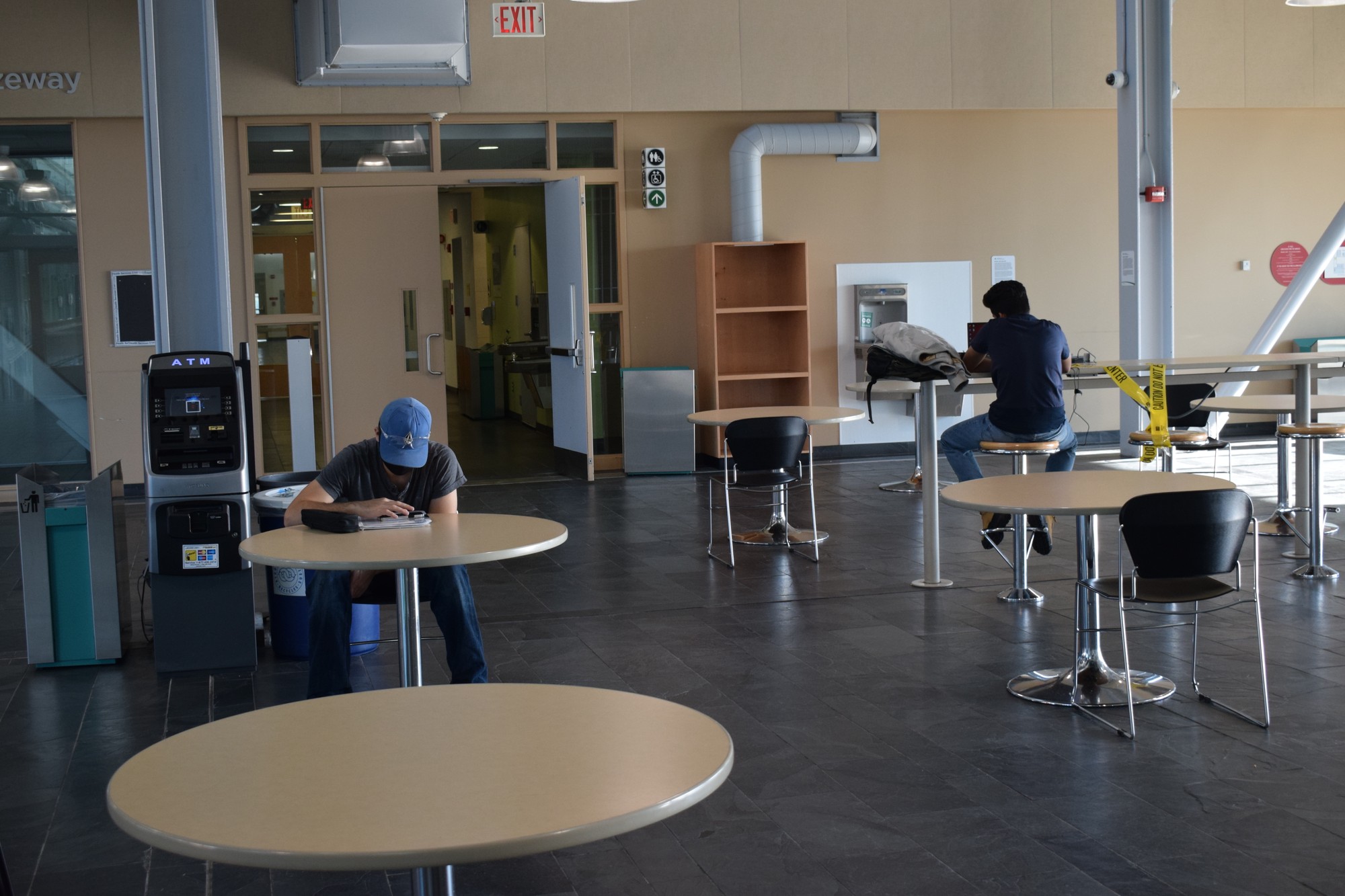
Students on campus share their Halloween plans, favourite costumes and memories from past years.

As the sun begins to set earlier and the leaves darken, a season of spookiness settles upon us – Halloween. People are beginning to decorate their houses and carve pumpkins, but for what?

Ottawa is currently back in stage two, and Halloween is sort of a no-go. So, we used this opportunity to allow students to share their plans with us and reflect on how they celebrated in previous years.

On Monday, Oct. 19, Algonquin Times reporters set out to campus for a mood check to get a feel for what students are up to this spooky season. The majority of the campus’ population was in study mode in light of due to midterm week.

Martin Schrappe, a paramedics student in the Student Commons.
Martin Schrappe, a paramedics student in the Student Commons. Photo credit: Phaedra Hamer

Paramedics student, Martin Schrappe, is feeling the heat from schoolwork and hasn’t put much thought into his plans for this year.

“I’m not sure if I have plans, I’m pretty busy with school so probably not,” Schrappe said.

Alex Graf (left), Jessica Mapila (middle) and Dara Palmer (right) are biotechnology students who shared their past Halloween experiences
Alex Graf (left), Jessica Mapila (middle) and Dara Palmer (right) are biotechnology students who shared their past Halloween experiences Photo credit: Phaedra Hamer

A group of biotechnology students don’t have much lined up either, but had fun stories to share about their past celebrations.

“There’s nothing to do this year,” said Jessica Mapila, a biotechnology student. “Me and my friends used to all dress up in group costumes. One year, we were all Dr. Seuss characters.”

Like Mapila, Dara Palmer and Alex Graf have plans to candy and watch scary movies.

Palmer shared fun stories from her childhood years of trick-or-treating.

“As a kid, my favourite thing was going to expensive houses and neighbourhoods,” she said. “There you’d get all the good candy, like full-sized chocolate bars and cans of pop.”

Electrical engineering technician students Gurpartap Singh (left) and his classmate Aditya Shah (right) studying together in the Dare District.
Electrical engineering technician students Gurpartap Singh (left) and his classmate Aditya Shah (right) studying together in the Dare District. Photo credit: Phaedra Hamer

An electrical engineering technician student, Gurpartap Singh, remembers his favourite costume.

“My favourite costume as a kid was pretty simple, just a ghost,” Singh said.

Singh’s classmate, Aditya Shah, is an international student and it’s his first Halloween in Ottawa. He wants it to be special but is celebrating in an interesting and safe way.

“My work is going to give us costumes to wear from the movie IT,” said Shah. “Maybe even the clown costume from the movie.”

Travel and tourism student Emma Pearce (left), library and information technician student Maggie Street (middle) and business marketing student Jackson Kemp celebrated last Halloween in residence.
Travel and tourism student Emma Pearce (left), library technician student Maggie Street (middle) and business marketing student Jackson Kemp celebrated last Halloween in residence. Photo credit: Phaedra Hamer

Emma Pearce, a travel and tourism student, and her friend, Maggie Street, a library and information technician student both celebrated Halloween on campus last year.

“I was in residence so I would just go to different rooms dressed up as the Arthur meme,” said Pearce.

“One year I dressed up as a clothing hamper, which was cool,” said Street. “I had suspenders on and attached a clothing hamper to them with hangers and clothes on it.”

Jackson Kemp, a business marketing student, was also with Pearce and Street. While he doesn’t have plans this year, he remembers celebrating as a kid.

“One year I went to a dance studio in Kingston that set up a haunted house inside when I was younger,” said Kemp.

Halloween will look different this year, with Ontario health officials recommending people in hot-spot areas to skip door-to-door trick or treating.

Whether it be decorating, dressing up, watching Halloween-themed movies or skipping trick-or-treating and binge-eating candy, people are finding ways to celebrate safely within the comfort of their own homes.

From almost cancelled to virtual: the annual Boot Drive marches on

The pre-service firefighting program’s annual Boot Drive avoided cancellation and went virtual thanks to the initiative of program leader Ashley McKenny. As fate would have it, the pandemic pushed the […]
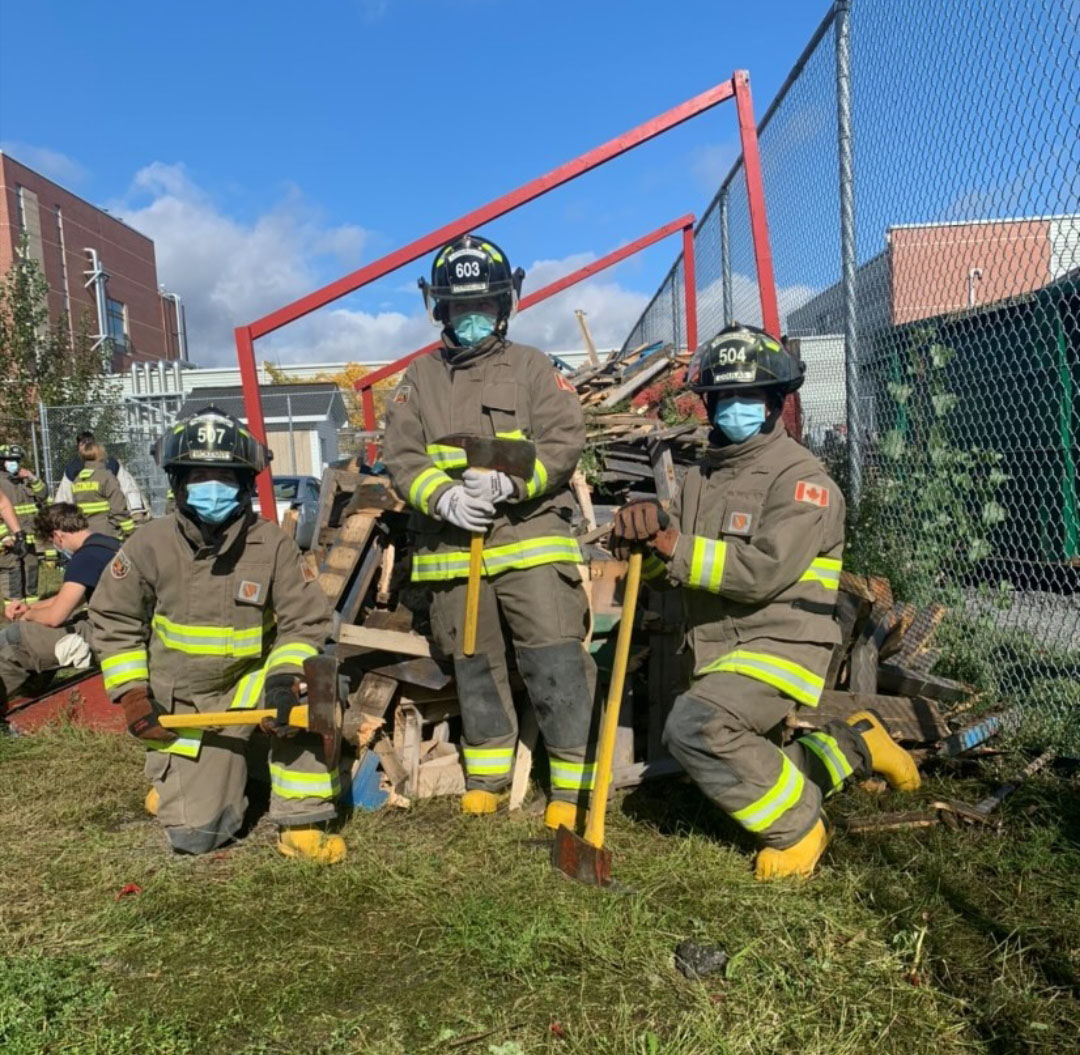
Photo: Ashley McKenny, Brooke Congdon and Cheryl Coulas. Photo credit
Left to right, students in the pre-service firefighting program at Algonquin College

The pre-service firefighting program’s annual Boot Drive avoided cancellation and went virtual thanks to the initiative of program leader Ashley McKenny.

As fate would have it, the pandemic pushed the pre-service program from June 2020 to December 2020, creating a unique opportunity wherein students in the program could run the fundraiser twice.

“Because we did it last year, I thought, why can’t we do it this year, even if it’s not in person?” McKenny said. She then reached out to Chief Cheryl Hardwick, her instructor, about the novel idea of having a virtual fundraiser.

The Boot Drive fundraiser started three years ago and served as a way to show students what can be done in an hour. The response from the college community has always been incredible, Hardwick wrote in an email to the Times.

McKenny organized last year’s in-person Boot Drive so that when she approached Chief Hardwick, it was an easy yes.

Next, she reached out to Jessica Clark, coordinator of the Food Cupboard — who was immediately on board. Due to the pandemic or other circumstances, the Food Cupboard has seen twice the students this past summer than in the previous year. Clark said they are doing what they can to adapt and was eager to help out with the initiative.

In conversation, Clark highlighted the creativity of the pre-service students in past years as well as this year. “It just blows my mind, she said, adding that last year, the students went out in their firefighting gear. “It’s such a visually eye-catching thing.”

“And Ashley specifically, has reached out to me two years in a row to start the initiative,” she said. The Virtual Boot Drive was her brainchild.

Preparation for the event took two weeks.

McKenny and her co-coordinator Cheryl Coulas, who acted as a second voice, worked on getting the two groups of 20 students motivated. Posts on social media had to be shared with friends and family.

McKenny and Coulas shared it with media organizations such as CTV News and Magic 100, who reposted their event.

The process, McKenny admitted, was harder than she had expected compared to the previous Boot Drive. Last year, the two platoons fanned out across the campus soliciting donations during a lunch hour. Within the span of two hours, the students managed to raise $1,600 for the Food Cupboard. This is in stark contrast to this year’s Virtual Boot Drive which is in the second week of its three-week run.

Although the prolonged fundraising was McKenny’s idea, she intuitively understood how the fundraiser would play out. “You can’t compare the two,” McKenny said. “But even if we just get over $1,000, I think that would be a huge help.” The fundraiser has raised over $800 so far.

The Virtual Boot Drive is on now and continues until Oct. 28, 2020. Find more information here.

Thunderdome comes down after cancellation of winter varsity season

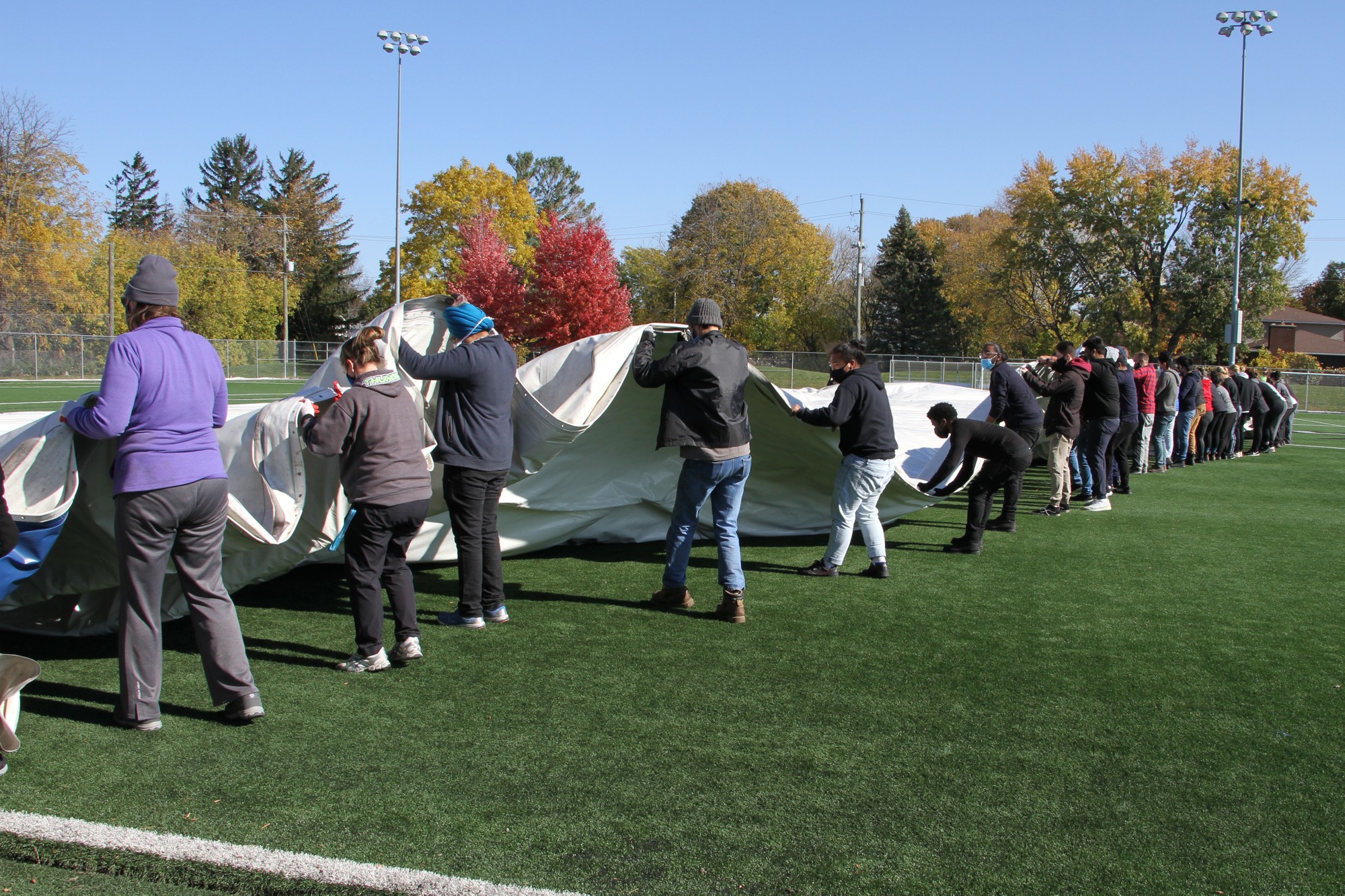
Participants gathered at the Thunderdome Soccer Facility on Saturday Oct. 17 to take down the sports structure.
Photo: Jocelyn Galloway
Due to rainy weather, the dome take down event was pushed back from Friday, Oct. 16 to Saturday, Oct. 17.

Participants gathered at the Thunderdome Soccer Facility on Saturday Oct. 17 to take down the sports structure. Continue reading “Thunderdome comes down after cancellation of winter varsity season”

Algonquin Times podcast

Stay Informed

Sign up for our newsletter

Subscribe

* indicates required