main

The value of nostalgia in a pandemic

It can be tempting to think of nostalgia as a set of rose-coloured glasses that idealize the past, but there’s so much more to it than that. Nostalgia can counteract […]
Photo: Madalyn Howitt

It can be tempting to think of nostalgia as a set of rose-coloured glasses that idealize the past, but there’s so much more to it than that.

Nostalgia can counteract things like loneliness, boredom, anxiety and uncertainty by giving us something familiar to hold onto.

When revisiting our past, we can regain a sense of control and direction that calms our fears about the present.

When I’ve thought back on all the confusion, uncertainty and loneliness I’ve felt because of the COVID-19 pandemic, I’ve noticed that revisiting better memories has helped me feel at ease.

It may sound like I’m just trying to ignore the current reality of the world, but I don’t see it that way. Instead of dwelling upon all the things I can’t control or the things I can’t do anymore, I’ve found comfort in the past.

Instead of feeling trapped in a present that I have little control over, I’ve listened to music or watched movies I used to love. I’ve adventured through Hyrule and wandered through Westeros by revisiting some of my favourite franchises.

I’ve let myself reminisce and feel like a kid again and afterward, I don’t feel as lost. In fact, I feel more confident that things will turn out well.

“It’s okay to go back there, as long as you don’t get stuck there,” said Cheyne Gallarde in his TED Talk, The Power of Nostalgia. “The trick is to let it ground you but not let it weigh you down.”

Amidst all the uncertainty, anxiety, loneliness and boredom caused by COVID-19, I ask you this: Why not let yourself take a break and be a little nostalgic?

When the term nostalgia was first used in 1688, Dr. Johannes Hoffer described it as a “neurological disease of essentially demonic cause.” Since then, it’s had a rather negative connotation, to say the least.

It’s been thought of as something to be used and abused by corporations through advertisements or something that makes old movies seem much better than they actually were. But there’s more to nostalgia than your grandfather giving you the old ‘back in my day’ spiel.

It can be easy to feel negatively about nostalgia, but it’s not necessarily right. Looking back with fondness at the past doesn’t mean you’re trapped in it, it just means you’re taking a break from the present so you can come back stronger.

“Nostalgia can give our lives texture,” said Gallarde. “It reminds us that we are valuable people, that we have meaningful lives.”

In more recent years, studies into the effects and different types of nostalgia have shown that rarely are we trapping ourselves in the past, but instead, are finding ourselves in it.

Research by the University of Southampton shows that nostalgia “elevates mood, self-esteem, and a sense of social connectedness; it fosters perceptions of continuity between past and present; it increases meaning in life; and it ‘fights off’ death cognitions.”

An article by National Geographic suggests that people turn to nostalgia in times of loss, anxiety, isolation and uncertainty. I struggle to think of many things in recent memory that have brought about as much isolation, anxiety and uncertainty as COVID-19.

And it’s not all peachy. Nostalgia is after all a ‘bittersweet emotion.’ When we allow ourselves to reminisce on the pleasantness of the past, we force ourselves to face the inevitable shock of returning to the present.

But that shock isn’t that bad. And it shows us that there is more to life than the current situation.

When we get caught up with all the problems in the world, nostalgia can give us a much needed break. It can contextualize a situation and remind us that things weren’t always how they are now, and that things won’t always be like this.

So the next time you feel a yearning to watch a familiar movie from childhood or remember something you haven’t thought about in years, don’t feel bad about it. Instead, let yourself find comfort in it and trust that things will be alright.

Massage away your end-of-term stress

The anticipation of rejection creeps up on me as I approach another student to ask about their opinion on the new U-Pass protocols on campus. When I come across a […]
Photo: Katelin Belliveau

The anticipation of rejection creeps up on me as I approach another student to ask about their opinion on the new U-Pass protocols on campus.

When I come across a culinary management student, a sigh of relief comes over me with his willingness to talk to me and share his experience.

As a student reporter with the Algonquin Times, part of my job is to talk with people and ask them questions. It’s how journalists build an article and it’s important to include different opinions and perspectives to cover all sides of the story.

Face-to-face social interactions are so limited right now, that I think we sometimes forget how others are coping. So, when Jessie Byers, third-year massage therapy student, told me I was his first client in the massage clinic since March, I understood his relief to be granted the opportunity to gain more experience in his field during these unprecedented times.

“I think people are apprehensive,” said Byers. “And we can’t see the public. So, I think there would be some people that would be more than willing to come in here but can’t.”

Since COVID-19 restrictions have been in place in Ottawa, the college has been slowly accommodating as many students as possible for them to gain the experience they need to be successful while maintaining health protocols.

“They’re in labs, they’re still learning,” said Debbie Robinson, support staff for the massage clinic. “And when they don’t have clients, they work on each other. So, they are getting some experience. However, the true client experience is not the same, because when you receive the public, they’re exposed to a lot more different challenges.”

On Monday, Nov 2., the massage therapy clinic opened its doors to employees and students who have access to campus.

The massage clinic is booking massages until Dec. 11 with affordable rates of $10 for students and $15 for faculty. Robinson said they hope the clinic will remain open in the new year.

When Robinson suggested I experience a massage for myself, I was a little hesitant. I have never experienced a massage before. Especially during the most intense part of my semester, the thought of a massage felt like an indulgence I did not deserve.

However, during a time where we are glued to our technology and hunched over our phones, Byers said there are body alignment issues we may not even be aware of.

“Someone starts working on your muscles, you start realizing things about yourself that you’ve never realized before and it really helps you to tune into your own body,” said Byers.

I could not agree more. Since I received my massage, my anxiety has come down and I’ve been more productive than I have been in weeks.

As students, we can sometimes be a little bit nervous when working when with people and perhaps take up more of time than a professional service. But if you have access to campus, and are willing to receive a massage, get a new haircut or even answer a few questions from a journalism student, you would be giving a priceless gift.

Want to be a remote learning success? Set up a workspace and commit

Distance learning in a spot designated for school leads to academic success, according to UTEP Connect, a university based in El Paso, Texas that specializes in online programs. That’s because, […]
Photo: Zainab Almehdar
Remote office setups when done right can really make online learning easier.

Distance learning in a spot designated for school leads to academic success, according to UTEP Connect, a university based in El Paso, Texas that specializes in online programs.

That’s because, according to UTEP Connect, having too many options on how, when and where to study makes online learning more difficult. In other words, students learning remotely who want to be successful need to set up a study corner – and stick with it.

Gina Mouchet is a graduate of Algonquin College’s early childhood education program and is now getting her bachelor of education degree at the University of Ottawa. In the daytime, she converts her dining room table into her office.

“My workspace currently includes the table in our living/dining room and one of our side tables where I keep all of my school supplies,” Mouchet said. Staying organized is important to her because she has to store her supplies on the side table or bookshelf when her family eats. “When I am doing school work, I usually take up half of the space on the table.”

Mouchet has only received a few grades this semester, but she is currently maintaining a status as an A student.

Michael Van Gaal, a computer engineering student, is completing his co-op placement remotely. He works at a long desk which he shares with his significant other, Martin Grant.

“To keep my desk organized I recently bought a drawer system that acts as desk legs on my side of the desk,” Van Gaal said. “I keep all of my cables and hard drives in it to keep as much as possible off of the desk.”

He keeps his space uncluttered by putting stuff away as soon as he’s used it and going wireless as much as possible.

Van Gaal has added plants to his workplace and an espresso machine.

“I drink a lot of coffee during the day,” he said. “It makes it feel a bit more like a school/office environment. It helps me not feel like I am always at home even though I am.”

Though his office environment is about to get a bit of a personal touch as the pandemic continues.

“I recently decided to paint one of the walls in my office space to brighten up the room,” Van Gaal said. “I think it helps a lot with making the space feel more personal. I have always been apprehensive about painting in rental properties but the pandemic made me cave because all the white walls made it feel really closed.”

Meghan Garrioch studied concept art and digital painting at Algonquin College, taking three different programs in her time there. She is now a part-time instructor at the college with the General Arts and Sciences Faculty. She teaches life drawing and an intro to photoshop for digital painting and creative thinking for design class.

Meghan Garrioch's home workspace.
Meghan Garrioch's home workspace. Photo credit: Meghan Garrioch

As part of the school staff she had her own office space but like students she is now working from home.

“I try and keep it organized as best I can,” Garrioch said. “The messier it is, the more likely I am to get distracted.”

According to Garrioch, it was beneficial to her mental health to keep her workspace clean. It helps her with her lessons.

“I try to make sure I have a clear space to record lessons or teach live that I can easily transition to from my usual studio work setup,” Garrioch said. “It took awhile to make everything functional, but now that it is, I also find it much easier to keep things tidy.”

Garrioch has decorated her workspace so that it fits her tastes.

“I have a lot of cool art up on the walls to remind me of my goals and to motivate me,” she said. “I also have a little couch on the other side of the room for a bit of a break area. I need a lot of short breaks, so being able to cross the room is enough of a disconnect if I keep a cozy spot reserved.”

Umbrella

“An umbrella questions the life for one man.” An umbrella has been hovering over my head since I can last remember. If it’s shielding me or covering the outside world, […]

“An umbrella questions the life for one man.”

An umbrella has been hovering over my head since I can last remember. If it’s shielding me or covering the outside world, I still do not know. It steers me away from storms, guarding me against the rays of something bright.

The umbrella says these things are dangerous, that I shouldn’t leave the space from underneath it. It says that I couldn’t handle the harsh outside world without its protection. Maybe it’s right; perhaps I shouldn’t leave the shelter it provides me.

But I see others wander, free of their umbrellas. Striving through life, they seem at peace. I’m never at peace; the umbrella always looms over me, watching me, judging me, telling me all the things I do incorrectly. All the things I’d keep doing incorrectly if I didn’t have its help – its guidance.

I’m getting too big for the umbrella though. My head’s starting to hit the top, struggling against its restraints. The umbrella doesn’t understand that I no longer need its protection, that I can wander the world free of its advice. It has given me enough to survive out there.

Alone, free of its judgement, free of the condescending words it spouts out. It may have given me shade from the sun all these years, but the shadows can be a dark and lonely place to be kept in.

And soon enough, I will become an umbrella myself.

Desirea Caballero – Desirea is an avid reader and storyteller. As a second-year Professional Writing student, she hopes to reach and inspire people with her work.

Pandora’s Box

“The most horrifying terrors in the simplest objects.” I am not Pandora. I am Pandora’s box. I stay locked away in doomsday, that never seems to stop. I have been […]

“The most horrifying terrors in the simplest objects.”

I am not Pandora.

I am Pandora’s box.

I stay locked away in doomsday,

that never seems to stop.

I have been set free,

out of the whimsies of curiosity.

On a mission to teach,

the people of my county

cruelty and murder, and treachery.

I am not the innocent,

I’ve always been the plague.

I am the catalyst of evil, and I have never strayed.

I teach children hunger and adults slaves,

I am the reason for your loss and the reason for your praise.

And Yet I am the Needed.

And Yet I am the Hope.

You can’t live without me,

‘Cuz then you’ll never grow.

Linda Ixchel Deslauriers – Linda is the most “fangirly” person you will likely ever meet. She’s a second-year student in Algonquin College’s Professional Writing program. She enjoys hot chocolate, rainy evenings, literature and cinema. If looking for her, you will find her on her bed; enthralled in whatever new addiction she’s developed since.

My Grandfather’s Watch

“What became yesterday’s history is now today’s property.” I have a watch that used to be my grandfather’s. It has an old leather band and a scratched face and hands […]

“What became yesterday’s history is now today’s property.”

I have a watch that used to be my grandfather’s. It has an old leather band and a scratched face and hands that go tick, tick, tick. Well, it doesn’t go tick, tick, tick anymore, but it still looks good strapped on my wrist or lying on my dresser. Besides, it doesn’t need to tick anymore. There’s phones and microwaves and TVs and ovens and fridges all trying to tell you the time. Nobody asks watches like this one what time it is anymore.

My grandfather always did. He would wear this watch wherever he went and he would always ask it what time it was. He would wear it when we all went out to dinner together every Friday. He’d wear it to church on Sunday morning. Everywhere he went, people would stop him and tell him how much they liked his watch. Sometimes, they would show him their watches and they would compare them. “Mine goes tick, tick, tick,” my grandfather would say, and they would say, “Mine goes tock, tock, tock.” My grandfather told me never to trust someone whose watch goes tock, tock, tock. But fewer and fewer people would stop my grandfather with watches that went tock, tock, tock. Fewer and fewer people had watches at all. They had phones and microwaves and TVs and ovens and fridges and no watches. My grandfather’s watch grew lonely.

That’s why it stopped ticking. One night it worked – tick, tick, tick – and in the morning, it realized how pointless it was to go tick, tick, tick, so it stopped. But I still keep it with me. I think to myself, one day I’ll fix this watch. I’ll take it to somebody who knows how to talk to watches. I’ll take it to them and I’ll say, “this watch, it was my grandfather’s watch, but it doesn’t want to tick anymore.” And they’ll say, “you’ve come to the right place,” and I’ll give the watch to them and they’ll talk to it, and they’ll tell it how special it is, and how much my grandfather cared for it, and it’ll start to feel better, and one day it’ll start ticking again.

I’ll wear it to dinner, I’ll wear it on Sundays, I’ll show it to everyone I see. I’ll say, “this was my grandfather’s watch,” and they’ll all look at my wrist and they’ll all be very impressed with my grandfather’s watch. And it won’t matter that all the phones and microwaves and TVs and ovens and fridges are trying to tell you the time because none of those are my grandfather’s watch. None of those have an old leather band and a scratched face and hands that go tick, tick, tick.

Alex Foster-Petrocco - Alex has a BA in History from Carleton and is currently a 2nd-year Professional Writing student at Algonquin.

Struggles of young people ignored during pandemic, says NDP leader

Federal NDP leader Jagmeet Singh says he believes in “putting money in people’s pockets when they need help,” and when young people need it especially, is now. “The plight of […]
Photo: Breanna St-Jean
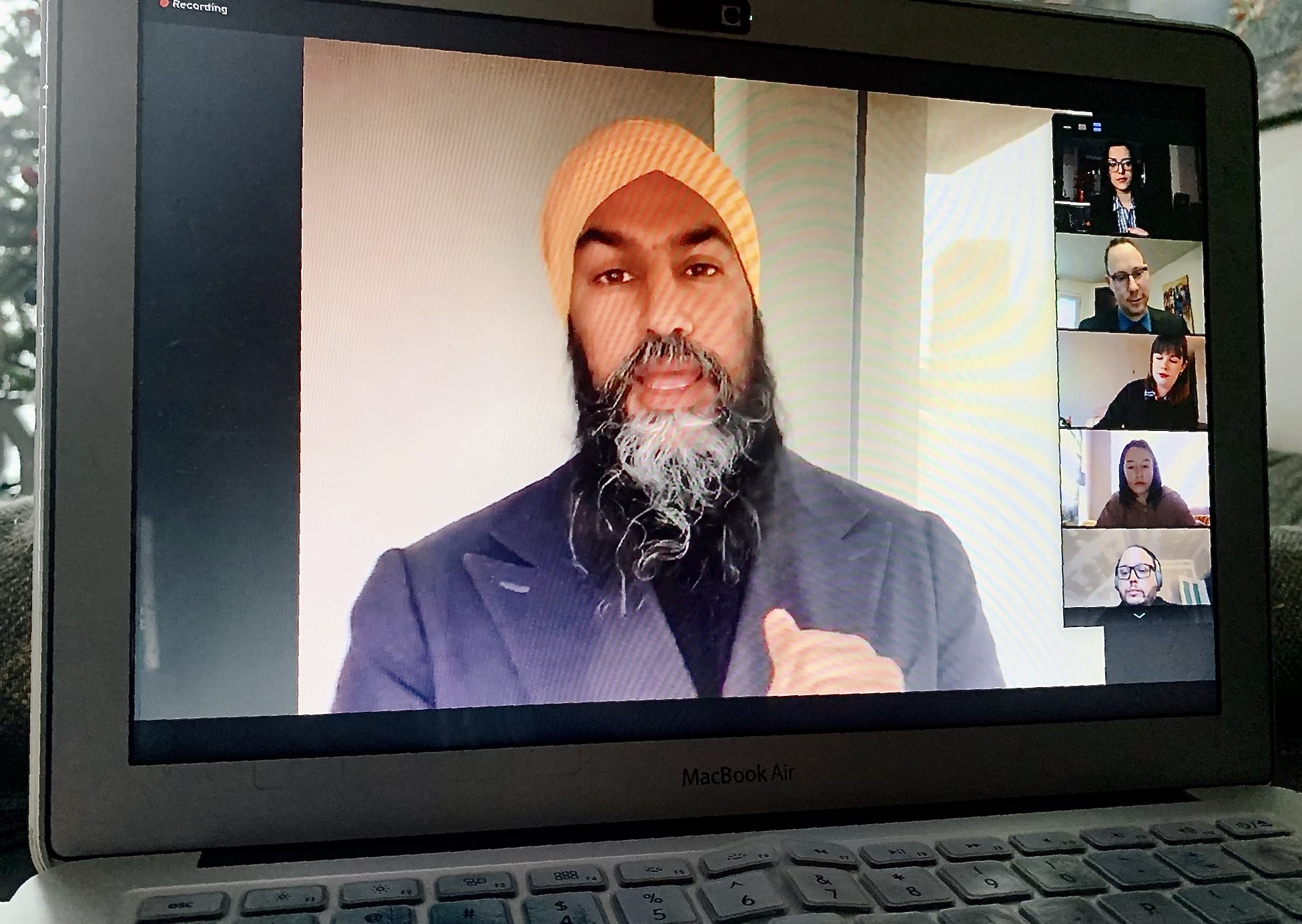
NDP leader Jagmeet Singh joined Algonquin College journalism students for a virtual press conference on Nov. 27.

Federal NDP leader Jagmeet Singh says he believes in “putting money in people’s pockets when they need help,” and when young people need it especially, is now.

“The plight of young people has been ignored during the pandemic,” Singh said during in a press conference over Zoom with Algonquin College journalism students on Nov. 27. “They are one of the hardest hit communities.”

Acknowledging that young people who are starting their careers in a pandemic “will feel the weight of this a lot more than someone who has already established a career,” Singh fielded questions from reporters about how the NDP plans to support young Canadians struggling with issues ranging from student debt to housing inequality.

In particular, Singh addressed how the NDP would support post-secondary students who are feeling the weight of mounting student debt and an uncertain job market during the pandemic.

“The massive debt that people go into [for education] is for me the worst way possible to have someone start their life,” said Singh.

One way he proposes helping students is by bringing back the interest-free moratorium. “We actually believe it should be a permanent end, there should be no interest charged in federal student debt,” he said. “I absolutely believe there should be no barriers to pursuing education. Including post-secondary education into our public education system is our ultimate vision. That’s what I want to achieve.”

Singh also proposed a federal minimum wage of $15 an hour as another quick solution. “Most of the workers that would benefit from this are young workers, or workers starting off in their career,” he said.

Singh criticized the Liberal government for failing to put this into action. “How could the federal government have any moral authority to talk about good wages if we don’t even have a livable or at least working towards a livable minimum wage at the federal level?”

When pressed on why the NDP’s motion called for only a moratorium but did not call for full loan pardons, Singh admitted it was part of the party’s strategy to fight for what it sees as achievable goals.

“One of the strategies that we that we’ve been using in this pandemic is, is where we can win battles that we know there’s enough public pressure and support to kind of get the get the momentum behind getting this done,” he said.

“The moratorium was there before the Liberals took it away, and we thought, this is a clear thing that we can actually get back and clear victory, a concrete thing that we can get done. So that was the reason why we focused on bringing the moratorium back.”

Looking ahead to post-pandemic financial support, Singh was asked specifically if he supports implementing a universal basic income to help Canadians in the long-term. He admitted he believes in the philosophy but hesitated to embrace the terminology.

“I’m not caught up on the label,” he said. “People talk about a livable guaranteed income, about annual guaranteed income. I just want money in people’s pockets directly.”

He instead expressed concerns that Canada’s current tax system allows for too many loopholes to be taken advantage of in a universal basic income scenario and prefers instead to focus on issues of immediacy.

“We were the ones that fought for CERB in the first place, because we believe getting money to people, was important. We wanted CERB, universal because in a pandemic we knew that everyone would need it, and let’s make it as effective and as quick and as easy as possible.”

While he was reluctant to put a label on it, Singh re-iterated that he supports the general idea of a universal basic income. “Moving forward I believe in it. We campaigned on a pilot project nationally, so that we could actually get the data to address some of the stereotypes, that people won’t work, people will be lazy, all these kinds of false myths.”

With sudden job losses and increased financial pressures for Canadians during the pandemic, the push for a federally implemented universal basic income has been gradually gaining public support. A universal basic income is a proposed government program where Canadians receive a set amount of money on a regular basis in order to help alleviate poverty and potentially replace other need-based social programs altogether.

“It actually gives people a support for them to then find better employment, it actually helps people get back to school, helps people start up their own businesses and helps address child poverty, so I really believe in income supports,” said Singh.

A UBI pilot project has been proposed in Newfoundland and the costs and benefits of running the program are currently being weighed. When asked if he supports other UBI pilot projects being implemented across Canada, Singh says he does.

“With a national pilot project, we’ll get the data to actually prove that these [myths] are wrong,” he said.

Singh signed off emphasizing the need for immediate financial supports for Canadians. “That’s something I fully believe in, and I want to find the best way to achieve it.”

Students form online friendships to purge pandemic loneliness

The pandemic has put strain on many aspects of life, not least of all our relationships with family and friends. Public health restrictions have made visiting with those close to […]
Photo: Meara Belanger
Making new friends online has helped many students with their mental health during the pandemic.

The pandemic has put strain on many aspects of life, not least of all our relationships with family and friends.

Public health restrictions have made visiting with those close to us more difficult. Whether or not we’ve been anxious about our own welfare, or concerned about a loved-one with underlying health conditions, COVID-19 has certainly put a damper on physical closeness.

Although the phenomenon of finding friends – and even a partner – on the internet is as old as floppy disks themselves, the pandemic has been a catalyst for creating a solution to quash quarantine loneliness.

John Muldoon is a counsellor at Algonquin College. He reminds us that although this isn’t a new trend, it’s a rapidly growing one.

“Online friendships have been around for well over a decade,” said Muldoon. “Having an online friend, or having people you talk to online can really bolster your friendships. [You] sort of stay connected, share ideas and thoughts and funny photos […] and memes and all that kind of stuff.”

One student who has forged many friendships online is first year business administration student Mairead Morrison. She uses Bumble Friends to connect with people online – most of whom she describes as “casual acquaintances.”

“For every one in five people I match with, do we actually continue to talk on a regular basis,” said Morrison. “Some are just every now and then others are just that first day you match and then you don’t talk much after that.”

Over the summer, Morrison met with one of her online friends when the case-count in Ottawa was low.

“Since then I haven’t met anyone else, but I do plan to,” said Morrison.

Others have met friends online who they imagine keeping in their lives forever.

Don Seneviratne is a game development student in his second year at Algonquin. He describes an invaluable friendship he made with someone he met through a chat group.

“My cousin introduced me to the group,” said Seneviratne. “Most people were awkward with me but she always kind of related to my ideology […] on certain things. So after a while I contacted her directly and started talking to her. She’s like the yin to my yang.”

Seneviratne says his friend is someone who always has his back, even though he’s never met her in person. He describes their bond as close and emotional.

“I am thinking of meeting her in the future,” said Seneviratne. “In fact, we’re at a point where I want her to be my best-woman at my wedding, ‘cause in such a short time she knows secrets about me that no one knows.”

Although some people might view an online friendship differently than an in-person one, they are one and the same for Chris Pavone, a graduate of Algonquin’s radio broadcasting program.

“Some I talk to a multiple times a week,” said Pavone. “Some a couple times a month. I view them the same as someone I know in person.”

Pavone met most of his online connections through Twitch, Twitter and Facebook. He says he doesn’t have any issues with coordinating real-life plans with his friends after the pandemic has ended.

“I have met a few already,” said Pavone. “Meeting an online friend can be the best thing ever.”

Even with all the social benefits the internet offers as the pandemic confines us to our homes, there can be drawbacks to restricting ourselves to online social connections. Muldoon argues that online communication is a tool that should be used in conjunction with in-person socialization.

“It does show sometimes that if you just have an online friendship, it doesn’t quite meet the full need of physically being with somebody in person,” said Muldoon.

However, since meeting physically is discouraged these days for safety reasons, Muldoon understands the invaluable need to stay connected through other means.

“There’s still lots of value and importance of being physically with people around us,” said Muldoon. “Ideally we still want to have those connections, but under the current circumstances it’s not really permitted.”

Muldoon believes that online socialization has become much more intimate in recent years with the introduction of technologies such as video chat, which have made it easier to pick up on body language and social cues. Although the pandemic will one day end, Muldoon believes the long-term effects from this lengthy period of social isolation will endure.

“Especially when there is a video, you’re in your environment and they’re in their environment,” said Muldoon. “When you’re in person, you have a shared environment, which sometimes influences how people interact, and connect and communicate. Just the warmth you get from being with somebody is not always there with a virtual world. […] Being able to hug somebody or sit on the couch and watch a show together, those are lots of shared experiences that are different.”

Muldoon believes that trading some of those shared experiences for a more isolated, virtual one will perhaps leave a psychological mark on us post-COVID.

For students who are interested in getting involved socially, Muldoon recommends taking advantage of some of the virtual resources offered by the school.

The college is now offering group counselling online to help peers support one another in a therapeutic capacity.

AC launches first Victimology Research Centre in Canada

Algonquin College launched a new Victimology Research Centre on Tuesday for National Victims and Survivors Crime Week. The event focused on one of their current studies: community response to homicide. […]
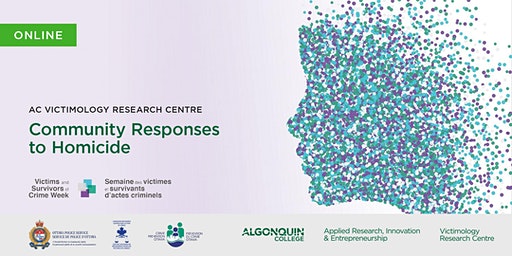
The Victimology Research Centre held its virtual launch event Nov. 24.

Algonquin College launched a new Victimology Research Centre on Tuesday for National Victims and Survivors Crime Week.

The event focused on one of their current studies: community response to homicide.

Dr. Benjamin Roebuck is the research chair and professor of victimology at the college and Diana McGlinchey is the research manager of the centre.

“This is a partnership between the newly formed Victimology Research Centre, the Ottawa Police and the Victim Crisis Unit, the Canadian Resource Centre for Victims of Crime and Crime Prevention Ottawa,” Roebuck explained. “We have such a great group of partners that have helped to put this on.”

The event was opened by Claude Brulé, Algonquin College president, who welcomed all the attendees.

“This centre is unique to Canada,” Brulé said. “The centre’s work produces groundbreaking research in its field in partnership with non-profit organizations and government stakeholders studying victimization and the experience survivors have with the criminal justice system.”

Algonquin College’s learners from the victimology program, police foundations program and community and justice services program have been using the centre as a resource. “These students perform the central role as they work on various research projects,” Brulé said.

The event had Roberta Della-Picca, an elder of the Algonquin Peoples and a recipient of the order of Ottawa for her work in advocacy and preventing violence against women, perform a greeting.

“This is funny because we are all in cyberspace,” she said. “But we are all on unceded Algonquin traditional territory.”

Della-Picca sang a song of welcome. Presenters throughout the event acknowledged the Algonquin Anishinabe Nation’s unceded land.

Dr. Roebuck also released a documentary film titled After Candace: The Art of Healing, which was one of the research centre’s past projects. The film captures the healing journey of Cliff and Wilma Derksen – survivors of their daughter’s homicide.

“Understanding the experiences of victims and survivors is exceptionally important work,” Brulé explained. “It can only lead to greater awareness and positive changes in our institutions and society in general.”

The Research Centre will also be focusing on three other studies: Victim Services and Vicarious Resilience, Male Survivors of Intimate Partner Violence in Canada and COVID-19 and System Responses to Homelessness.

Holiday Baking Contest

Date: November 17th – December 18th Tis’ the season to be baking! Check out @atpromo Instagram account to participate in another fun baking contest for the chance to win a $25 […]

Date: November 17th – December 18th

Tis’ the season to be baking! Check out @atpromo Instagram account to participate in another fun baking contest for the chance to win a $25 Amazon gift card.

Instagram post: https://www.instagram.com/p/CHsvAbRFgju/?utm_source=ig_web_copy_link

Algonquin Times podcast

Stay Informed

Sign up for our newsletter

Subscribe

* indicates required