main

Residence carves in-person events back into schedule

On Friday, Oct. 15, Danilo Calobrizi had the opportunity to carve a pumpkin for the very first time during one of residence’s first in-person events since the pandemic began. Caolbrizi, […]
Photo: Tanner Reil
Reegan Derikx (left), residence advisor, and Raivyn Halcro (right), residence community advisor, remain optimistic about more in-person residence events.

On Friday, Oct. 15, Danilo Calobrizi had the opportunity to carve a pumpkin for the very first time during one of residence’s first in-person events since the pandemic began.

Caolbrizi, a first-year teachers of English as a second/foreign language student, arrived at Algonquin College from Brazil only three weeks ago.

“It’s amazing because in Brazil, we only get this in movies,” said Calobrizi. “This is something that like every child would dream about,” he added.

Calobrizi, like many of his fellow residents, is relieved that in-person events are beginning to return to the residence. The events give students like Calobrizi an opportunity to socialize and make friends also living in their new home-away-from-home.

"I just went to the traditional look, because this is my first time doing it," said Calobrizi.
"I just went to the traditional look, because this is my first time doing it," said Calobrizi. Photo credit: Tanner Reil

Friday afternoon’s pumpkin carving contest was set up in the residence lobby next to 35th Street Market Café. The event allowed participants, solo or in pairs, to carve pumpkins in two sessions from 12 p.m. to 1 p.m. and 2 p.m. to 3 p.m.

Halloween music filled the residence lobby as 25 participants attempted to win a variety of prizes including Halloween cookie houses, hot chocolate mixes and pumpkin pies.

Patrick Whyte, a first-year game development student, challenged himself by going for a less traditional design for his pumpkin carving.

Whyte takes a less traditional approach to his pumpkin, as he begins to carve out a cat.
Whyte takes a less traditional approach to his pumpkin, as he begins to carve out a cat. Photo credit: Tanner Reil

“I thought of getting a cat with a moon background and some bats, it’s gonna be fun,” said Whyte.

Raivyn Halcro, residence community advisor, and Reegan Derikx, residence advisor, were a part of the team responsible for organizing and running the event. Halcro and Derikx both remain optimistic regarding having more in-person and hybrid-style events as opposed to online, while still following COVID-19 restrictions.

“We are slowly working our way into moving towards half online and half in-person,” said Halcro. “We have noticed a huge increase, over 50 per cent, more participants with the hybrid when compared to just virtual.”

Since students arrived at residence in September, the team has held virtual events including escape rooms, JackBox Games nights and speed friending.

“There’s not usually much participation on Zoom,” said Derikx. “People will join but they’ll keep their cameras off, they won’t really speak, they’ll take the materials and make the craft on their own, there’s not as much interaction.”

More in-person residence events are currently planned for the coming weeks, including movie nights, Halloween mocktails and make your own crafts. According to Halcro, the best way for residents to stay up to date with the status of in-person events is the events calendar and @ACResidence Instagram, where the winning pumpkins will also be announced.

To the World

What is buried is not dead. by Jasper Compton The dirt tasted like ash, but Bane couldn’t remember the others having any fires on top of him recently. They did […]

What is buried is not dead.

by Jasper Compton

The dirt tasted like ash, but Bane couldn’t remember the others having any fires on top of him recently. They did that sometimes. Oh, they didn’t know he was there, but he was there nonetheless. They had their bonfires and alcohol, they sang and danced and drank. They got depressed, they had sex, and he was there to witness it all without anyone witnessing him.

As much as he wanted to say he understood their lives, he didn’t. He’d never been that type of person. It was the very fact that he wasn’t one of them that led Bane to where he was now.

Bane had been eighteen for eighteen years, with no way to tell if he was alive or dead. Oh, everyone believed he was dead… his mama, his cat, and especially the others- the ones who partied over his body now, the ones who’d dragged him way out here and buried him while he was still breathing until nothing but ash and dirt filled his lungs. They all believed he was dead. But he wasn’t. Or, not completely.

Bane couldn’t tell you why he hadn’t been killed. Oh, sure, he knew he was at least partially gone, but he could still hear and taste and smell. He could hear worms in the dirt, taste the ash that seeped into the ground, and smell that awful vomit the others left behind for him in the morning.

Over the years, the ground had grown around him, but it had also grown inside of him, and they’d become one. It was soft in some places, heavy in others. And then one day, when he wondered what anything and everything would look like beyond all the underground dark, the earth simply split open for him. After years of only darkness, an eighteen-year-old boy who’d been eighteen for just as long, saw colour for the first time. And Bane… Bane of the Earth was unleashed unto the world.

I’m someone who really enjoys different types of art ranging from visual to music and more. But I especially love exploring the art of word and story craft.

Are you an Algonquin College student interested in seeing your own creative writing published? Email Nicole Chatelain at chateln@algonquincollege.com for details!

The Heart of It

A bleeding heart is patched with faith it hemorrhages bleeds out drains itself of all but steadfast loyalty and dies a cruel, lonely, death alone cast out unworthy not seen […]

A bleeding heart is patched with faith

it hemorrhages

bleeds out

drains itself of all but steadfast loyalty

and dies

a cruel, lonely, death

alone

cast out

unworthy

not seen or known

for its greatest gift

belief

in you, in us,

in Him

who was also

cast out

unworthy

and bled out, too

alone

because of love

two millennia ago

Naomi Johnson is a compulsive note-taker who reads daily and loves listening to audio books over dinner. She plans to complete her first memoir after graduation but her real dream is to “live the religious life.”

Are you an Algonquin College student interested in seeing your own creative writing published? Email Nicole Chatelain at chateln@algonquincollege.com for details!

Living and working in a college residence during the dark days of COVID-19

As Algonquin College students return to study and live on campus, they’re still hit with the reality that a sense of normalcy is not the easiest to find. Before COVID-19 […]
Photo: Muna Aden
Reegan Derikx, a third-year student in the Bachelor of Public Safety program and residence advisor, has felt the effects of living in residence with limited activities to do.

As Algonquin College students return to study and live on campus, they’re still hit with the reality that a sense of normalcy is not the easiest to find.

Before COVID-19 became a worldwide pandemic, students living in residence were able to roam around and have their typical college student life.

Reegan Derikx, a third-year student in the bachelor of public safety program and residence advisor, has felt the effects of living in residence with limited activities.

“It is harder to meet people and have the experience of being with other people in a chill environment without worrying and without being on Zoom where it’s more awkward, I find,” said Derikx.

In previous years, the Algonquin residence staff would hold a variety of events that would give returning and new students an opportunity to get to know each other and enjoy a night of fun without feeling confined to one space.

Brittanie Walker-Reid, a residence life manager for the past seven and a half years, was just one of the many residence workers who attended these events.

“Our favourite was community kitchen, in the back lobby with wonderful food and music,” said Walker-Reid.

Another event that would be held throughout the year in residence was a coffee house, where students could come down and grab a cup of hot chocolate, tea, or coffee and mingle with fellow students.

“There was always something going on somewhere in the building, and often I would find out about an event by simply walking by it, and oftentimes if I was interested, I could just join right in,” said Derikx.

This year, with many guidelines in place, in-person events and even casual student hangouts aren’t permitted. If students would like to participate in activities and events, they have the opportunity to do that online through Zoom. The focus now is for residence workers and students to have a safe living environment.

“Lots of focus on maximizing community safety. Making sure all students have engaged with the mobile campus safety app to place their vaccination status in,” said Walker-Reid.

Although only time will tell when the residence can look like it once did, Derikx is remaining hopeful and looks forward to being able to continue working at the residence once it’s at full capacity.

“I really do hope that I can have another year or even just another semester with kind of a more normal experience before COVID,” said Derikx.

Algonquin’s commitment to Truth, Reconciliation and Indigenization

Truth, Reconciliation and Indigenization is never far from my mind.  On September 30, we recognized the first National Day of Truth and Reconciliation with a variety of in-person and online activities including videos, a podcast, a memorial fire and […]

Truth, Reconciliation and Indigenization is never far from my mind. 

On September 30, we recognized the first National Day of Truth and Reconciliation with a variety of in-person and online activities including videos, a podcast, a memorial fire and an on-campus exhibit.  

It was a meaningful and important day, but for Reconciliation to be truly successful, this cannot be a singular annual event. In fact, here at Algonquin College, Truth, Reconciliation and Indigenization is happening on our campuses in various forms almost every day. For starters, you can learn just by wandering the communal Indigenous spaces on our Ottawa campus, which include:  

  • Nawapon, our Indigenous Learning Commons on the first floor of the DARE District. It serves as a gathering place for the College community and a place to host events. It includes The Lodge, a circular space that can be used by smaller gatherings for meetings and events. Nawapon’s “green” roof includes Indigenous plants that grow naturally in local communities. 
  • Just outside, our Ishkodewan courtyard includes a Gathering Circle and fire-vessel – and can be used for special ceremonies and an outdoor classroom. In the green space surrounding the circle, Horticultural Industries students planted the largest Indigenous garden in Ottawa — with more than 100 plant species that have cultural and historical significance to Indigenous Peoples for their medicinal, nutritional or cultural properties. 
  • The Three Sisters Garden (located in the outdoor courtyard between E, H and D Buildings ) showcases beans, squash and corn – three symbolic crops that are central to the Haudenosaunee creation story. 
  • Three-storey Indigenous mural in the DARE District also reflects Indigenous creation stories 
  • Within the DARE District and around campus, we have incorporated Indigenous symbols reflective of Anishinābe culture and traditions. 

Of course, our Mamidosewin Centre provides a gathering place for Indigenous students looking for support, services and community while also providing cultural programming and learning opportunities for all. 

We are also proud that our Pembroke Campus is home to an Elder-in-Residence, Kampus Kokum and Campus Drumkeeper who all help to educate and bring traditions and resources to Indigenous and non-Indigenous students. Ceremonial drums were also created for our campuses in Perth, Pembroke and Ottawa. 

At the highest levels of the College, we are proud of having a Vice President Truth, Reconciliation & Indigenization – the first position of its kind created at an Ontario College. Ron (Deganadus) McLester and his team are committed to assisting us become better allies and learners.  

The College is in the process of developing a multi-year Truth, Reconciliation and Indigenization Strategic Plan, in consultation with the College stakeholders and our Indigenous community. Alongside the Students’ Association, we are also developing a Student Leadership Pack that will create opportunities for Indigenous learners to share and celebrate Indigenous culture with their peers, the College community and Indigenous partners. 

In developing our new three-year vision for the College, we “incorporated Indigenous knowledge and storytelling to help ground and focus our work … and examine the world around us with both Western and Indigenous perspectives.” A number of College initiatives have relied on frameworks based on the Anishinaabe Medicine Wheel teachings to help govern the way we collaborate, think and effect change.  

The College offers a variety of Indigenous academic programs, including the Pathways to Indigenous Empowerment and Indigenous Cook: Pre Apprenticeship program, and courses like  Indigenous Peoples: Understanding and Reducing Victimization and Indigenous Studies.   The Institute for Indigenous Entrepreneurship is part of our DARE District, a state-of-the-art facility, that helps indigenous students take their entrepreneurial ideas and turn them into reality through a combination of mentorship, peer support, and cultural connections. 

We are also trying to have an impact on Truth, Reconciliation and Indigenization well beyond our campuses – working with partners across the province and the country. Last December, we started working with Employment and Social Development Canada, to lead the $7-million expansion of Indigenous Youth Development Canada, a program that brings First Nations communities together with educational institutions, government, and corporate stakeholders to help Indigenous youth acquire job-ready skills while extending their education. 

We are very proud of the many different ways in which we support our Indigenous community and strive to become better allies and learners, yet we acknowledge there is still much more work to be done. We need to continue to integrate Indigenous ways of knowing and being throughout all that we do as a College. Rather than having a single goal related to Truth and Reconciliation or Indigeneity, we must be committed to adapting our processes and practices to honour and respect our institutional namesake and the traditional territory the College is situated on. I welcome your thoughts and ideas at president@algonquincollege.com. 
 

Learn more at www.algonquincollege.com/tri/ 

Television Broadcasting students help CTSACT broadcast charity event

After a year of remote learning, students of the television broadcasting program broadcasted their first live event. On October 8, the Centre for Sexual Abuse and Childhood Trauma (CTSACT) held […]
Photo: Julien Bernier
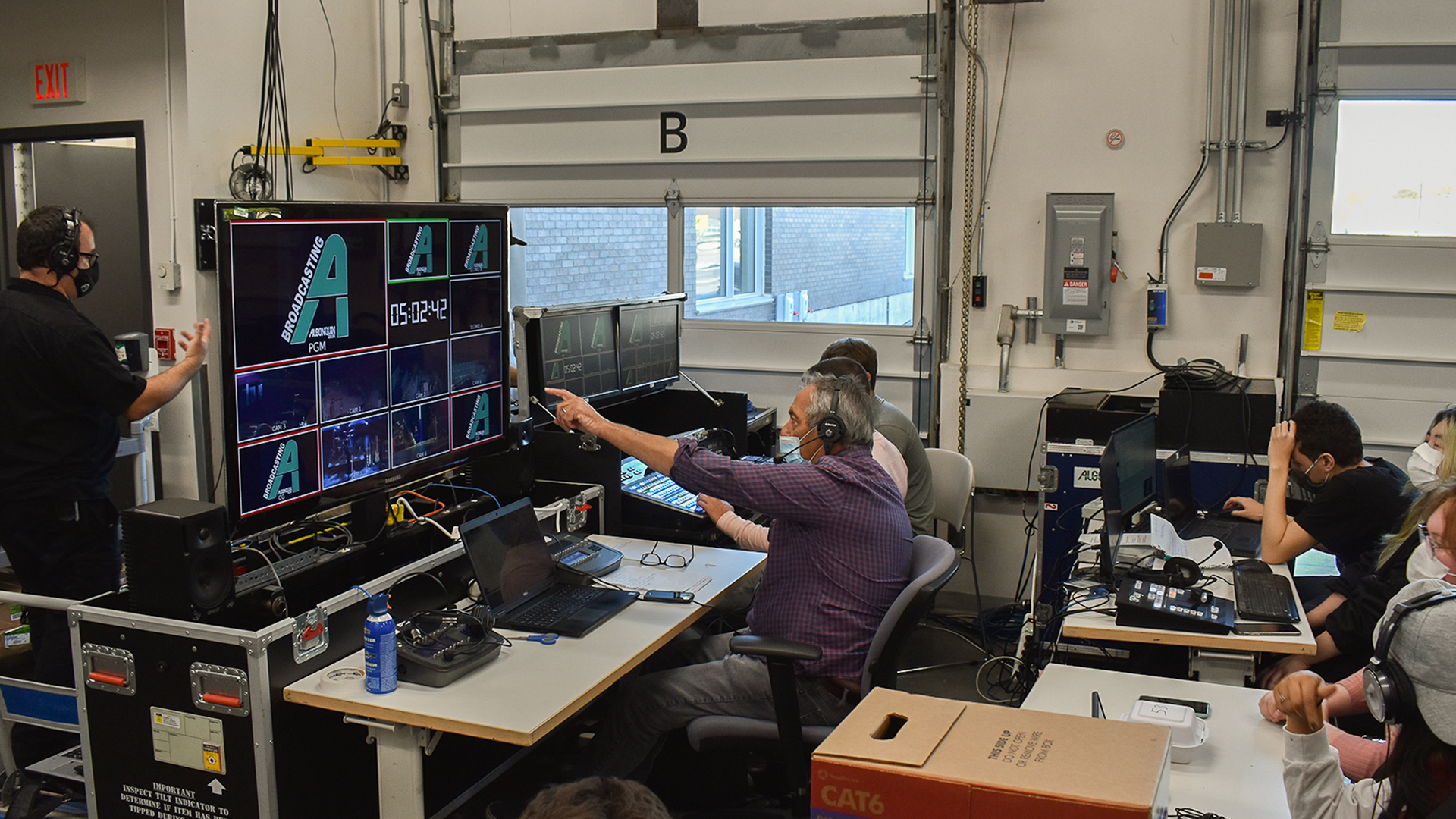
David Grigg mentioned that setup for this event took six hours and that traditionally it should take three, due to distance for cabling. He expects the setup will go much more smoothly for future events.

After a year of remote learning, students of the television broadcasting program broadcasted their first live event.

On October 8, the Centre for Sexual Abuse and Childhood Trauma (CTSACT) held a charity event at the Algonquin Commons Theatre to raise funds for their organization so they could lower the cost of the services they offer.

Genevieve Leblanc, an associate therapist at CTSACT and the event’s MC, mentioned that services offered at their centre are not currently covered with OHIP and that there are very few organizations like theirs that are.

A silent auction was held during the event, as well as musical performances by three Ottawa area artists. However, this event would not have been able to be streamed without a dedicated team.

David Grigg, a professor of live event production in the television broadcasting program at Algonquin, said he was contacted by CTSACT in June.

“They approached me and asked if I would be interested in doing it [the event],” said Grigg. “They told me […] it was three different performances and that it was for charity and I thought it was a good idea.”

Grigg brought this idea to Ken MacLeod, the senior manager of theatre and venue operations, and Macleod ironed out the details with CTSACT.

“I came along and when Ken was planning it, he wanted to have four different stages per se,” said Grigg. “There’s three different performers at the house position but they’re going to be in different parts of the theater.”

Grigg mentioned that that element really attracted him because it gave him and his team of students so many places to shoot video and it would not all strictly be on stage. “That was pretty cool and that excited me so I put it on the schedule.”

Riley Thero, 20, a third-level television broadcasting student at Algonquin, explains that in the first year of the program they had in-person classes twice a week, as opposed to three times a week this year.

Though this event took place at the start of the Thanksgiving long weekend, Thero believes that regardless of holiday or event students in the television broadcasting program should want to do events day or night
Though this event took place at the start of the Thanksgiving long weekend, Thero believes that regardless of holiday or event students in the television broadcasting program should want to do events day or night Photo credit: Julien Bernier

“Being online sucks,” said Thero. “This program is very hands-on like you’re playing with the equipment, cameras, switcher, audio. You need to be at the college for that.”

Thero explained that many of the courses in the first year were online, and some that should have been in person were not, and so that was an added challenge, as it affected their knowledge of the equipment.

Leading up to the charity event, Thero mentioned that they had enough practice using the equipment to the point they could run a five-minute news show or run a news story and even did a kid’s show as one of their final shows in the first year.

“Last year we wouldn’t have a sweet clue how to come and do a live event,” he said. “I’ll put it this way, 15 minutes in the studio was worth more than six weeks online.”

Thero was unsure as to the reason his professors decided to do the event but was happy to be able to get the practice in.

“I can’t speak on behalf of my professors if it’s the nature of the live event,” he said. “Regardless, it’s definitely – just get events. Let’s do events if it’s small, big, whatever. As many as we can do [let’s] get them.”

Ethan Morse,19, another third-level television broadcasting student, said that this being his first live event production, he will likely be more nervous once the event starts.

Morse specified that this was his class's first run at broadcasting a live event but he was excited for it.
Morse specified that this was his class's first run at broadcasting a live event but he was excited for it. Photo credit: Julien Bernier

“We have another two hours until it starts,” he said. “But when it does, it’s going to all hit me at once and it’s going to be a little nervous [sic] at the beginning, but I feel like I’m going to get used to it after a while.”

Morse mentions that learning for much of his first year online brought its own sets of challenges.

“Yeah, it was definitely challenging,” he said. “One of the classes we had was learning about all the equipment we have to use and stuff – of course, that class is online for some reason.”

Morse said that he remembers more of the stuff he learned on campus than he learned online because he was actually using the equipment and getting a feel for it.

The students were nervous but also excited.

“Everyone’s a little nervous. Everyone’s excited. But overall, I know my team and I are going to do great things,” said Morse.

Ottawa LRT derailments leave students with transit issues

On Sept. 19, 2021, Ottawa’s O-Train derailed on the Confederation Line after the Tremblay Station when a set of wheels came off the track. According to CTV News Ottawa,13 passengers […]
Photo: baking and pastry art management student Aidan Calder Right
Left

On Sept. 19, 2021, Ottawa’s O-Train derailed on the Confederation Line after the Tremblay Station when a set of wheels came off the track.

According to CTV News Ottawa,13 passengers were on board and nobody was injured. It is the second derailment of an O-Train on the Confederation Line since Aug. 8, 2021. CTV News reported on Aug. 8, 2021, that another train derailed near the Tunney’s Pasture station after a wheel came loose from its axel on a switch near Tunney’s Pasture.

With the train expected to be down for a minimum of three weeks, the city has deployed replacement buses to run in the train’s place. However, when the replacement buses started running, the buses had as long as 30-minute waits between buses and were packed to the door. And although the city has remedied the wait times partially, many riders have become increasingly frustrated with the city’s response to the O-Train in the past month.

In a statement, OC Transpo said “Improvements are being made each day to the replacement bus service to better meet customers’ travel requirements.” Those improvements include direct buses from Blair to downtown, additional trips operating from Tunney’s Pasture to downtown in the morning peak period and from downtown to Tunney’s Pasture Station in the afternoon peak period. Cancelled trips on other routes will help increase the frequency of the replacement buses.

According to the Ottawa Citizen, Mayor of Ottawa Jim Watson has proposed that OC Transpo services become free for the month of December to apologize for the many issues of the O-Train, and only time will tell if that comes to fruition. However, after two years, this 2.1-billion-dollar system has one thing going for it; comfort. Algonquin Students who have taken the O-Train say it is a very nice ride and is comfortable and very spacious.

“When it’s running, it’s been good.” said baking and pastry arts management student Aidan Calder. “There are certain points where it shakes a little bit, but the seats are comfortable and there is a lot of space I find, so it doesn’t feel too crowded.”

“I’ve taken the O-Train a fair number of times, but I’ve never experienced any of the troubles with it,” said former environmental studies student Anna Bramble. “I know they’re going on, and I would like a better-functioning train, but overall, my experience wasn’t awful. It smells a bit weird and it’s loud but it’s alright.”

For the next three weeks at minimum, riders will have to deal with the replacement buses.

Dan Levy talks LGBTQ+, PRIDE and Prejudice

Although Canadian writer and actor Dan Levy is now a household name and a media darling across North America, the adoration and acceptance that Levy has received since his hit […]
Photo: Jose Mandojana
Dan Levy was honest and open when tackling tough questions from students.

Although Canadian writer and actor Dan Levy is now a household name and a media darling across North America, the adoration and acceptance that Levy has received since his hit show, Schitt’s Creek, swept the Emmys in 2020 is a welcome change after working for decades in the industry.

On Oct. 5, Levy sat down with his former MTVCanada co-host, Canadian television personality Jessi Cruikshank, to connect with college and university students across Ontario, fielding questions on topics that ranged from bullying to fashion, Levy’s work as an LGBTQ+ actor and activist, and, of course, Schitt’s Creek.

Students from several schools were given an opportunity to participate in the Q&A-style interview, including Algonquin’s own Carlos DoVale, a student of the esthetician program, who posed this question to Levy – Do you think you would be the same “you” as you are now if you hadn’t been bullied?”

Levy shared that although he may not have enjoyed every difficult experience in his past, he also wouldn’t change them because they had an impact on his life.

“The negativity of others can really drive us in a really major way,” said Levy, “Take a second the next time something or someone makes you feel bad and try and use it as an exercise…how can you harness that experience into something makes you a better person.”

Levy was also asked to suggest ways that people who themselves are not part of a marginalized community can still support and be an ally without overstepping boundaries. He was clear that inclusion and sensitivity were key.

“Get some friends together that are part of the community to help you, and collectively so that you can help them, to implement something that makes people feel better.”

Cruikshank and Levy riffed and entertained attendees for over an hour, taking the event into overtime. Levy was charming and funny, but more importantly, he was thoughtful and considerate with every comment and answer that he offered.

One of the last bits of advice Levy offered was how important it is to be true to yourself in every situation.

“Authenticity I think is the greatest gift that you have, and you are the only person who has it because nobody else is you.” He goes on to say, “always be yourself…never be swayed by other people’s expectations or what you think people want.”

Workers return to campus as college reopens

When students began returning to campus in September 2021, there were approximately 75 campus services employees working on-campus, according to Brent Brownlee, the director of campus services. These employees worked […]
Photo: Brett Thoms
Mary Anne Murphy behind the counter at Savoir Fare.

When students began returning to campus in September 2021, there were approximately 75 campus services employees working on-campus, according to Brent Brownlee, the director of campus services.

These employees worked in various positions, ranging from food services, retail services, print services, parking, lockers, card services and residence.

“Our food services department has seven food services locations on campus, of which three are currently open: The Marketplace Food Court, The Fix Eatery and the 35th Street Market Café,” said Mara Lowrey, the marketing & communications manager for campus services. “The Algonquin Students’ Association owns and operates three food service locations as well, of which two are currently open, Starbucks and the Wolves Den.”

“We have experienced an increase in both demand for on-campus services as well as more of our team members working on campus for the Fall 2021 term so far,” said Lowrey.

While many campus services remained operational during the pandemic, the trouble caused by the shutdowns cause a lot of complications in the lives of the workers who staffed them.

“The store was closed for awhile then it reopened, then it closed, then I was out in the hall because no one was allowed in the store, then we closed it again, then we offered curbside and then since July we’ve been open,” said Mary Ann Murphy, who works at the on-campus hospitality store Savoir Fare. “Of course, it’s quieter because there are fewer students and staff on campus but it’s all good because at least we’re open and people are popping in when they are on campus.”

In order to social distance, only three people are allowed in the store at once, according to Murphy.

“It’s easier for people to move around in store than before,” said Murphy. “I feel safe on campus and I’m fine with it. Whatever they want, I’m easy. As long as they keep the store open, I’m happy.”

Some employees have noticed less of a change.

We have changed the rules a little bit, but we’re still working everyday as students still need equipment for projects,” said Kyle Woods equipment manager for the school of media and design.

“At the beginning there was a little bit of a learning curve but as things progressed everyone has followed the rules pretty much,” said Woods.

As campus activity levels increase, Lowrey said the number of employees will rise to ensure needed services are provided. However,
there is noticeably less demand for positions , which matches the trends in the
rest of hospitality sector of Canada, according to Lowrey.

Voice actor John Stocker to visit advertising program

On Nov. 17, experienced voice actor, John Stocker, will be visiting with Algonquin College’s advertising and communications management program. Stocker has appeared in hundreds of productions including; ‘The Dream Team’, […]
Photo: John Stocker
“I’m always in awe, that what I have done has made so many people happy,” said Stocker.

On Nov. 17, experienced voice actor, John Stocker, will be visiting with Algonquin College’s advertising and communications management program.

Stocker has appeared in hundreds of productions including; ‘The Dream Team’, ‘The Care Bears Adventure In Wonderland’, ‘Look Who’s Talking Now’, ‘The Big Hit’ and ‘The Super Mario Bros. Super Show!’

Behind the scenes, Stocker has also voice directed many productions including ‘Beyblade’, ‘Sailor Moon’ and ‘Caillou’.

“I’ve done everything from stage work, through improvisational work, on-camera, voice, voice directing, casting and teaching,” said Stocker. “I’ve worked in all of the fields; the two basic disciplines have been commercial work and animation.”

Jake Volt, advertising and communications management professor, will welcome Stocker to his level three theatre of the mind class.

Volt’s class introduces students to radio as an advertising medium, its advantages to advertisers and its opportunities for copywriters. He hopes his students will learn to get the most out of their radio voices from a respected veteran like Stocker.

“When you’re doing voice work, you’ve got to pretend really that you’re someone else,” said Stocker. “You’ve got to pretend that you buy that product, you’ve got to pretend that it’s the most wonderful product in the world, that it will change your life.”

Volt’s students write creative advertising commercials and familiarize themselves with broadcasting production facilities, all which Stocker has done professionally for decades.

“Because he’s been behind the mic, and he’s been behind the glass, he’s really qualified to talk to the students about how he likes to be directed,” said Volt. “I think hearing from an old pro like him will be really fascinating and enlightening. Because he also directs voice talent, he’ll talk about what it’s like to be on the other side of the glass and how he likes to direct voice talent.”

Volt met Stocker in Toronto, where he is originally from. Stocker would become Volt’s favourite voiceover artist to use as a writer, due to his versatility.

“He could bring things I didn’t expect,” said Volt. “Almost anything I could think of that I was writing; he probably could do it.”

Stocker’s upcoming visit marks a rare online-learning perk for Volt’s class, who have yet to set foot in the campus recording studio. The Toronto-based Stocker would likely not be able to visit an on-campus class but will Zoom-in for the second year in a row.

“Usually, in my program I will bring in local Ottawa artists that I’ve worked with,” said Volt. “Now that we’re on Zoom, I can go afar.”

After Stocker passes his knowledge and experience to the class, much like last year, Volt anticipates many questions to arise about his various roles, many of which his students would have grown up with.

“He’s got lots of great stories because he’s been at it for a very long time,” said Volt. “The students go crazy over ‘Sailor Moon’.”

Stocker is frequently in awe when hearing about how his work has affected so many people.

“When I talk to the class I’m going to be very, very honest, and very, very open,” said Stocker. “Everything is going to be personal; you’re going to hear my perspective. I’m very passionate about what I do.”

Algonquin Times podcast

Stay Informed

Sign up for our newsletter

Subscribe

* indicates required