Mayoral candidates debate key issues ahead of election
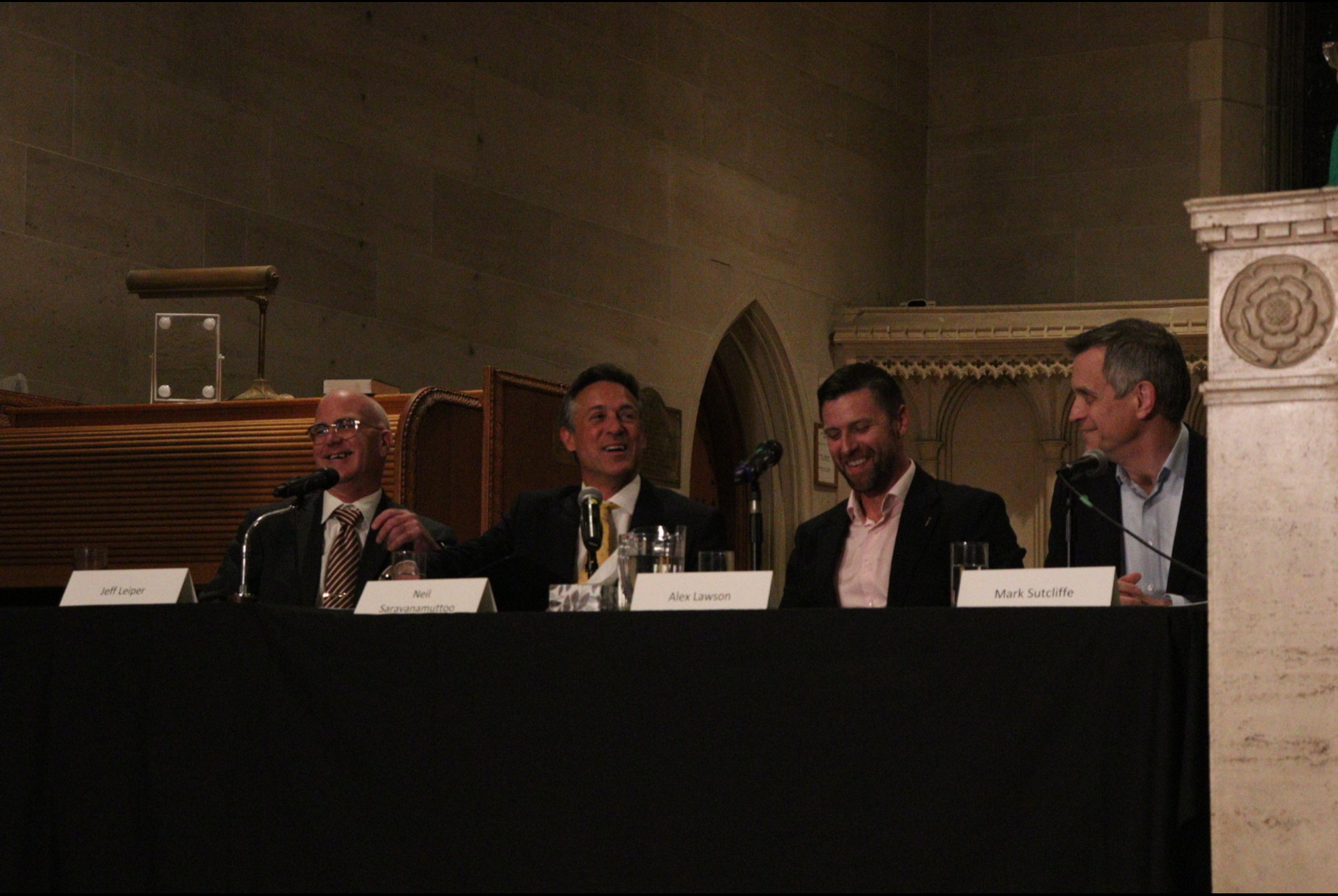
With less than two weeks left in Ottawa’s mayoral race, the top four mayoral candidates, Alex Lawson, Neil Saravanamuttoo, Jeff Leiper and incumbent Mark Sutcliffe, gathered to debate “Leadership for a Livable Ottawa.”
That was the theme of the Oct. 15 debate at Knox Presbyterian Church organized by 20 community organizations and moderated by CBC’s Hallie Cotnam.
Improving OC Transpo
All candidates acknowledged the faults with Ottawa’s transit system and offered different solutions to improve service.
Leiper said he plans to buy more buses and vowed to reverse the New Ways to Bus route changes. The bus reductions and cancellations, implemented in April 2025, cut over 70,000 hours of service annually.
Saravanamuttoo said riders should not be paying for services as-is and he plans to implement a $1 fare until service improves.
Lawson agreed with Leiper that the New Ways to Bus route changes did not improve service, adding that the main issue with OC Transpo is poor management.
“New Ways to Bus wasn’t effective for anyone,” he said. “We cut service, we still fail to provide the routes and we lost $54 million in the process.”
According to Mark Sutcliffe, the reason that he initially ran for mayor was that he was “fed up with what was happening with the LRT.”
“We didn’t get a good deal on the LRT,” he said. “We allowed Ottawa taxpayers to pay 55 per cent of the cost of construction of the LRT while the people in Toronto, Mississauga, Brampton and Hamilton are paying close to zero per cent.”
Biggest future spending item: infrastructure
Leiper said that under Sutcliffe’s governance, the infrastructure gap — the available funds to repair utilities such as roads and pipes — has grown to be almost $11 billion and that he would work toward combating this issue by implementing a one per cent infrastructure tax.
“Sutcliffe has kicked the can down the road far enough,” Leiper said. ”It’s time to start investing in infrastructure.”
Saravanamuttoo said that before setting a tax rate, Ottawa needs to open the books and do a full financial review for the first time since 2004 to identify where money can be saved before setting an appropriate tax rate.
“We need to look at 100 per cent of the money that we’re currently spending and make sure we’re spending that as well as we can,” he said.
Sutcliffe said the city’s growing population requires better infrastructure, putting forward a $10 million plan to invest in services such as public parks, roads, sidewalks and flood prevention measures.
Lawson agreed with the other candidates, identifying infrastructure as one of his top concerns and suggesting a unique tax freeze, while also bringing up public safety as a priority.
“We’re going to freeze your property tax in the first year, one per cent in the second year, third and fourth we aren’t going above two per cent,” Lawson said. “We need to be looking inside before we look to take it out of your buckets.”
Public safety and housing
Sutcliffe said he wants to prioritize addiction treatment, safety within the ByWard Market and plans to increase policing for that area.
“We need more resources in our communities, we need to reduce the amount of open drug use,” he said. “We need to put an end to the pill mills that are allowing people to buy drugs and resell them in the community.”
Leiper said the safe consumption sites were key to mitigating public drug use and their closure only worsened the issue.
He criticized Sutcliffe for not advocating to the provincial government against the ban.
“I will be a loud voice for residents of Ottawa,” Leiper said.
“You’ll be an activist, not a leader,” Sutcliffe said in response.
Saravanamuttoo disagreed with Sutcliffe’s plan to increase policing in the downtown core.
“Mark, you cannot police your way out of homelessness,” he said.
Saravanamuttoo said he plans to focus on providing shelter and health clinics for individuals, rather than arresting open drug users.
“Anyone that gets arrested is thrown back on the street the next day,” he said. “It’s a problem that we have across the syst”
Lawson agreed with Sutcliffe that increasing police presence would be a positive plan.
“We won’t police our way out of this, but I’m going to be blunt for a second. ANCHOR doesn’t stop your bike from being stolen.”
Lawson also said that he plans to open a recovery centre in Ottawa for those struggling with addiction and homelessness, providing job training and mental health support.
“We can’t just wait this problem out, and we can’t just hide them in tiny homes,” he said.
Housing and tiny homes
An issue of much contention between all candidates throughout the debate was Saravanamuttoo’s plan for implementing tiny houses to provide temporary housing made from converted shipping containers.
He said the shelters aim to help transition the unhoused, specifically those struggling with addiction, into a permanent home. They are heated for winter, cooled for the summer and similar concepts are being implemented in Gatineau.
According to Leiper, Saravanamuttoo has been told by housing experts that these homes are not an appropriate idea.
“It is irresponsible to continue putting this solution forward,” he said.
Lawson and Sutcliffe both agreed with Leiper, saying that tiny homes are not the best option for addressing homelessness.
The municipal election is Oct. 26.