main

In The Eye of the Beholder

A painting worth a thousand words The view before me threatens to take my breath away. Everything around me is still and quiet. My eyes trace the delicate curves of […]

A painting worth a thousand words

The view before me threatens to take my breath away.

Everything around me is still and quiet. My eyes trace the delicate curves of the bubbling brook before me. Some of the larger rocks break through the water, their smooth surfaces damp and glossy. From the way the sunlight reflects on them, you’d swear they could be crystals.

Further back from the water’s bank is an impressive wall of trees. A maple tree with vibrant red leaves commands attention, the sheer height of it coming close enough to scrape the bottom of the wispy mare’s tails that hang overhead. Its golden-brown bark is rich with rough texture, adding layers I can almost feel from this vision before me.

A large root juts out in front of a small bush, which still houses a few small remaining berries that the encroaching autumn and local animals have yet to take care of. The brown of the root and hints of the deep purple berries contrast with the mass of green that pleases the eye. It adds a little bit of visual interest where there would not have been before.

The sun peeks out from just above the treeline, yellow light blending with the colours of nature. It’s creating an atmosphere of warmth on the world below it.

This view evokes some of my fondest childhood memories, of times when my sister and I would play in a forest just like this one until our mother called us back to our cottage for dinner. The wafting smell of her fresh blackberry pie already cooling on the windowsill beckons us indoors.

I haven’t seen that place in years. We’ve all been so busy. My own life has been so hectic I can barely manage one day off, let alone the three or four required to truly enjoy the cottage.

How I would dearly love to see it again.

But now is not the time to indulge in memories. I have a job to do.

“This is incredible. Genuinely, I’m in awe,” I say, turning to the young woman standing beside me, “You’ve created something spectacular here.”

She lights up like a rising sun. “Thank you, ma’am. I’m honoured. I poured my heart and soul into this. Painting is my passion!”

Corrin is a 2nd-year Professional Writing student and a lover of all things fantasy. “In the Eye of the Beholder” is the first story to ever win her a writing contest, which she personally thinks is pretty neat.

C*4 Wrestling set for Algonquin Commons Theatre return

Professional wrestling is stomping its way back to the Algonquin Commons Theatre when Capital City Championship Combat (C*4) presents “Better Watch Out,” on Friday, Dec. 10. The Ottawa-based independent promotion […]
Photo: Tanner Reil
'Speedball' Mike Bailey prepares to jump onto Kevin Blackwood during their match at C*4 "Never Say Never Again," on Nov. 12.

Professional wrestling is stomping its way back to the Algonquin Commons Theatre when Capital City Championship Combat (C*4) presents “Better Watch Out,” on Friday, Dec. 10.

The Ottawa-based independent promotion was founded in 2007 by Mark Pollesel, a graduate of Algonquin College’s scriptwriting program.

Pollesel still uses the skills he learned during college as he pursues his passion for storytelling, including his first feature film which is currently in production. However, starting C*4 was not always Pollesel’s goal. After graduating he became involved in the local wrestling scene, wanting to contribute in any way he could.

“I realized as I was doing it that I was really trying to create something that didn’t exist when I was at my biggest point in my own fandom as a kid in Ottawa – and that was create a solid independent wrestling promotion,” said Pollesel.

With C*4 entering it’s 14th season, it’s hard to argue that it hasn’t become anything less than that solid promotion Pollesel had hoped.

Aside from much of Canada’s current top independent wrestling talent, many former C*4 stars now wrestle in major promotions such as World Wrestling Entertainment (WWE), All Elite Wrestling (AEW) and Impact Wrestling.

The impressive list of C*4 alumni includes stars such as Kevin Owens, Sami Zayn, Cesaro, Colt Cabana, Evil Uno, Stu Grayson, Brian Pillman Jr., Josh Alexander and Daniel Garcia.

“C*4 is an accomplishment I am tremendously proud of,” said Pollesel. “We have built something incredibly special up. It’s a creative outlet in my life that exists in a way that nothing else does. It is a medium that provides immediate audience response to ideas and thoughts that I am putting out into the world. And, just as quickly, it’s over and on to the next one.”

On top of the in-ring action C*4 has raised over $450,000 for the Canadian Cancer society over the past ten years, through their ‘Fighting Back: Wrestling with Cancer’ events. The events began when Phrank Morin, a member of the local wrestling scene passed away from cancer in 2011.

The Dec. 10 event will be the promotion’s third event since returning from an 18-month absence due to the pandemic. Their previous event, “Never Say Never Again,” occurred on Nov. 12 at their regular venue in Little Italy. It was headlined by a winner takes all match which saw C*4 Champion ‘Speedball’ Mike Bailey defeat C*4 Underground Champion Kevin Blackwood.

“Better Watch Out,” will be C*4’s first show at the ACT since Oct. 2, 2018. The main event will feature Kobe Durst challenging Bailey, with both of his C*4 titles on the line.


Elsewhere on the card, current AEW stars Evil Uno and Stu Grayson of the Dark Order return to C*4 to take on the duo of Mark Wheeler and Jessie V – Locked n’ Loaded, in a tag team match.

The final matches announced as of writing, feature Junior Benito taking on “Weapon X,” Matt Makowski, and Cecil Nyx versus Space Monkey.

“If you’ve never been to a C*4 show before, prepare for an experience like nothing else in Ottawa,” said Pollesel. “We are thrilled to be returning to the Algonquin Commons Theatre. It’s a spectacular venue and certainly helps elevate the event itself. I promise if this is your first C*4 show, it won’t be your last.”

December Horoscope

Algonquin College hosts events surrounding addiction awareness

Algonquin College hosted National Addictions Awareness Week (NAAW) events from Nov. 22 to 26 to help raise awareness for addiction, recognize how it affects people and find preventative action against […]
Photo: Gabrielle Nadeau
"It's important for us to let people know we are there to support them no matter what," said Sarah Crawford, Umbrella Project and sexual violence and harm reduction coordinator at AC.

Algonquin College hosted National Addictions Awareness Week (NAAW) events from Nov. 22 to 26 to help raise awareness for addiction, recognize how it affects people and find preventative action against it.

The college encouraged attendees to have difficult conversations by hosting online and in-person events open to all students.

According to the Canadian Center on Substance Use and Addiction, within the past year, youth aged 15 to 24 continue to have the highest self-reported use of illegal substances compared to other Canadian age groups.

The AC Umbrella Project, a project funded by the Ministry of Advanced Education and Skills Development Mental Health Innovation Fund, aims to create a safe space on campus for students to feel comfortable and supported.

This project is a collaboration between Algonquin’s Student Support Services, Partnerships and Applied Research, community partners Rideauwood Addiction and Family Services, the Wabano Centre for Aboriginal Health and the Tungasuvvingat Inuit Centre.

According to Sarah Crawford, the sexual violence and harm reduction coordinator at AC, the aim of the project is to encourage students to discuss the safe consumption of alcohol and other substances through extra-curricular training, workshops, education, awareness and welcoming support services for both students and staff.

“We want to change stigma and use of stigmatizing language,” said Crawford. “Often people will refer to addicts as ‘drunkies.’ Words like that are really damaging.”

On Monday, Nov. 22, the Umbrella Project hosted a virtual Lunchtime Yoga session from 12:05 p.m. to 12:50 p.m.

A weekly All People, All Pathways meeting, in partnership with the Community Addictions Peer Support Association (CAPSA), is offered to students struggling with addiction or in search of a safe space to talk about their substance use habits.

“All People, All Pathways is a group for anyone looking to explore their relationship with alcohol and other substances,” said Crawford. “It is not like Alcoholics Anonymous or Narcotics Anonymous where people have to be abstinent — it meets people where they’re at and allows them to explore their relationship with substances and decide whether they want to make any changes, learn more about harm reduction or stop altogether,” she added.

A Make-Your-Own Christmas Ornament event took place on Monday in the college’s residence building where students decorated Christmas ornaments while discussing addiction and simultaneously raising awareness for NAAW.

On Tuesday, Nov. 23, students partook in a ‘Spill the Tea’ event run by Crawford and Algonquin college counsellor at Patti Hancock, which safely guided students in frank discussions related to sexuality, sexual health, consent, kinks and dating. This week’s discussion focused on addiction.

A ‘Let’s Toke About It’ event happened Wednesday evening, discussing and informing attendees about safe cannabis use.

“When people are using substances, often it’s the only time people expect them to get better before providing them any support, whereas you wouldn’t say ‘come back when your cancer is better in order to be supported,’” Crawford said.

Counseling services are offered on campus for anyone dealing with substance use at welcomecentre@algonquincollege.com.

“Regardless of what is happening, people who are looking for support should always be supported,” Crawford added.

Seminar aims to help students improve study skills

As students begin their exams in November, Bethany Wiseman, learning strategist at Algonquin College, holds a workshop to help students improve their study process to their fullest potential. The event […]
Photo: Cedfrei Sarmiento
The workshop showcased many effective study tactics for students to use to achieve their maximum potential when it comes to assignments and exams.

As students begin their exams in November, Bethany Wiseman, learning strategist at Algonquin College, holds a workshop to help students improve their study process to their fullest potential.

The event was broken down into three different sections, the first being the types of learners and the different methods of studying.

Wiseman spoke about the three types of learners: the visual, the auditory and the kinesthetic. Although the learner category can be broken down into these three specific types, Wiseman explains that most people have different aspects of each in their studying habits.

“The reality is most people aren’t so strongly one type of learner that that’s the only way they can learn,” Wiseman said. “Most people actually benefit most as combination learners, they learn by seeing something, hearing something and by doing something interactive,” Wiseman added.

Along with the three types of learners, Wiseman explained how some learning theorists have identified a fourth type of learner called read and write learners, who learn best by doing assignments and the process of reading up on whatever subject they are learning at the moment.

Wiseman then told a story about how she would ask students how they study and 95 per cent of the time they would say read. Wiseman then continued to explain that reading is actually not an effective strategy skill for studying and it actually leaves you with nothing most of the time unless you do the reading routinely.

“What we actually do when we’re reading is we mistake that for understanding the material, but really what it means is we understand it for the moment but that doesn’t necessarily mean you retained it, so even though 95 per cent of students say they read to study it’s actually not an effective way to study,” Wiseman said.

Wiseman encourages students not to just read but to study actively and practice with the materials they are given in class for certain subjects.

“If you take one word away from today it’s practice, and getting practise using the material in advance of a test,” Wiseman said.

Retrieval practise and spaced practise was the most relevant form of studying that was focused on in the workshop.

Retrieval practice is storing the information in your head and not just reading it while spaced practice is studying a little at a time and not all at once.

Other helpful study processes include elaboration, concrete examples, dual coding and interleaving, a form of studying in which you switch between ideas while studying.

The end of the event concluded with a take-home message from Wiseman.

“Try to tweak a couple of things, if you change two or three things, does it give you better results?” Wiseman said. “If one of those things doesn’t work try something new, the one major change I would say, that I see make the most difference for most students is the shift to retrieval practice, self-quizzing and starting early with spacing practice,” she added.

Hafsah Omar, a second-year student in the office of the health administration services program at Algonquin, says she uses retrieval practice and memorizing her material when it comes to studying.

“I study in those ways because it helps me memorize certain concepts and that I learn throughout each course,” Omar said.

Omar also agrees with the statement of actively practising and not just reading the material once.

“Write down notes in your notebook when attending lectures, do extra practice for each assignment within that course in order to review the skills you have learned, always do the homework given to you by the teacher,” Omar said.

How esthetician and hairstyling programs are changing with COVID-19

While currently spending two days a week on campus for the esthetician program, Mackenzie Lafontaine wonders how her schedule might change in the new year with many programs returning to […]
Photo: Maggie van Lith
Mackenzie Lafontaine (right) gets a pedicure from a fellow classmate.

While currently spending two days a week on campus for the esthetician program, Mackenzie Lafontaine wonders how her schedule might change in the new year with many programs returning to campus full-time in January.

“I live an hour away and I have to drive in and then I’d have to drive in even more,” said Lafontaine. “It [staying partially remote] is cheaper and you don’t spend as much money on gas and as much money on food like when you’re on the campus.”

Other programs in the faculty of hospitality, tourism and wellness have faced similar changes to hands-on learning during the pandemic lockdowns.

Across the hall in the salon and spa wing of the college, Zoe Davidson, 22, practices cutting, colouring, perms, and more in the hairstyling program. Now in her second and final year of the program at Algonquin, Davidson actually started learning about hairstyling at a private hair school in Ottawa called West End Academy.

Two months into the 10-month program the pandemic hit. Davidson said the school “handled it horribly” and she wasn’t getting the education she needed.

“I dropped out of that and moved to Algonquin because I already had a good experience with it [in the pre-trades program] and I had friends that were going to Algonquin during COVID and they said that it was being treated very seriously and they were doing a very good job at it,” she said.

Deanna Douglas is the program coordinator and a professor in the hairstyling program who has admired her students’ resiliency while facing many challenges in their programs’ delivery.

Throughout the restrictive second wave of the pandemic, the students were only attending in-person labs every other week so the classes could remain at less than half capacity.

"I was a bit nervous, I don&squot;t think I would have started right in the middle of COVID because I knew there was going to be a lot of limitations," said Mackenzie Lafontaine about starting the esthetician program.
"I was a bit nervous, I don't think I would have started right in the middle of COVID because I knew there was going to be a lot of limitations," said Mackenzie Lafontaine about starting the esthetician program. Photo credit: Maggie van Lith

During this time, many skills were taught online with students occasionally having to improvise with household objects to replace their tools. Douglas recalls a time when students used a butter knife to imitate straight-razor shaving techniques.

However, the pandemic did have some positive outcomes for the program including higher attendance rates and a successful online hair donation event.

“We used to also host Hair Donation Ottawa in the college every year which is to raise money for CHEO to help kids who have cancer get wigs,” said Douglas. “But even then, they commissioned to do an online event which raised more money than they ever have doing the in-person event because they could just reach more people.”

For now, the programs are unsure if they will remain partially remote, with theory being taught online and labs in-person, or if they will be able to have an entirely on-campus delivery.

“I think that we really do need to sit down and re-evaluate what we could do differently,” said Douglas. “As of this year, it has been so busy and so intense with COVID that we haven’t really looked ahead with those different opportunities for the students.”

amievenhumananymore?

What have I become? by Amanda Monterroso Screws come loose Robot parts lay strewn across the floor My limbs taste of penny dust and The way copper catches in the […]

What have I become?

by Amanda Monterroso

Screws come loose

Robot parts lay strewn across the floor

My limbs taste of penny dust and

The way copper catches in the sun

I could trick you into thinking it’s beautiful

They stare wherever I go

At the half girl, half something else

With missing parts, a body riddled with holes

But fear not,

My crooked tooth smile and crinkle-cut eyes

Will assuage your uneasiness

Your inkling that I am something

Not quite human

My milkmaid bones creak and rattle

They strain under the weight of the sky

Isn’t it funny?

The machine felt sorry for Atlas.

As a first-year professional writing student, I feel art all around me. I’m like a painter who brushes a canvas or an orchestra playing a symphony. I string words together and hope you see the masterpiece.

The Sound of Falling in Love

How do you know you’ve fallen out of love? by Madison Costeira As we drove, my eyes were glued to the beautiful view. I hated the cold but nestled in […]

How do you know you’ve fallen out of love?

by Madison Costeira

As we drove, my eyes were glued to the beautiful view. I hated the cold but nestled in the warmth of a heated car, I couldn’t help but appreciate the soft white glow outside. A thick blanket of snow weighed over the trees, glistening as the car purred down the driveway.

I huffed on the window, watching my breath fog up the glass. I pressed a fingertip to it and scribbled a crooked smiley face.

“That’s gonna leave a mark, you know.”

I turned to face Mark, whose eyes were locked on the road ahead of him, his face expressionless. He turned quickly to look at me, his eyes hardly making contact with mine before he turned back to the road. A heavy silence draped over us for the rest of the car ride.

When we finally reached the school, I wasted no time unbuckling my seat belt before shoving myself out of the car. I waited expectantly for him to do the same, but he didn’t move. It was the fifth class of the year and he had been “busy” for the last four. There was no sense arguing, so I made my way alone.

When I reached the classroom, I slid through the half-open door and settled in at my usual table, the seat I saved for Mark still empty.

“Alright, guys! Your prompt for today is to write about what falling in love sounds like. I want to see emotion and style,” Mr. Haybury exclaimed, “and don’t be afraid to stray from the prompt!”

I watched the rest of the class dive for their pencils and start to write, and I tried to force myself to do the same.

With my paper blank, I couldn’t help but wonder. What did love sound like?

Surely it wasn’t the sound of the turn signal blinking in a silent car or the sound of six missed calls? Maybe it was the sound of a pillow being tossed in between your bodies as a barrier or even crying in the kitchen while he sleeps in the guest room.

The passion, love, and excitement that Mark and I felt were short-lived, but the chore of nursing a dying romance seemed never-ending. I couldn’t remember the exact moment I had lost feelings. It wasn’t like I suddenly woke up and realized I wasn’t happy.

“Ally? Are you ready to share?”

My stomach dropped and I tried to stay calm.

I stood, my chair scraping against the tile, making the room fall silent. My hands were shaking but I still clenched my journal until my fingertips turned white. I swallowed hard and looked up at the class. Thirty-some eyes peered up at me, waiting for me to speak. To them, it was no more than a piece of writing. To me, it was a confession.

I cleared my throat, “I decided to write about the sound of falling out of love”.

And with that, I looked down at my journal, the paper still bare.

Madison is a second-year Professional Writing student with a love for unhappy endings. She hopes to one day become an established fiction writer.

Students join forces to bring youth mental health awareness to Algonquin

Stephanie Dejardin is set to launch Algonquin College’s first Jack.org chapter through the Students’ Association in January 2022. Dejardin is originally from Ottawa, but recently completed her bachelor of science […]
Photo: Supplied by Stephanie Dejardin
Stephanie Dejardin is helping establish a Jack.org chapter at Algonquin College, a youth led movement to end the stigma against mental health and bring empowerment to Canadian youth.

Stephanie Dejardin is set to launch Algonquin College’s first Jack.org chapter through the Students’ Association in January 2022.

Dejardin is originally from Ottawa, but recently completed her bachelor of science in animal biology at the University of Guelph where she lived for four years. Currently, she’s in her first semester in the medical radiation technology program at Algonquin College.

It was during her second year in university where Dejardin heard of Jack.org, a community started by youth for youth to empower other young adults through their mental health journey.

Dejardin attended a few events held by Jack.org at the University of Guelph and when the chapter announced they were looking for executive team members, Dejardin applied.

“I’ve always been very passionate about mental health,” said Dejardin.

Because it was Dejardin’s first time being away from her family and friends she was trying to branch out and develop a good support network. She believed that being around people who also cared about their mental health would be good for her.

Dejardin was first diagnosed with a panic disorder and generalized anxiety disorder when she was in high school.

“I feel like I’m in a better place now and I want to be able to help other people get connected to help,” said Dejardin. “That’s pretty much what Jack.org’s goal is, to connect people with resources.”

Sabrina Mastroianni, now a fourth-year neuroscience and psychology student at the University of Guelph, first met Dejardin during her second year of university.

Mastroianni has been involved with Jack.org since her high school years, which was when she took the initiative to start looking after her mental health.

As a child, she began displaying symptoms of anxiety and obsessive-compulsive disorder. In her teens, she was professionally diagnosed with both, as well as depression.

“Jack.org has been a huge part of my university experience,” said Mastroianni. “I don’t know where I’d be without the team and I just think it’s so important to have that youth-led conversation about mental health and illness. I think it’s been really amazing that Jack.org has been open to hearing so many different perspectives.”

Yasser Siddiqui, who lives in India, has plans to move to Ottawa before the winter semester begins to study marketing management.

Siddiqui has been working as an engineer for six years, and for the past two years, has been working as a mental health advocate through his own start-up.

Siddiqui had seen Dejardin’s Facebook post looking for members.

“The words ‘mental health’ immediately caught my eye,” said Siddiqui. “I got in touch with her to discuss more about what it was about. I found it similar to the kind of work that I’m doing.”

Because Siddiqui isn’t in Ottawa yet, he has noticed that there tends to be a gap in communication.

Regardless of this obstacle, according to Siddiqui, Dejardin has been an amazing co-lead to interact with and ensure that everything is in place.

Everyone on the team has a strong understanding of how important it is to normalize and de-stigmatize the conversation around mental health, which has created a strong foundation for the club.

“We want to bring change to how people talk about, discuss or care about their mental health,” said Siddiqui.

Dejardin wants students to know that there are options out there if they need mental health support or a safe community to talk with — whether it be the people at Jack.org, her club or the college’s resources.

“We’re still looking for team members, so if anyone wants to join we’d greatly appreciate it and it’s not a great commitment of time,” said Dejardin. “Honestly, the experience for me has been worth it. I’ve made lifelong friends and if you wanted to be part of a community project, it’s pretty low key, but we also are a really great community of people who support each other.”

For more information, contact jack.orgalgonquin@algonquinlive.com or follow on Instagram @jack.org_algonquin_chapter.

Food cupboard supports students in need

The Algonquin Food Cupboard, funded by members of the Algonquin community and the Algonquin Students’ Association, seeks to provide students with access to food and necessities. It is located in […]
Photo: Carol Goddard
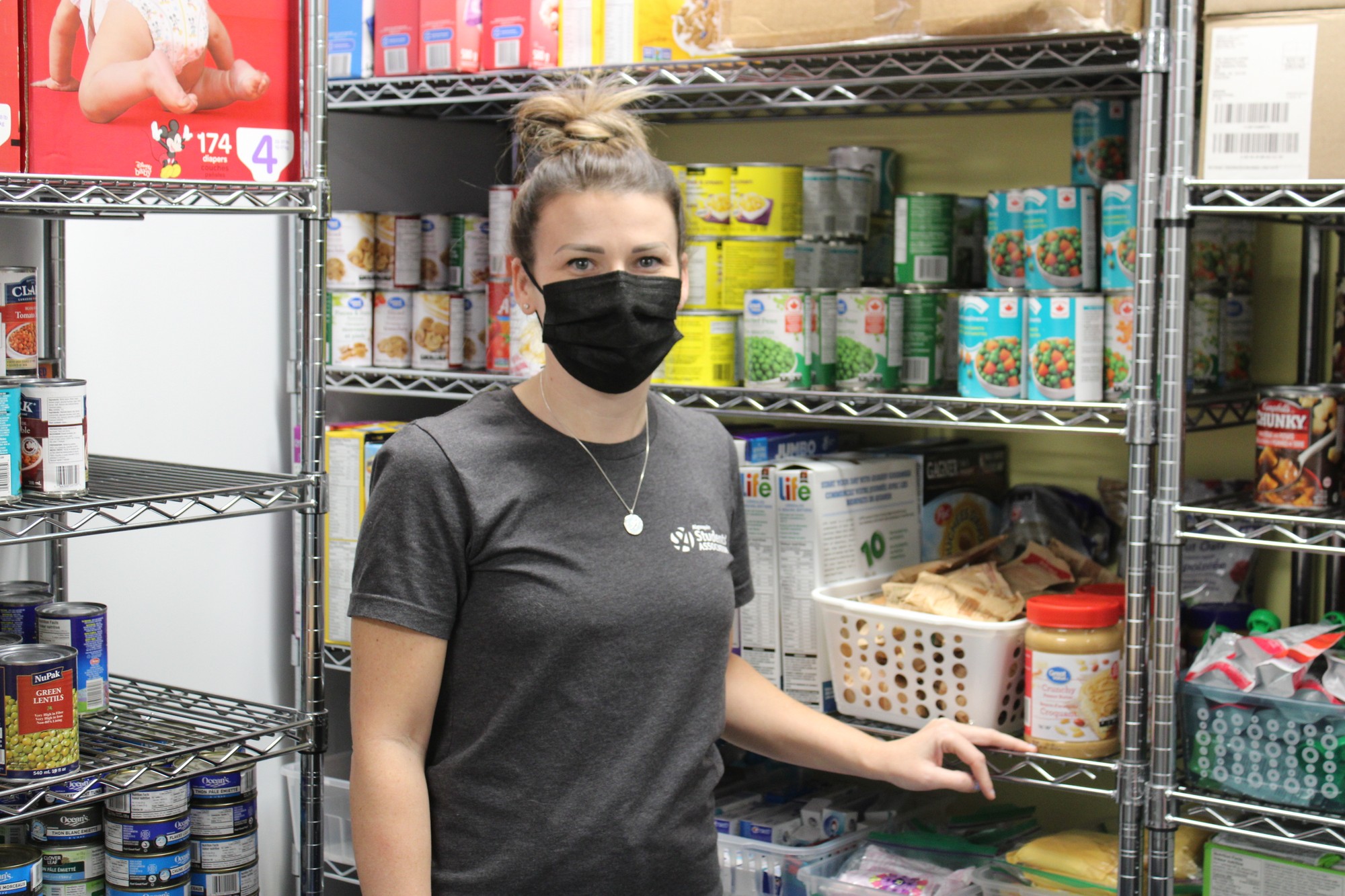
Jessica McCabe, food cupboard coordinator, is shown in the Woodroffe campus of AC.The shelves are full of food and other items for students to access if needed.

The Algonquin Food Cupboard, funded by members of the Algonquin community and the Algonquin Students’ Association, seeks to provide students with access to food and necessities.

It is located in the Student Central in the basement of C- Building on the Ottawa Campus and open by appointment on Tuesdays, Wednesdays, and Thursdays from 8 a.m. to 3 p.m.

The food cupboard opened in December of 2014 as a response to student concerns about food insecurity which can be defined as not having reliable access to food.

This issue arose because of several factors including the cost of tuition, cost of housing and food, coupled with financial concerns. Skipping a meal, running out of money that was budgeted for food, or worrying about not having enough to eat are all ways in which food insecurity is manifested.

Hungry for Knowledge, a study that has investigated food security among post-secondary students, was conducted across five Canadian university classes and found 8.3 per cent of students in the study had encountered severe food security, 30.7 per cent had moderate food security with 61 per cent not facing this issue.

Students as well as other members of society suffer from food insecurity.
Students as well as other members of society suffer from food insecurity. Photo credit: Source: Hungry for Knowledge study
Source: Data from Hungry for Knowledge study
Source: Data from Hungry for Knowledge study Photo credit: Carol Goddard

https://cpcml.ca/publications2016/161027-Hungry_for_Knowledge.pdf

“The Students’ Association board of directors recognized the need for a food bank on campus,” said Jessica McCabe, food cupboard coordinator at AC, when asked why the Food Cupboard began.”The food cupboard has been a recipient of support from the community and members of Algonquin College staff since it began,” she added.

McCabe continued how the need for food cupboard resources vary between accessing its resources on a monthly basis or only once or twice a year such as waiting for Ontario Students Assistance Program funds to arrive or upon returning to college after the holidays.

She mentioned in her email, between September 2020 and August 2021, the food cupboard was accessed 1136 times, before noting during the same time period, 56 spouses were “served through their partner accessing the service” and 85 children “served through their parents accessing the service.”

McCabe commented the food cupboard can provide its clients with access to resources available at their local City of Ottawa Food Banks and works with Period Packs, a local company “who have generously donated packs of menstrual products for students in need.”

As plans for a full return to students to campus, McCabe mentioned there may be an increased opportunity food cupboard fundraising activities, before mentioning a contactless food drive for the Algonquin Food Cupboard is planned for December 15 between the hours of 11 a.m. and 2 p.m. outside C-Building.

More information on the Algonquin Food Cupboard is available at www.algonquinsa.com/services/food-cupboard.

Algonquin Times podcast

Stay Informed

Sign up for our newsletter

Subscribe

* indicates required