New tiny forest takes root at Algonquin College’s Woodroffe campus
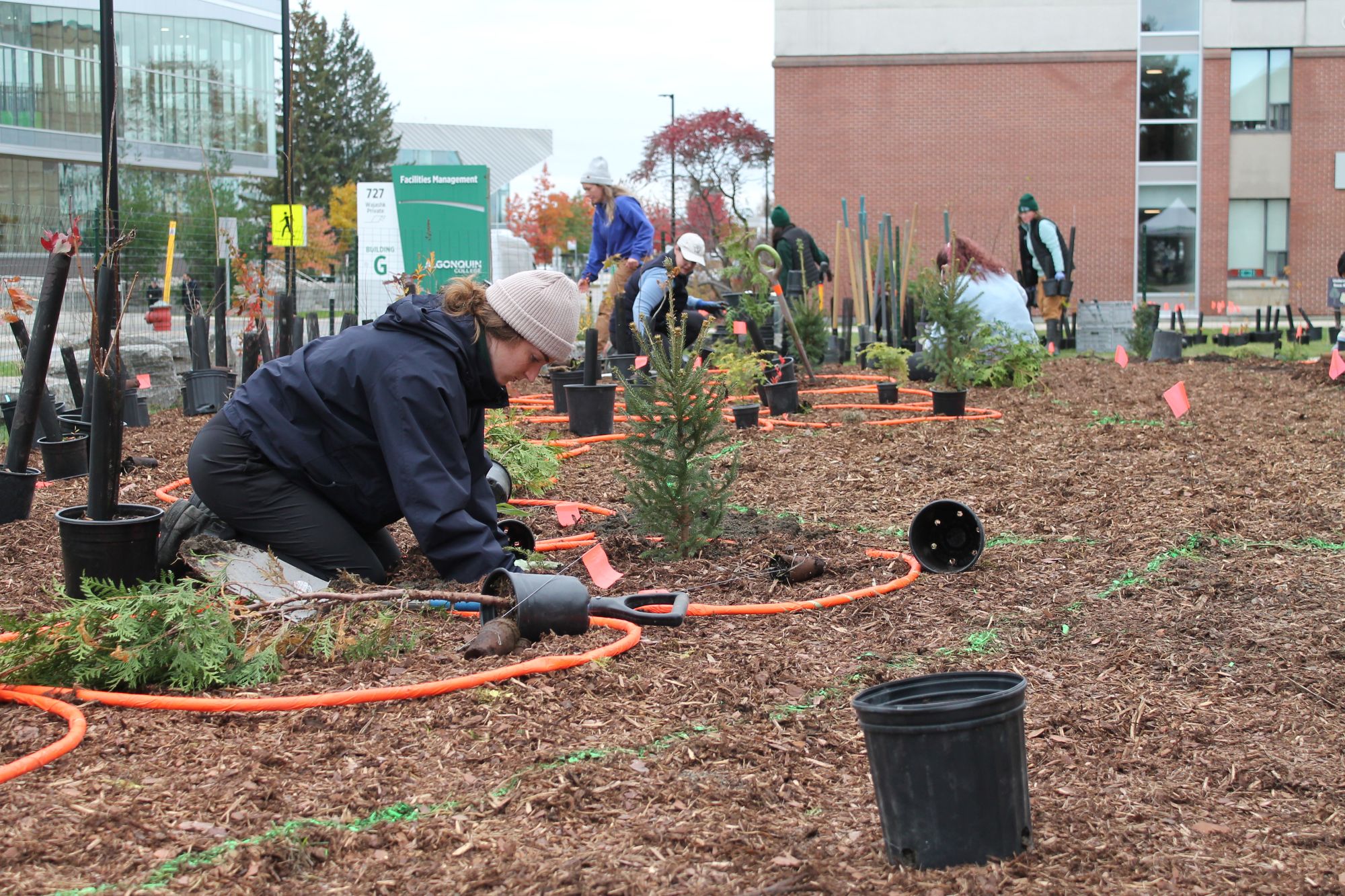
On a cloudy fall day in October, a group of environment and conservation-minded people gathered outside Algonquin College’s G-building to plant the campus’s first tiny forest.
For Dianna Cinnamon, it was a somewhat bittersweet moment.
A graduate of Algonquin College’s now-defunct horticultural industries program, Cinnamon is an intern with Forêt Capitale Forest, an Ottawa based non-profit organization dedicated to mitigating the effects of climate change by planting forests.
FCF assists efforts throughout the community to promote and develop stewardship of forest programs.
Cinnamon, now a community forest program assistant with FCF, said the tiny forest would have been a great opportunity for the horticulture program to help develop the campus as a greener space.
“I thought the program would come out and help plant, because it would be a good opportunity for them,” Cinnamon said.
“We need more green space and more programs that have all that. I was a bit bummed (the program shut down).”
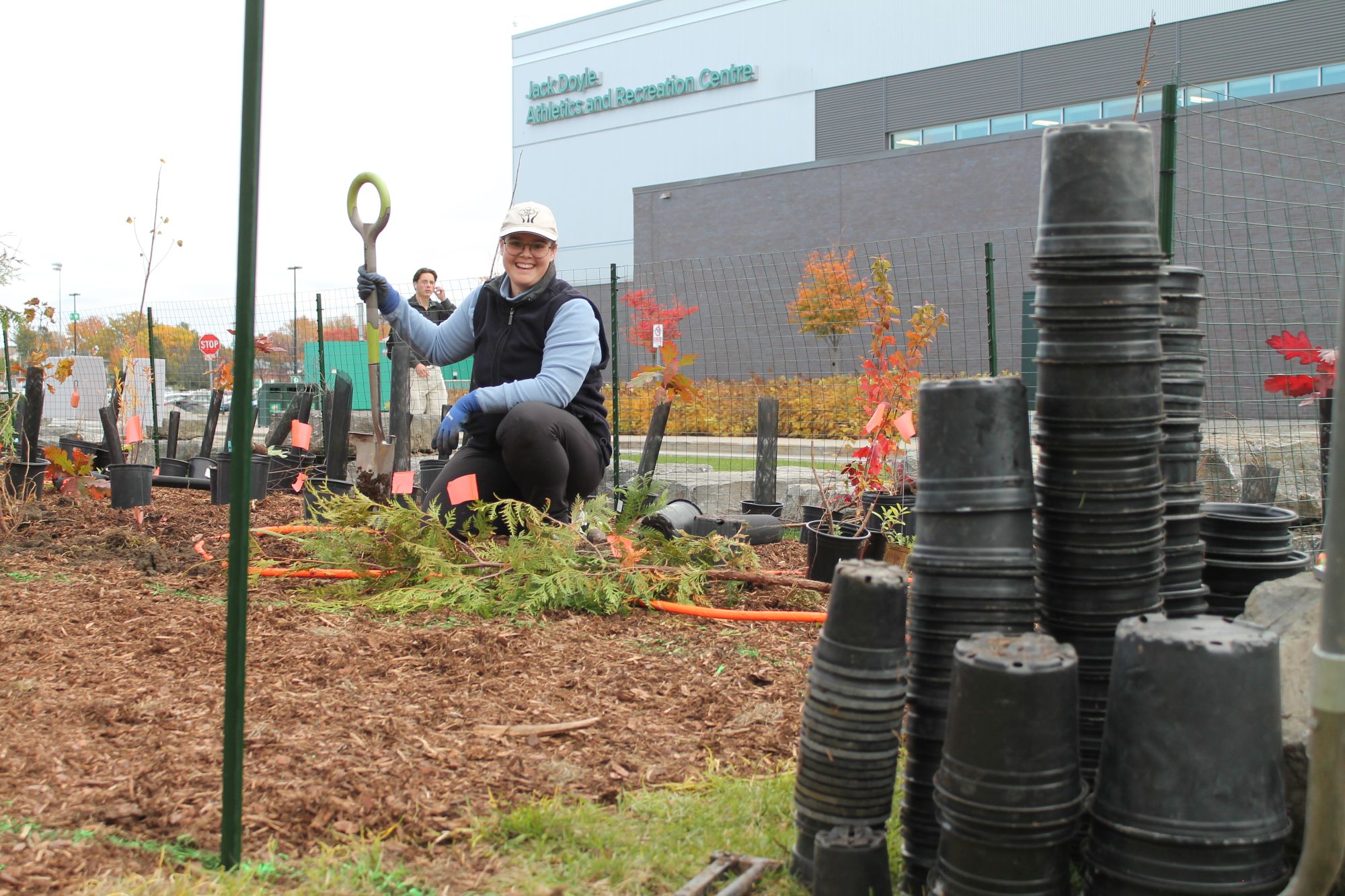
Planting a tiny forest on campus was an idea first sparked by a partnership between EnviroCentre, a non-profit which supports organizations taking action through practical measures on climate change, and Algonquin College’s ground operations through EnviroCentre’s Trees for Schools Program.
In an email to the Algonquin Times, Patricia Thome, supervisor of custodial and ground operations at Algonquin College, said “when EnviroCentre approached us with the idea, we immediately fell in love with the concept.”
“Not only does it support the expansion of the campus tree canopy and enhance biodiversity and wildlife habitat, which are priorities we have been advancing through several initiatives across campus, but also creates valuable experiential learning opportunities for students, an area that grounds operations is particularly passionate about,” she wrote.
Tiny forests, also known as Miyawaki forests, are based on an afforestation technique first developed by Dr. Akira Miyawaki, a Japanese botanist and director of the Japanese Centre for International Studies in Ecology.
Miyawaki found that dense, multi-layered native species mini-forests grew 10 times faster due to competition-induced growth among species and could become self-sufficient after two-to-three years of maintenance.
Leann Byette, afforestation program coordinator with Forêt Capitale Forest, said the space outside G-building was ideal for the closely packed forest of native species.
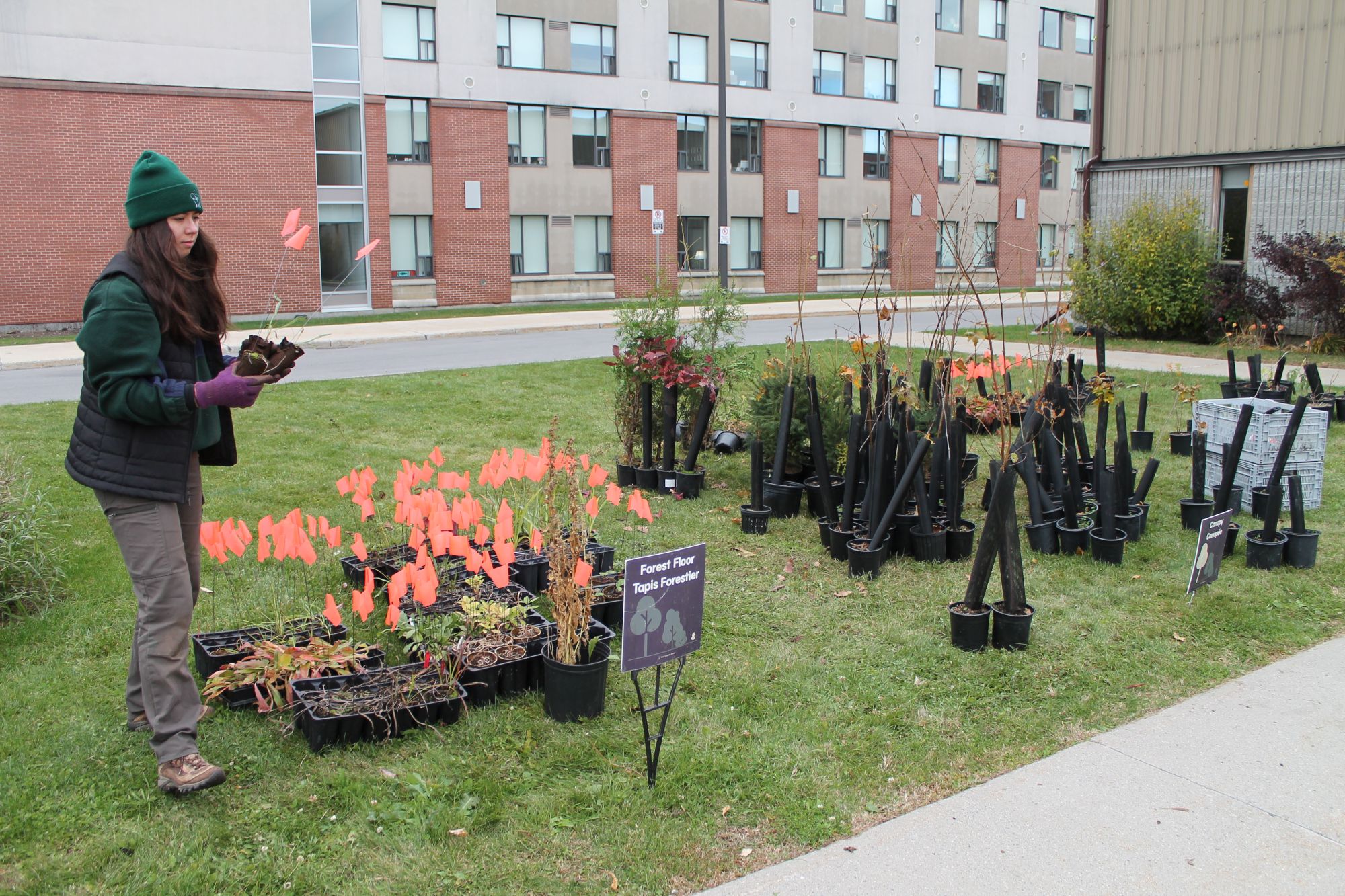
“There’s roughly 200 hundred square metres here and the idea is that in each square metre, you’ll find three plants, roughly,” Byette said.
“One from each layer of the forest: you’ll have your tall canopy trees, you’ll have your subcanopy like shrubs and shorter trees, and then your little forest floor perennials. You’re planting all three layers of the forest at the same time.”
Thome said the tiny forest project has several long-term objectives, including “increasing tree canopy coverage” and “enhancing biodiversity and wildlife habitat,” welcome news for a city struggling to keep up with tree canopy loss related to climate change.
A September 2025 report found that while tree canopy coverage across the city increased from 34 to 36 per cent over the preceding five years, the increase was largely attributable to the Greenbelt rather than growth in residential areas.
Algonquin College, located in College ward, is one of the few areas to have achieved the city’s goal of 40 per cent tree canopy coverage.
Extreme weather events in recent years have only increased the need to continue developing tree canopy levels. The May 2022 derecho alone is estimated to have destroyed tens of thousands of trees throughout the city and up to 70 per cent of the upper tree canopy in National Capital Commission-operated lands.
For Cinnamon, the planting comes at a crucial time and will encourage people to learn more.
“We need more forests and green space in the area. Whenever people come by, they’ll (ask), ‘Why are all the trees closely planted together?’” Cinnamon said.
“It’s actually supposed to be like a forest in the real world. They’re all compacted, they grow side-by-side, and I think that’s valuable for people to know.”
Students and community members can visit the tiny forest outside G-building on Algonquin College’s Woodroffe campus but are asked to remain outside marked-off areas for the time being in order to allow trees and plants to establish their roots.